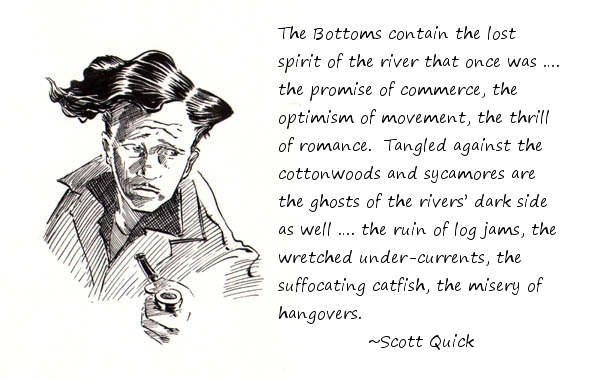
One of the artists I had the pleasure of meeting at the first Spectrum Fantastic Art Live event was a local, Missouri’s own Scott Quick. At that time Scott had fairly recently began a webcomic called Camden Bottoms, a traditional strip series inspired by the small town he grew up in, featuring various interesting characters who are just that…real characters. Scott Quick sat at his booth drawing, examples of his work on postcards and bookmarks showcasing he could bring these various creatures to life with his pens and ink.
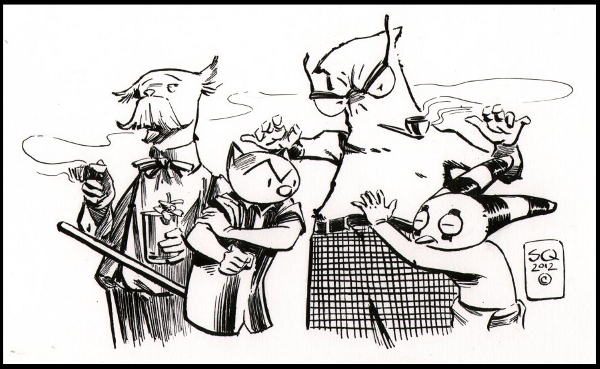
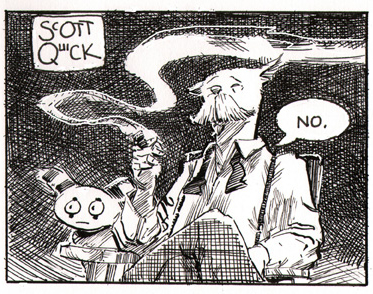
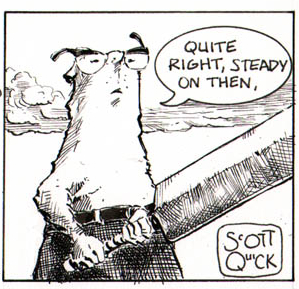
The characters who inhabit Camden Bottoms are a hoot to get to know. They each have their own unique personalities that shine through both in Scott Quick’s drawings and the scenarios he puts them through. Although I recommend reading all the strips from start to finish, you might want to start with the full story featured in “The Wreck of the Medusa”. There is a moment with a cricket bat that had my boyhood self laughing with sadistic satisfaction. On the Camden Bottoms site you can click ‘Archives’ and scroll down to start any storyline you wish, then use the ‘next’ button below the strip to navigate. New strips come out on Wednesdays and Sundays, so you have a nice backlog to enjoy and can get new story moments twice a week!
I grew up in a small town myself, a fan of the various comic strips that ran in our daily newspaper. It didn’t take long to connect with Scott Quick or his work and it is a pleasure for me to introduce you to him and his creation. Before the interview begins, here is a thumbnail of the artist lifted from his website:
“Raised on a diet of Slim-Jims and comic books, R. Scott Quick spent much of his childhood visiting his grandparents in Camden, Missouri. In 1996, he attended the Joe Kubert School of Cartoon and Graphic Art in Dover, New Jersey, after which he scratched a career out of video game animation. At the turn of the century, he was treated for what psychiatrists believe may be the first case of In Barra Vite, or chronic embarrassment over one’s very existence.
Retired from animation, Quick now draws this strip from a sanitarium just outside of Saint Louis, Missouri, visited frequently by his dutiful wife and son.”
CVA: Nearly a year has gone by since the inaugural Spectrum Fantastic Art Live event. What are some of your lasting memories of the experience?
SQ: I remember being thrilled with meeting so many fans with a similar appreciation for fantasy and comic art; it was nice to interact with people who spoke the same language so to speak. The high quality of the work would be another strong impression I took away. I remember talking to someone who summed up the show with the phrase, “Nothing sucks!!” That’s a pretty good recommendation.
CVA: The creation of works of art would appear to be an activity that happens largely in isolation, what is it like for you, in contrast, interacting with fans and fellow artists in an up-close, personal way? What do you hope fans take away from the experience of meeting you and seeing your work in person?
SQ:I’ve been a freelancer and an animator for many years, but I’m relatively new to exhibiting in these types of venues. The point being, I’ve got a small fan base (although highly intelligent and with great taste), so most people I meet are unfamiliar with my work. It’s a real ego boost, though when my work really connects with someone- sometimes even referencing one of my big influences like Herriman or Foster.
I hope that people who meet me, once they get over how handsome I am in person, will be open to taking a second look at traditional pen & ink illustration. People tend to like looking at this type of work up close, which is something digital work doesn’t offer.
CVA: You have married a long-standing tradition, the comic strip, with what is still a relatively new medium in the internet. How does doing a web-based strip inform or influence your work? In what ways do you feel this works better, or perhaps just differently, than more traditional print-based media?
SQ: It’s all about control, I suppose. The internet offers a platform for anyone who wants attention (usually not a good thing, I know), and in my case it offers an opportunity to show my work for little to no cost. Honestly, I pretend I’ve got an old fashioned strip that’s gotta be at the presses on time. It must be working, because I’ve never missed a deadline!
CVA: You work in a traditional manner, drawing and inking your work on paper, correct? What is your process like from the beginning of an idea through to its release online?
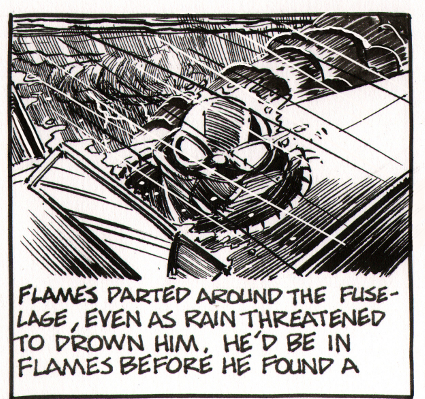
SQ: Yes, I work on good old Bristol board with a Hunt 108 pen nib. I try to keep it pretty low tech. I’ll jot down ideas for storylines and sketch out ideas for visuals when I’m working on a new project. Once I’m working on a story and moving towards a deadline, I’ll draw everything out loosely in pencil on a 4 X 13” (roughly) piece of Bristol. As soon as the layout looks good, I’ll tweak the writing, usually editing for space as there’s always less room for text than you need. I’ll finish the lettering with a micron pen, ink the balloons and borders with a brush, and dive into inking the rest of the strip in pen. I’ll then scan it into Photoshop and clean up any mistakes and it’s on to the site from there.
CVA: The internet has brought more artistic work to the eyes of the general public than has ever before. How does the wider array of competition for people’s attention affect your role as an artist? Do you find yourself having to do more marketing than you expected and if so what are your thoughts on this?
SQ: I tend to limit my time online as I find the raw tonnage of competition a little overwhelming. I think most artists concentrate on connecting with the comparatively small number of like-minded people that make up one’s audience, at least that’s what I try to do. My wife handles all my marketing (such as it is) and follows the site traffic and occasionally she’ll tell me something like: “someone in Siberia looked at 63 strips last week!” That kind of thing always makes my head swim.
Marketing is a full time job or at least could be and I don’t think I’ve got the skill set for it. My wife tends to take care of that side of things, but she’s an attorney by day, so it’s not like she’s got a lot of extra time to push my strip. We advertise on sites like the Webcomic List and that boosts traffic. But to be honest, I wanted to build up a good backlog of storylines before going full tilt with marketing. Now that I’ve got almost 2 years under my belt with consistent posting, yeah, it’s time to market a bit more!
CVA: Are there any plans in the works to convert your web-comic to a print edition? Are any other products related to Camden Bottoms in the works? Additionally, are there any dream projects you have yet to get to that you would like to discuss?
SQ: I’m publishing collected storylines and selling them at conventions and soon online on my website. I’m of the age where I still enjoy seeing things on the printed page. For Spectrum I’ve got 2 different volumes of storylines I’ll be offering in hardback editions that I’m pretty excited about. [CVA: Looking forward to that!]
I’m based in St. Louis, and there’s a group of artists who get together several times a year to publish comic stories in anthologies under the title “Ink and Drink”. I occasionally contribute stories to these anthologies as a way to satisfy the urge to work in a 10 x 15” format for a change!
Also, my great-great aunt was Flora Quick, a legendary horse thief and bandit who sometimes disguised herself as a man known as Tom King. She was associated occasionally with the Daltons. I always thought her story would be interesting to tell and illustrate. We’ll see if I can squeeze that in someday.
CVA: And finally, what is bringing you back to Kansas City for Spectrum Fantastic Art Live 2?
SQ: I’ve spent many years going to comic conventions, including San Diego ComicCon, and I always enjoyed looking at the original art and meeting the artists I admired. Spectrum has taken my favorite attraction and centered an event around fantastic art and the talent that drives it. The venue is very open and welcoming, without the long lines and insane “autograph fees” found in most conventions now. It’s nice to get in on the ground floor of an event like this.
I also admire how Cathy and Arnie Fenner have made this a Kansas City event. Spectrum has an international reputation and they could have had this show anywhere and it would have been a success. As a Missouri artist, I appreciate their decision to bring an international event like this close to home.
I want to thank Scott Quick for taking the time to share with us and for allowing me to share with you some examples of his work and why it drew me to his booth last year. If you get a chance to attend Spectrum Fantastic Art Live 2 this year make sure to stop by and tell Scott ‘hello’, and snag a print copy or two of his work. I know I will. In the meantime, head on over and acquaint yourself with Camden Bottoms and let us know what you think of Scott’s work, things he has shared in this interview, your feelings about comic strips, etc.
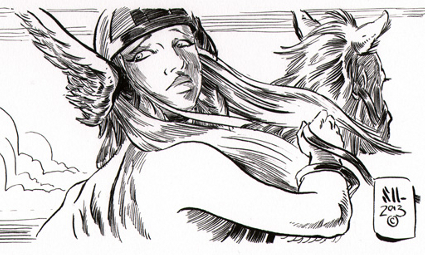
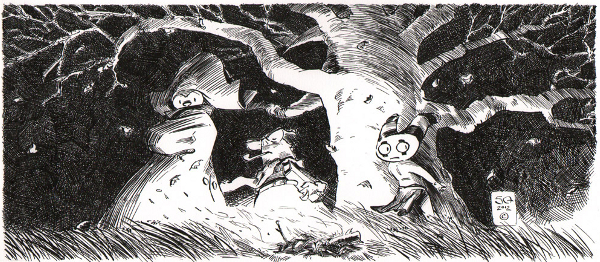
Will definitely be bookmarking ‘Camden Bottoms’ to peruse on those slow days at work! His linework reminds me a lot of Eisner and the old Pogo strips…and Herge’s Tintin line work. I really, REALLY like that last art clip, would cheerfully hang that on my wall! 😀
Here’s hoping for some slow days. 🙂 I hope you enjoy the work. I agree with you on the linework, it is very reminiscent of those artists and that is one of the reasons I enjoy it, it has a classic feel to it.
Wonderful line work. Reminds me of some early Frazetta work.
Yes, I can see that too now that you mention it.
that first frame was perfectly placed. I was immediately intrigued by Quick’s work.
I like that comics online are available and open the field for both creator and viewer alike, but I always have a strong desire for my favorites to be collected into print–I really need for publishers to continue to pick up work and place it in print. and for these kinds of conventions to keep putting the art/artists in a proximity other than screen for people to experience.
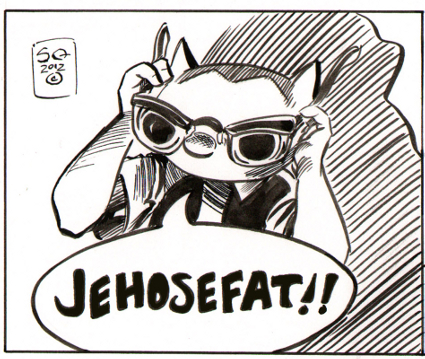
It is a really fun self-portrait, of sorts, that he did, wasn’t it?
I was happy to read in this interview that his work is now collected and that he will have it at the show. I too want to see the work on printed page. Despite using and enjoying my Kindle and the online format in general, I’m still old school at heart.