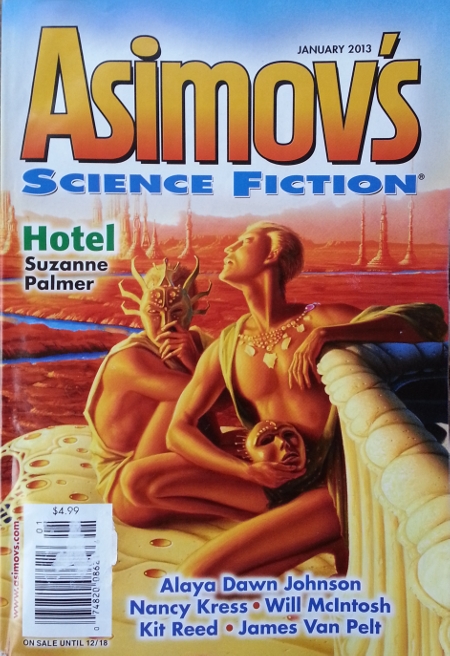
It must be my inner game-show-geek coming out, but I get a small thrill any time I can recognize the work of an illustrator, particularly in the SF/F field. So I couldn’t help but smile at my small victory when I came up the steps after returning from my afternoon run Friday to see the merest sliver of an image peeking out of my mailbox. I said aloud, “that looks like a Michael Whelan cover” and was rewarded to see his cover image for Ray Bradbury’s The Martian Chronicles on the January 2013 issue of Asimov’s Science Fiction magazine as I extracted my mail.
I am not the most constant of readers. I have subscribed to Asimov’s in print form for the past year and most of the issues sit unread, awaiting my attention. That fact hasn’t lessened my enjoyment of seeing them arrive in the post. The thrill of wondering what the next cover image will be and which authors will have stories included makes it fun to be a subscriber.
Maybe it was the recent passing of Ray Bradbury and the fact that he has been on my mind, or the Whelan cover image, but I determined right then and there that I would sit down and start my Asimov’s year 2013 with a weekend read. I’ve read some really good issues of Asimov’s and others in which the stories were geared for readers with other tastes than mine. This was a good one. A really good one.
Though I am only intermittently faithful, when I do sit down to read Asimov’s I do it cover to cover. I don’t skip around. I don’t skip anything. And in that I am often rewarded with something that would have been a shame to miss. In this issue that began immediately with the editorial by Sheila Williams. Ms. Williams won a Hugo award this year for Best Professional Editor: Short Form and this editorial proves that her editorializing is as skilled as her ability to edit award-winning fiction.
Sheila Williams pays her respects to the author Ray Bradbury of whom she says: “I had to swim upstream to appreciate the works of Ray Bradbury…My grandfather, a firefighter and avid reader, made no attempt to hide his annoyance with an author who could imagine a world where firemen started fires and burned books.” She then goes on to pen a lovely tribute wherein she manages to share her own personal experience with the fiction of Ray Bradbury in a way that becomes an all inclusive overview of his impact on the world, one that makes her experiences universal for all fans of Ray Bradbury’s work.
Almost without exception the highlight for me of any issue of Asimov’s is the Reflections column by Robert Silverberg. I live in the sincere hope that these will be collected one day as I suspect that I am not the only one who could sit with great contentment reading essay after essay of Silverberg’s thoughts on an extremely varied range of subjects. In this issue Silverberg relates his recent reading of an essay collection by the author John Updike in which Updike shares memories of his friendship with fellow author John Cheever. As part of those recollections Updike discusses a letter published after Cheever’s death in which Cheever said some very unflattering things about him. He also shared another incident when an author was very critical of him. Silverberg contrasts this with his own experiences coming up in science fiction and his assertions that science fiction authors are a different breed, one in which there is more of a fraternity of authors than the more cut-throat New York literary scene. Throughout the article Silverberg highlights moments in his career that provide an exciting glimpse into the past for those interested in the history of science fiction. Several times in any given year I find myself annoyed at various petty arguments and soap-boxing among some members of the science fiction community and an article like this sheds the kind of positive light that I wish shined with greater frequency.
He also included a story about the harrowing wreck of an 1816 French frigate. I learn something fascinating every time I read one of his articles.
The Stories:
They Shall Salt the Earth with Seeds of Glass ~Alaya Dawn Johnson
This is Johnson’s debut in Asimov’s and it is apparent right from the start why it was chosen. She demonstrates talent for telling a good story. The setting, a future in which earth is under a mysterious oppressive alien government, is fleshed out well within the novelette with details being revealed in the actions and decisions made by the two sisters who are the protagonists of the story. Despite the skill present I cannot say I liked the story, which I am willing to admit is perhaps a failing on my part as I am not sure exactly how I am to interpret it. Was it a pro-abortion story? A thinly-veiled commentary on an imagined future based in extreme right-wing ideology? The answers seemed obvious until she got to the end, where I felt that she summarily let her message, or her idea go, leaving me wondering what this story was trying to say.
The Family Rocket by James Van Pelt:
This is a story that produces the kind of heart-warming glow that a good Ray Bradbury story can produce. Though brief, Van Pelt has crafted a short story that is like a slice out of a science fictional version of Dandelion Wine. It is a sweet and bittersweet recollection of young love and father-son relationships. A very strong offering.
Bikini Snow ~Robert Borski
Talk about coincidences. I was just speaking with a co-worker Friday about a show I was watching about the Cuban Missile Crisis which led to us talking about what it was like growing up at the end of the Cold War, being convinced that one day soon Russia would be sending nukes our way. Even on the tail end it was an interesting time to live. I echo Borski’s poetic hhprayer.
Over There ~Will McIntosh
In McIntosh’s novelette a trio of scientists have come together to record the results of their latest experiment only to see their world quite literally come apart at the seams, resulting in two similar but off-center realities existing at the same time. McIntosh structures the story in a slightly disorienting fashion that reflects the simultaneous experiences of his characters. The tale splits into a two-column format with each column telling the story in its own reality and it is a highly effective experiment. I was not only impressed with the story itself but the way in which McIntosh and the Asimov’s staff were able to make each section so perfectly fit the page. The format may be initially disorienting but the reader quickly adjusts to it and is sucked into the ultimately terrifying tale. This isn’t my first experience with McIntosh’s work in Asimov’s and he is fast becoming one of those short story authors whose name on the cover will make me buy a magazine.
Mithridates, He Died Old ~Nancy Kress
Fresh off the World Series you must forgive the baseball analogy: Kress hits one out of the park with her short story inspired the A.E. Housman poem ‘Terence, This is Stupid Stuff’ (Check it out, it is fun verse). “She hadn’t expected to enjoy dying so much”. Margaret Lannigan lies dying in the hospital after an automobile accident, the recipient of experimental “last-ditch” drug therapy. The results of the drug therapy (or are they?) is a this-is-your-life visit from people over whom Margaret exerted a powerful influence during her life. Kress’ story is tightly-woven with an effective economy of words and the contrast between what she is experiencing and what her physician and family are seeing echoes perfectly Margaret’s belief that “[people] always got it wrong”. I learned a bit of history, discovered a new-to-me poet and was told an effective story. I tip my hat to you, Nancy Kress.
Just Another Day in the Burbs ~G.O. Clark
This poem is ideally placed after reading the Housman poem. Clark turns a phrase, or a line of verse, to much effective, cleverly using science fictional language/ideas to examine that all-too-familiar feeling of “isn’t there more to life than this”? My standard disclaimer on poetry is: “at least that is what I got out of it”. Nicely done!
The Legend of Troop 13 ~Kit Reed
The timing of this January issue, released during Halloween week, couldn’t be more ideal for Kit Reed’s tale of a feral troop of long lost Girl Scouts and the animal passions that drive folks to seek them out. Reed’s tale plays on the legends told ’round camp fires and the secret hopes of the adventurous that reason-defying things can and do exist out there in the dense, unexplored woods. The story is told from the points of view of various characters, their vignettes driving the story forward in a manner that creates increased tension and suspense. The Legend of Troop 13 has a malevolence that creeps up on you. A real page-turner.
Hotel ~Suzanne Palmer
This last, and longest, novelette closes out the January issue of Asimov’s in top form, making this one of the most enjoyable issues of Asimov’s I have ever read. As the website described it in their ‘Next Issue’ preview: “Patriots, smugglers, soldiers, spies—you’ll find them all, along with murder and intrigue, at Suzanne Palmer’s grand old Mars “Hotel.”” And find them all you will. “Hotel” is an immensely satisfying story filled with eccentric characters and the twists and turns you expect from a good spy/espionage tale. Though Mars merely acts as a mostly-silent setting for this story it remains a thrilling setting for those who like that good ol’ nostalgic feeling of stories that dreamed of human and aliens coexisting on the Red Planet. I want to put my wish right now out to the cosmos that one day Ms. Palmer will have a collection on the order of Larry Niven’s The Draco Tavern containing a collection of short fiction featuring Sofi, Verah, Eddard, Rickard and, of course, Hotel.
Paul Di Filipp closes the issue down with his On Books column that whets the appetite with high quality collections of older, more obscure comic art/storytelling by illustrators like Al Williamson and short story collections that threaten to pull the money right out of your wallet. Thank God for the library system, from which I immediately placed a hold for the Nancy Kress short story collection that I hadn’t realized came out earlier this year.
This was a particularly fun way to spend a Friday evening and Saturday morning and although it doesn’t often happen this way it is an example of why printed short story genre periodicals are special to me: I felt like a gift was delivered to me in the mail yesterday and it was a gift that delivered on its promise of good short fiction by today’s top and up and coming authors. This is an issue worth picking up, be it in print or digital form. Science Fiction is not always an easily accessible genre but this issue, maybe in honor of the wide appeal of Ray Bradbury, is full of stories that will engage readers of all kinds. Though my calendar tells me it is November 2012, I give kudos to Asimov’s for starting out 2013 with a bang.
I’ve got that issue of Asimov’s sitting on the kitchen table, thanks to you I’ll be reading it sooner rather than later. Whelan is an amazing artist, and his artwork is just the tip of the iceberg of everything that’s crammed into that little magazine.
Yes, this one was a gem to me and I’m glad I didn’t delay on diving right in. The stories are all running through my head now and I’ve been thinking there are a couple I may need to read aloud to my wife. Hope you’ll share your thoughts once you’ve read it.
No promises that I’ll be able to read it cover to cover in one sitting, but if something in this issue hits me like a ton of bricks the way the Popkes novella from the December issue did, you bet i’ll blog about it! 🙂
I don’t always do that either but I’m more likely to actually finish an entire issue if I do read it pretty much all over the course of a few consecutive days.
Thanks for the review of the magazine, and I’m glad you enjoyed my piece.
You are most welcome, thank you for such a great homage to the work of Ray Bradbury. I would love to go on that rocket ride, actually either of them. 🙂
This is a really good review (and a great cover!).
On the back of your recent piece I did try to get some Ray Bradbury out at the library and was really disappointed! I’ll have to go online I think.
I’m always reading these great reviews for authors and books that seem really inaccessible over in the UK. Charles deLint, Catherynne Valente, Ray Bradbury! To mention just a few! Ah well. It gives me something to look out for.
Lynn:D
I’m sorry you are having a hard time tracking them down there. Especially Bradbury. I’m nost sure why I didn’t remember, or didn’t realize, that you were over in the UK. I know I’m always disappointed when I read about a book and can’t find it in the library. Even if I end up buying something I like having that free option.
All right! I’ll buy it!
Tired of me twisting your arm, eh? 🙂 This issue was worth the cover price in my opinion.
What a nice way to spend your time. All of us need to do this whenever we can: focus on the things we enjoy and not all the stuff we have to do.
It really was, especially given that it ended up being a very good issue.
Thanks for the review.
Still conflicted on Mcintosh’s offering. On the one hand I found it incredibly ambitious and impressive. I agree with all of your comments on the accomplishment of simply formatting this piece. On the other hand I found the last bit of the story wholly unsatisfying. That last couple of pages told us how things were to play out for the characters, sure, but, and maybe this is my fault for expecting this, there was no big payoff, nothing to speak of on the fate of the rest of the world that the story did seem concerned with at times. Really exciting stuff and then it just kinda trailed off.
You are welcome, JH.
I will have to go back and re-read the ending as it is not leaping to mind right now, which probably validates your point. It was an exciting story and unfortunately so many short stories seem to do just what you mentioned, they engage the reader with great ideas and story, and sometimes really great characters, and then they just…end. Convinces me that being a successful short story author takes a very special skill set.
I get the digital releases of Asimov’s and F&SF, and tend to skip around without reading everything, but I’m with you in turning first to the Silverberg essay when I see a new issue pop up on the e-reader. But my comment is mainly to point out that there IS a book collecting Silverberg’s columns that came out a couple of years ago: “Musings and Meditations”, from Nonstop Press. They also published his autobiography, “Other Times, Other Spaces.”
There you go, I just need to use the ol’ google once in awhile rather than just idly wishing. Thanks Scott, appreciate the heads up about the books as they both sound like ones I need to pick up.