The Three Laws of Robotics
1. A robot may not injure a human being or, through inaction, allow a human being to come to harm.
2. A robot must obey the orders given to it by human beings, except where such orders would conflict with the First Law.
3. A robot must protect its own existence as long as such protection does not conflict with the First or Second Laws.
It is the late 21st century and Gerald Martin, Chairman of the Science and Technology Committee, has taken the bold step of procuring a robot servant for his home, a prospect that is still too frightening for the general public. Designated NDR-113 by the manufacturer, United Stated Robots and Mechanical Men, the robot soon comes to be known as “Andrew” courtesy of Gerald Martin’s youngest daughter. Mr. Martin’s situation is doubly unique for he has purchased his robot rather than leasing it. This rare allowance by USRMM will soon become a very critical distinction, for Andrew is not a typical robot. The generalized pathways of his positronic brain are beginning to function in ways unforeseen by his creators. Andrew exhibits creativity and artistic talent. Andrew experiences feelings. Andrew is fond of the various members of the Martin family. And soon Andrew begins to wonder just what it means to actually be human.
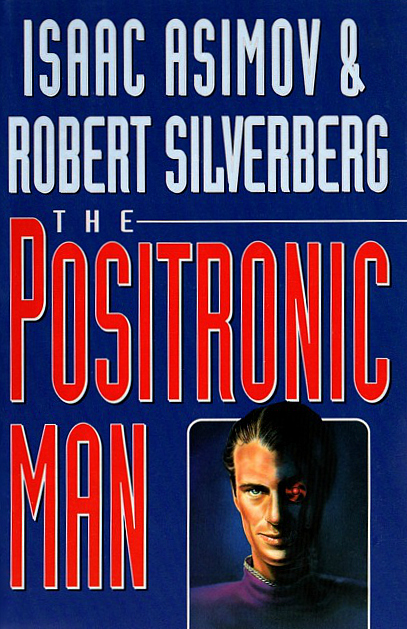
The Positronic Man is the final collaboration between authors Isaac Asimov and Robert Silverberg. Built upon a short story by Isaac Asimov which introduced the Three Laws, the novel was published in 1993, one year after Asimov’s death. Although I have read it, I don’t readily recall the details of Asimov’s short story and this is the first fiction I’ve read from author Robert Silverberg so I am not studied enough to be able to recognize each author’s contribution to the work. Suffice it to say that The Positronic Man retains the charm and the subtle depth of Asimov’s other robot stories while also lessening, if not eliminating, many of the dated elements of science fiction written in the 40’s and 50’s.
It is the retention of that “charm” that was one of the prime factors in my immense enjoyment of this novel. My first exposure to Asimov’s work came in early 2008, the year I turned 40. I cannot ascertain with any degree of certainty whether my age was a factor or not, but my adult exposure to acknowledged masters like Asimov, Bester and Heinlein have yielded some of the most pleasant and personally rewarding reading experiences that I have had in my life. I can theorize that these authors came into my life at an age where I was naturally thinking back over my own childhood days with fondness and the nostalgia that they generated (and still generate) tapped into that emotional state. At any rate I find myself firmly and most happily planted on the far side of a palpable dividing line, opposite those who find little of value or enjoyment in the output of these authors. Turning the conversation back to The Positronic Man, I find it a strong recommendation of their abilities as collaborators that the novel was able to encapsulate that same sense of wonder that Asimov’s early works have in spades.
The Positronic Man takes place over a period of 200 years, with an opening chapter taking place near the end of this time. It is a chapter that hints cryptically of things to come for Andrew and it left me with dual feelings of anticipation and dread which carried with me throughout the story, compelling me to read in large chunks. The strength of many of Asimov’s robot stories, and the reason I am convinced they continue to be relevant today, is that they allow us to examine ourselves as individuals and as a society through the lens of science fiction. We are a species that never tires of analyzing ourselves, or at the very least the guy next door, and the subtlety of a story about a friendly, curious robot lulls us into into thinking we are reading a light, throwaway story until the import of the themes of the story sink in. As readers we see everything through the eyes of Andrew, giving us a unique look at humanity through a protagonist who is life-like enough that we can still identify with him. Asimov’s three laws are skillfully woven into the story in ways that make them accessible for readers at any comfort level with science fiction. The Positronic Man examines prejudice and entitlement and the rights of the individual while telling a sweet, but not shallow, story.
Reading The Positronic Man was an interesting experience because I was deeply immersed in the story and became very emotionally attached to Andrew, and at the same time found myself thinking a great deal about why Asimov’s robot stories, or maybe robot stories in general, have such appeal. One realization I had was that I enjoy these stories because they are an extension of my childhood. I am positive that I am not alone in having a childhood where my toys, particularly my beloved teddy bear, came to life in my imagination and if given a wish would have had them come to life in reality. The Positronic Man taps into that. Who among us, if we had such a life-like machine in our homes, wouldn’t want it to actually care for us rather than merely be a thing responding to predetermined codes? Who wouldn’t cheer to see it begin to develop human traits? It is an idea that wasn’t new in Asimov’s time and yet it continues to capture our imagination today. Characters like Data, the holographic doctor, and even Odo in various iterations of Star Trek demonstrate just how much we are still swayed by stories of objects, of things, coming to life. More recent examples like the Toy Story films show how this idea of looking at humanity through the eyes of inanimate objects gets recycled without losing its ability to make us think.
The Positronic Man is a success because nearly 20 years after its publication, incorporating a story roughly 70 years old, it has a timeless message. It is the message that it isn’t merely our physical make up that makes us “human”, but that there is much more to that concept and we can and should choose to have an active role in our humanity. The Positronic Man is sometimes naive in a 1950’s manner and given that the novel is comparatively short by the standards of today it does mean that large parts of Andrew’s life go past without our being involved in them. Those things may be seen as weaknesses by some, but I believe they work because they allow the story to remain focused entirely on Andrew and his internal dialogue rather than shifting to focus on the world around him. It also creates a sense of what it would be like to contemplate time if one were for all practical purposes immortal. The manner in which we see and measure time would lose all meaning. Seeing the world of our future the way Andrew, a non-human, sees it is what allows The Positronic Man to have meaning and relevance today.
The Positronic Man was a Christmas gift from my friend Jerry and I cannot thank him enough for his uncanny perfect timing. Without planning it, The Positronic Man will end 2011 on an incredibly satisfying note while providing a perfect seque into our January group read of Isaac Asimov’s Foundation. You do not have to have any familiarity with Asimov’s other stories to enjoy The Positronic Man. There are references to events that occur in stories in the I, Robot collection that were fun to pick up on, but they are inserted in such a way that they make sense regardless of whether you have read them or not. If you are looking for recommendations for science fiction in the classic vein, or if you are simply keeping a list of good books to read, please allow me to suggest that you consider The Positronic Man. It is a real pleasure.
This sounds like the movie Bicentenial Man which starred Robin Williams. I wonder if that movie was an adaptation of this book? I know I loved the movie when I saw it growing up.
I didn’t realize that was the case until I was doing a little online research last night, but you are indeed correct. And I have not actually seen the movie. I am much more interested in doing so now though.
it’s a really good movie…and Robin Williams seldom get the credit he is due as an actor… I guess “never give up” sums up the story..if you can find it watch it!!
I know I’ve really enjoyed some of his movies over the years. He is somewhat a victim of his own schtick. When he can tone it down he proves that he is an amazing actor.
So this is the book Bicentennial Man was based on! And co-written by Silverberg? nice!
Carl, you should see the movie, it’s carefully done. Now I really want to read this, just so I can see how it differs from the movie.
Jeff said the same thing earlier today to me. I will need to try to track it down.
I was reading this and thinking it reminded me of something – then I read the comments! I’ve seen the film and it is good. Would be interested in seeing how the book compares. I suppose your review puts me in mind of bits and pieces of a few different films – even ones like Terminator and Robocop (particularly the three rules element).
Thanks
Lynn 😀
It is funny because although I haven’t seen the film I just assumed from what I know of pictures I have seen of it that it was just some cheesy thing and without fail people seem to like it, so I’m going to have to check it out, especially while the book is fresh in my mind.
This sounds like a cool book! I started reading a book by Robert Silverberg last night and am impressed thus far.
I ordered a short story collection by Silverberg with my Christmas gift certificate from Amazon and I’m looking forward to diving in. I really enjoy his articles in Asimov’s Science Fiction magazine.
I finished reading the book myself yesterday and thourghly enjoyed it. Andrew’s quest is one we can all use for self examzation. I haven’t read any Silverberg myself so I can’t be sure which parts contained his influence but I can say the story really felt like an Assmiov story to me. My guess is Silverberg did more to “update” the voice of the novel from the novella for new generations.
Thanks for the loaner Carl !!
I sort of had the same thoughts, Jeff, about Silverberg’s contribution. At least it is my assumption anyway.
I’m so happy you enjoyed this. I know I sometimes like this older stuff more than you and never can tell if you are going to connect with it in the same way, although I was pretty confident about this one.
You are most welcome, had to pay you back in some way for the quick borrow back of the Christmas present I gave you, Dancing Barefoot.
I will agree that I don’t often connect with vintage books like you do. ( It took me longer to get into Starman Jones for instance than you although I was hooked right away on The Puppet Masters. ) This one didn’t ” feel ” old though.
I often feel you connect with more books period than me wether modern or vintage books/short stories than I do. I think I judge the works more on how they connect with me as you stay more forgiving with what you feel the author was going for even if it doesn’t fully connect with you. Your more objective as they would say. Which is ok for us as far as I’m concerned.
I also just have weird connections with books. For example, I talked about the issues with The Big Time when we read it awhile back and think I even rated it low (for me, 3.5/5) and yet it has stuck with me all these years.
I agree with you, Positronic Man didn’t “feel” old, despite the times where the house-servant mentality was a little more 1950’s. Partially I think the idea of an non-living thing wanting to be human is an old and universal story (Pinocchio, etc) and so nothing in Andrew’s internal dialogue felt dated. And I’m sure Silverberg touched things up to make it a little more up to date.
The Puppet Masters has that special something that good space opera has and I did the same thing, connected with it right out of the gate.
Hmmm… I understand what you mean about books sticking with you longer that you expect but I will say sometimes it’s books that I don’t like or fail in their endings that stick with me that I wish wouldn’t as well. For instance I wish I could completely forget of Johnathan Strange and Mr Norell but dammit I can’t. That ending just let me down so much.
Well that is certainly true. Her Fearful Symmetry is a good example of that for me. Whenever I think of it I get this two-sided feeling–I recall all these beautiful and intriguing parts of the story and then couple that with and ending where all but one couple just disgusted me with the decisions they made.
Hi
Just read this and really liked it.
Thanks
Lynn 😀
Loved your review, glad you connected with it like I did. Such a sweet, surprising good read. Kudos to Asimov and Silverberg.