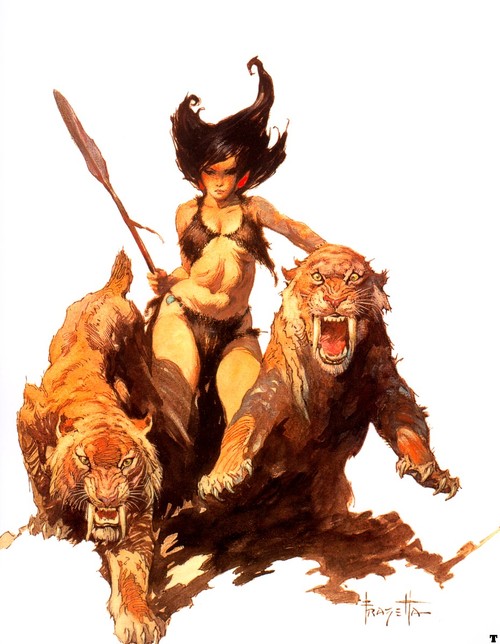
(Cave Girl, by Frank Frazetta)
Fear not, you are in the right place. Trust me, the image of the savage beauty is indeed relevant for this week’s discussion of the assigned stories for the group read of Neil Gaiman’s short story collection, Fragile Things.
Last week’s reading was my journey through the darkness, as that section of the book is among my least favorite. And yet all told there were things in 3 of the 4 selections that I really liked and not surprisingly the discussion for last week’s selections was rich and rewarding. As an avowed Neil Gaiman fan it was fun to actually explore some of his stories that just don’t do it for me and it was equally enjoyable to see how some of those stories stood out to the other readers. This joint reading experience has been a rewarding part of my September and I hope it has been for everyone else as well. And we have one more month of Gaiman short story conversations.
Life is Good.
Consider this your OSW: Obligatory Spoiler Warning.
Let’s talk short fiction.
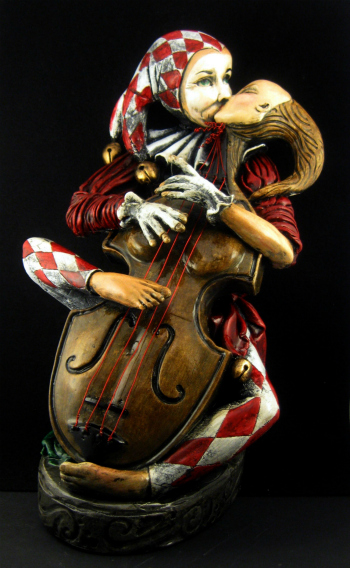
(Resonant Kiss, by Lisa Snellings)
- Good Boys Deserve Favors
This story, inspired by the Resonant Kiss statue created by artist Lisa Snellings, is paired with The Flints of Memory Lane in the introduction by Neil Gaiman. I don’t think this is accidental. Both feel like opposite sides of the same coin, not-quite-story-shaped stories that resonate with an everyday frankness of voice. Both are stories that you could imagine being told in a setting with a group of friends sitting around saying, “You many not believe this, but…”
I love this story. I find the narrator to be every bit as likeable as Neil himself which makes this feel as if it is an autobiographical tale. And you can almost believe something like this would happen to someone like Neil Gaiman, a person of incredible imagination whose creative output often has a magical music all its own. It is presented as a true story, and if we consider the fact that the story is being told from the viewpoint of a 9 year old then it could really and truly be a “true” story. And to be honest, I want to believe.
I never went through that period where I thought girls had cooties. I was always fascinated with the opposite sex and even as far back as the second grade I can recall the emotional turmoil of puppy love. And all through those pre-teen and teen years it was music that soothed the savage beast. Come to think of it is was also music that stirred up the angst! And who among us didn’t sit in front of our stereos singing, concocting imaginative scenarios in which we were in a band, impressing the girl, or guy, of our dreams? I remember often wishing I would have one of those magical experiences where suddenly I was an accomplished pianist or a wizard on the Fender Strat. It is a good thing I wasn’t offered a Faustian bargain when I was 12.
So I say all that to say that I can relate to the story teller. I suspect that this may be like The Flints of Memory Lane in that it will do little for some of the readers. I look forward to discovering everyone’s thoughts about this one.
About the artist: I discovered the work of Lisa Snellings when Neil mentioned her as an inspirational muse in the Smoke and Mirrors collection. I have been a fan ever since. She is a uniquely creative artist with a passion for embracing life’s experiences, be they good or bad. I have had the pleasure of featuring Lisa Snellings and her work on a couple of occasions (and have a planned feature coming up soon):
The Artisan Series: Lisa Snellings
A Lisa Snellings Halloween…and More.
- The Facts in the Case of the Departure of Miss Finch
Continuing with the “art as inspiration” theme, Gaiman mentions in the introduction that he was handed a picture of the above pictured Cave Girl painting by Frank Frazetta and was asked to write a story about it. In typical Neil Gaiman fashion he writes, “I couldn’t think of a story, so I told what happened to Miss Finch instead”. I couldn’t be more pleased. This is one of the stand out stories in the collection in my opinion. Admittedly my feelings are partially influenced by my great affection for the work of Frank Frazetta. He was one of America’s great illustrators, and before I launch into a novel-length post about Frazetta, I’ll acknowledge that I have already done so in this three part series and will move on:
The Artisan Series, Frank Frazetta Part One
Painting With Fire…or, Frank Frazetta Part Two
Frank Frazetta, Part Three: Influence and Conclusion
Moving on to the story, this one is presented in the form of a person relating a story of something inexplicable that nevertheless happened to them. I hadn’t realized until we began discussing these stories that Neil Gaiman has written so many stories with this device. It is fortunate that it is a plot device that I enjoy. Gaiman’s description of Miss Finch always makes me think of the librarian who just so happens to be hot but dresses with all the severity stereotypical of the profession. I am uncertain why I see her that way as she is presented to us as a more stylishly uptight biogeologist. As such she is paraded as the most unlikely character to be comfortable with the idea of attending a circus of the bizarre, let alone be the one of the group who allows herself to be reluctantly dragged behind the scenes as a “volunteer”.
I don’t know about you, but as unsettling as the circus is, I want to go see that circus! I have to imagine that Gaiman had a great deal of fun imagining what would happen in each of the ten rooms. I like that, in room five, we get a chance to catch a glimpse of the “real” Miss Finch, the Miss Finch who becomes animated as she talks about her work. Like our narrator, I too find myself warming to her. When the unexpected and unbelievable happens to Miss Finch I cannot help but feel happy for her. Miss Finch was not made to be content in our time.
The story of Miss Finch is itself something of a wish fulfillment tale, albeit an unconventional one, speaking to that desire to travel back in time, to come upon a portal to prehistoric times. I have a copy of The Cave Girl by Edgar Rice Burroughs whose cover is graced by Frazetta’s painting. I mean to read it one day, although I will do so with some trepidation. For after so many re-readings of The Facts in the Case of the Departure of Miss Finch, it is Miss Finch I see flanked by those two large cats. It feels like a betrayal of her memory to associate anyone else’s story with that painting.
And before I leave Miss Finch, I have to point out this line that I love (referring to another character in our story, Jane):
Her hair had been red the last time I had seen her. Now it was dark brown; and she curved like a Raymond Chandler simile.
- Strange Little Girls
This is one of two offerings in the Fragile Things collection that are included largely for Gaiman completists. It just so happens that one of these two work really well for me and the other doesn’t. This is the one that does not. Strange Little Girls is a series of anecdotes meant to accompany each of the songs for Tori Amos’ album of the same name. I am a fan of her work. For me Tori Amos is the musical equivalent of Neil Gaiman, a creative spirit who, when she gets it right, makes a work of art that speaks to me like nothing else does. I can listen to some of her albums (Little Earthquakes, From the Choirgirl Hotel, To Venus and Back, Scarlet’s Walk) from start to finish, over and over again, and be inspired each time. And then there are others that just don’t quite resonate with me. I have had the pleasure of seeing her in concert twice, going back stage to meet her on both occasions, and she is a magical person. A Gaiman/Amos collaboration seemed inevitable. I wish this one did more for me, though I do know that it is a very special collaboration for some of the fans and so I don’t have any problem setting this one aside and being happy for them. The final story, four lines, does light a spark for me. I’d like to read a story built from this:
Some of the girls were boys.
The view changes from where you are standing.
Words can wound, and wounds can heal.
All of these things are true.
- Harlequin Valentine
I owe almost my entire knowledge of the Harlequin stories to comic books and to Neil Gaiman. But that understanding, slight as it may be, does a lot to enhance my enjoyment of this story. Like the great Angela Carter, Gaiman turns the folk tale on its head with his treatment of the Harlequin and his Columbine. In his tale Columbine gets some of her own back. But the beauty of this story is that both Harlequin and Columbine step beyond their given roles, both exhibit mischievous personalities coupled with moments of true compassion. I am particularly fond of Harlequin’s interaction with the receptionist at the morgue. His compassion when he sees the course her life is on which leads him to interfere with that course touches me. It could almost be overlooked as a throwaway moment in the story, a distraction, but instead it tells us more about Gaiman’s imagining of Harlequin than pages and pages could. It is that compassion that I believe results in the Harlequin’s fate, a fate that hints of romance in his future.
There is a comic book adaptation of this story with fantastic art by John Bolton. If you get a chance to pick it up I highly recommend it.
Well, that is this week’s stories reviewed. Better late than never I am coming to the discussion and I can’t wait to see what everyone else thought. Please post any links to your Week Four discussion posts below.
______________
The four stories for next week include two of my favorite Neil Gaiman poems and the Gaiman short story that I struggle with, and dislike, the most. Can’t wait to talk about them all.
Locks
The Problem of Susan
Instructions
How Do You Think it Feels?
_____________________________
This book is a selection for the Peril of the Group Read portion of the 6th annual R.eaders I.mbibing P.eril (R.I.P.) Challenge. To find out more information and/or to sign up to participate, please follow the link. If you are interested in more books or films that are being reviewed as part of this event, please visit the R.I.P. VI Review Site.
I enjoyed the stories this week a lot more than last week. I haven’t got around to my post yet.
Me too, look forward to your detailed thoughts on them.
Now that I am done I just looked up Tori Amos. She has a lot of CDs! I think I will just start with the one the story is connected to. I am not sure having heard it would really make me love the notes he wrote for each song, but at least I would understand where he is coming from.
As to the other stories, I feel like I was missing something with Harlequin Valentine. It is not that I didn’t like the story, but I also didn’t love it either. I am sorry, the eating of the heart probably is where things went downhill for me…. That’s just disturbing and not something I wanted to picture. I didn’t even mind she was walking around with a heart in a plastic bag or that he cut it out and hung it up for her. If it had stayed like that I would have been fine, but eating it?
I really enjoyed The Facts in the Case… That goes back to me really being into circus-centred stories lately. (How are you liking The Night Circus, btw?) I was also interested in how the story was inspired.
Then, there is Good Boys Deserve Favours. I do agree with you about why the two stories were included together earlier in the collection, but I still wish he hadn’t done that. It confused me even though in retrospect it is a bit obvious.
(On another note, I have read the stories for next week and enjoyed them. I want to say something more, but I should probably wait!)
Yes, hold your comments for next week’s stories for next week! 🙂 But write them down now while they are fresh in your mind, lol!
If you are serious about spending some time with Tori Amos, Little Earthquakes is the one I would recommend above all others. It is an incredible album.
Harlequin Valentine is a story where I didn’t mind the darker elements, like the eating of the heart. That kind of thing hearkens back to the original fairy and folk tales, the ones where things were a bit more visceral. I couldn’t do it myself though. Not even with ketchup. Ugh!
I am enjoying The Night Circus, and I completely understand where you are coming from, the circus elements in the Miss Finch story are attention-grabbing!
Of course that first picture is appropriate! I, too, want to believe “Good Boys Deserve Favors.” You’ve captured it very well here. If you can get tickets, I’ll happily join you at Miss Finch’s circus.
Thanks Emily, I thought so too. Given my love of Frank Frazetta it was a foregone conclusion that when we got to this story I would be posting the Cave Girl image.
I am happy to know I am not the only one who felt that way about “Good Boys Deserve Favors”.
And I will definitely send tickets your way when I get them. 🙂
I will definitely have to check out the comic book adaptation — that story definitely lends itself to visuals!
It is fun. There is also a short film by Gaiman and Bolton called, A Short Film About John Bolton, that is worth tracking down.
What great thoughts, Carl! I, too, enjoyed this week more than last week, although I didn’t find last week’s stories to be all that horrible. I myself LOVED “Good Boys”, as much as I enjoyed “Flints”, and for much the same reason, which is why it is no surprise to me at all that they are grouped together!
I was so glad to read your thoughts on “Miss Finch” because, to be honest, this story didn’t do it for me at all this week and it helped to read your thoughts! I loved the circus aspect, but really didn’t find Miss Finch to be at all an appealing character, and for some reason the ‘person telling a story’ set-up didn’t work for me this time (although it’s been a dead ringer in past stories).
I happened to ADORE “Strange Little Girls” and “Harlequin Valentine”, although I actually liked “Strange Little Girls” a bit more. “Harlequin Valentine” was just SO sad! I also really appreciate your Angela Carter comparison, as I’ve just finished The Bloody Chamber and absolutely loved what she does with her stories – there is something quite Gaiman about it.
Looking forward to more poetry and to see if I can figure out just what it is you don’t like so much about the next stories. Thanks for hosting yet another great week of the read-a-long!
I am growing more and more fond of Flints and Good Boys each time I read them, and I was impressed the first time.
I actually expected people to have a different reaction from me to the Miss Finch story, thus I’ll be interested to read everyone’s reactions. I do suspect that I would feel differently about it if I didn’t like the Frazetta image so much. I believe I would still like the story, but I can’t dismiss the influence Frazetta’s painting has on my feelings about the story.
Funny because I don’t see Harlequin Valentine as sad at all. The Harlequin character is somewhat of a trickster and although Columbine gets her revenge on him it actually works out great for both of them. She gets to do something different with her life and the story ends with him actually having a little spark of romance and just the slightest hint that he hasn’t lost all of what makes him the Harlequin.
Oh, so glad you read The Bloody Chamber. I was staring at it longingly just yesterday, wishing/hoping I could manage a reread here in October.
And it is only the ONE story in the next section that I’m not fond of, I think the poems are great and I *think* I like the other story…though I honestly don’t remember enough about it to be sure. Perhaps that isn’t a good sign, LOL!
I’m so glad that you included images of both pieces of art! I had forgotten that Good Boys Deserve Favors was mentioned earlier in the introduction, so I missed it. I must say though, I much prefer the sculpture. And I see you’re reading The Night Circus – I hope you like it! I think it’s just wonderful. I can’t wait to read your review.
Thanks Jennifer, I’m glad I was able to find decent copies of both images to include.
Lisa’s sculptures are great. I have one of her Red statues and I just love it. Her Dark Caravan carnival, part of which inspired “Harlequin Valentine” is completely and utterly fantastic!!!
I’m enjoying The Night Circus thus far, just haven’t had much time to work any reading of it in with all the wonderful group reads that I am participating in and hosting.
I didn’t much care for Flints when we read it, but I greatly enjoyed All Good Boys Deserve Favors. It reminded me of my own days back in band, and also of that moment when drawing, writing, playing music, etc. when everything just seems to flow.
Harlequin Valentine was pretty cool. The trickster is one of my favorite archetypes. At the same time, I tried to read it while eating, which was probably a mistake.
Probably even more of a mistake if you happened to be eating meat! And far worse if it was something like liver! 🙂
I hadn’t thought about Good Boys that way but you are right, it does also touch on those moments when things just flow, and I would like to think we’ve all had those experiences in our lives. They are the kind of thing you cannot help but wish happened all the time, but then I suppose it wouldn’t be the same if that was commonplace.
I’ve just caught up with this group read and I’m so glad to be able to participate! For these 4 stories I really connected with Good Boys Deserve Favors. I was a violinist in high school so it reminded me of the special school violin I used each year (to broke to buy or rent one). It just had that special something the others didn’t have. So when the little boy fell on the bass 1) I cringed and 2) I understood why he he didn’t try a new instrument. It’s not easy to recapture that magic.
Me too Sarah, great to have you taking part.
Wow, you really do have a cool connection to the Good Boys Deserve Favors story. Very neat that you could connect with the story on a more personal level.
Sorry to get here so late – but lovely to feel I’m coming in on a conversation where I can join in. It was such a good week’s reading. Looking back at what I said (I wrote my post at the weekend but then didn’t have time to do anything more) I sounded a bit lukewarm about Good Boys – I really liked it a lot, and it’s great to see the image that inspired it, so thanks, Carl – it’s quite something! I really enjoyed what you had to say about your own reactions to the story, too.
Guess I have to admit that Tori Amos doesn’t really work for me – my musical taste is a bit UK-centric – so the stories in Good Little Girls don’t move me greatly either, but there’s a degree of satisfaction in seeing a craftsman at work.
I’m still enjoying the remaining two, the more I think about them the more I like them. They both have eveything I like best about Gaiman’s work, that dark, baroque colour that’s always shot through with wonderful bright detail like Jane’s hair or Harlequin and the woman at the morgue – like Angela Carter, too.
Glad you are in! I’ll check out your post as soon as I get a chance.
Good Boys was a real pleasure to read again and I’m thrilled that so many of you have enjoyed it this week. On top of that, reading everyone’s reaction to it has actually enhanced my appreciation of it.
Tori Amos is certainly not to everyone’s tastes, I’m sure. Makes me a bit sad, because I think she is a creative genius.
It is often the small details, a line here or there, that makes Gaiman’s work so amazing (Tori Amos’ too).
I don’t know exactly why, but I really loved the Miss Finch story. I hadn’t seen that painting before I read it, but it probably would have changed my view of it.