“I think…that I would rather recollect a life mis-spent on fragile things, than spent avoiding moral debt.”
“Stories, like people and butterflies and songbirds’ eggs and human hearts and dreams, are also fragile things, made up of nothing stronger than twenty-six letters and a handful of punctuation marks…But some stories, small, simple ones about setting out on adventures or people doing wonders, tales of miracles and monsters, have outlasted all the people who told them, and some have outlasted the lands in which they were created.”
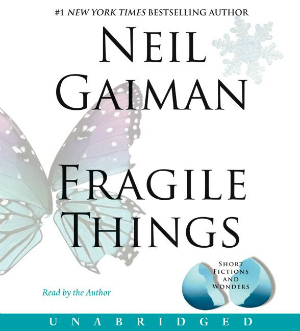
It is my great pleasure to be hosting a group read of Neil Gaiman’s short story collection, Fragile Things. 32 stories (including the Introduction and its special surprise)–Four stories each week for Eight weeks. I like the symmetry of that. I also like that it is a manageable task set amidst all that one has to fit into a 24 hour day. Short stories are best savored slowly, a lesson I have yet to properly learn, being a person who tends to gobble them up like sweets.
The expectations are few: read the stories and share whatever you want about them, good or bad, simple or profound, erudite or concise. The idea is not to limit yourself to non-spoiler conversation, so I’ll caution those who follow along here and elsewhere. If you plan to experience these stories for yourself it may be best to do so before reading these posts.
For those who are participating and those who have read these stories before and those who just feel inspired because of the conversation, please share whatever you so choose. I look forward to talking Neil Gaiman with you over the next eight Sundays.
Let us begin.
- The Introduction
It may have caused some head scratching when I announced that we would be reading the introduction to Fragile Things as one of our stories for this past week. For those who have read a Neil Gaiman collection before the reason was probably obvious: Neil likes to hide a short story in the introduction.
Now I would read an introduction to a Gaiman book without the promise of a short story, largely because of my previous experience. I am one of those people who is forever curious about where people get their inspiration for the stories they write. In Neil Gaiman’s case, he often gives some insight into this inspiration. Because of his introductory statements over the years I have discovered the work of an artist and friend, Lisa Snellings, have discovered the work of other authors that I ended up reading and enjoying, like Jonathan Carroll, and have also come to appreciate stories differently than I might have otherwise. An example being a story we will be reading later: The Facts in the Case of the Departure of Miss Finch. It was inspired by the Cave Girl painting by Frank Frazetta, a great favorite of mine. I love knowing that.
The embedded story, The Mapmaker, is a fun one. It is the kind of story that works better as a surprise gift in the middle of an introduction than it would on its own. It is an exercise in cleverness more than a complete story but I enjoy the way in which it showcases Neil’s imagination. It feels like a story that would have worked somewhere in the Sandman series, but I’ll be hanged if I could tell you why I feel that way.
Finally, I like Neil Gaiman’s introduction (and his introductions to other people’s books) because there are generally sentences, like those I began this post with, that stir up my imagination and remind me, as if I could forgot, just why he is one of my favorite authors.
- A Study in Emerald
This story won a Hugo Award for Best Short Story and a Locus Award for Best Novelette.
It is an amalgam of the mythos created by two powerhouses of the early twentieth century: Sir Arthur Conan Doyle and H.P. Lovecraft. I will be curious to read the reactions of those of you who are perhaps not familiar with one or the other or both of these writers. I personally think it is a very well-written short story that has a definite beginning, middle and end–something not all short stories manage. It leaves you with a pretty good idea of what occurred while at the same time leaving a mysterious aftertaste, questions that provoke thought and may just lead to a little post-story research, as it did with me the very first time I read it.
Lovecraft’s Cthulu mythos, his world of old-gods that are seen as hideous and unimaginable creatures from our very nightmares, is one that easily creates an atmosphere of fear and foreboding. Doyle’s Sherlock Holmes stories are set in that period of time where London was a dangerous, dark and dirty place. A period of time that is fertile for our imaginations to run wild with images of horrific things happening to unfortunate souls in the dark of night. Gaiman plays upon both of these by seamlessly bringing both worlds together. I enjoyed this story the very first time I read it, but I have to admit that my enjoyment grew exponentially last year after I read the Sherlock Holmes story, A Study in Scarlet, from which Gaiman draws inspiration.
I can’t help but be a caretaker again and warn that at this point I am going to start talking SPOILERS:
What makes this story so very entertaining is the revelation that our “heroes” are not in fact Sherlock Holmes and Dr. Watson, but instead are hinted to be Professor James Moriarty and Captain Sebastian Moran. That twist takes another turn for the reader if he/she finds themselves siding with the supposed villains of this piece, the seditious Holmes and Watson, who do not see the presence of the old gods as something beneficial to humanity. I tend to side with them and thus am thrilled they got away.
Finally, I think the old advertisements placed in between the chapters of the story are a treat. They are like old fashioned commercial breaks from an old radio play (if you are listening to this on audio as I was) or like the bills of sale you would find in the kind of circulars where these type of stories would have first made their appearance long ago.
- The Fairy Reel
I tend to like about 50% of Neil Gaiman’s poetry and could happily leave the other 50%. Probably not bad odds for a poet. There are two poems in this collection that I am very fond of, this being one of them. In reading it I tend to think about it the way I do about Catherynne Valente’s poetry–there is probably a lot in there I just don’t get because my knowledge of old folklore and mythology and fairy tales is not what it could be.
In the introduction Gaiman says, of The Fairy Reel: “Not much of a poem, really, but enormous fun to read aloud.” I think he is right, especially if it is him reading it aloud. He reads it with such great pacing, some lines just rushing by, that you cannot help but smile. If this did not do much for you, or even if it did, I suggest you try reading it aloud once. Try it on verbally and see how it feels. My own personal experience with poetry is that I often get more out of it if I go somewhere quiet and read it aloud to myself. There is something about the rhythm, the meter (I don’t know the right phraseology) that works better if you are hearing it, even coming from your own mouth, that doesn’t quite come out in the voice in your head. Or at least that is my experience. You?
- October in the Chair
This story won a Locus Award for Best Short Story.
Even without Gaiman mentioning it, this story would have reminded me of Bod in The Graveyard Book. An aside: reading the Introduction is something akin to time travel when you read about how this was a dry run for The Graveyard Book, a book that Neil was working on back when he wrote this introduction.
I like how Gaiman bookends this decidedly dark story within a setting where the various months of the year sit around telling stories. I may be alone in this, but the banter of the months of the year reminded me of The Endless in Neil Gaiman’s Sandman series. It is easy to picture these human-shaped representations of the months of the year sitting in a forest telling stories that in some way reflect their personalities.
I feel for ‘the runt’ the moment October introduces him in his story. Donald, the runt, is certainly not cared for. He is the poster child for neglect, despite his being fed and clothed and having a roof over his head. He is easy to relate to for any of us who have ever wanted to pack up and run away. You could almost picture him with a stick over his shoulder, with a gingham rag full of his provisions tied to the end. You realize early on when Donald meets the dead boy that the temptation is going to be there for him to in some way stay with this new friend, the first one he appears to have made in his life. Did anyone else think Donald was going to fall out of the tree and die when you read it? I know that is what I thought when I read it. The real end, the end in which Donald can choose to make a choice to remain with his new friend, is much more creepy and disturbing. Chilling really.
What do you think was inside that house?
I must say that I much prefer a scary story like this, where one is not sure exactly what lies behind closed doors, though it is certainly evil, to those which spell everything out in gory detail. Though I have read and listened to this story many times before, it still gives me a chill whenever it gets to the end.
_____________
Well folks, that is all for this week. Except of course some hopefully lively discussion here and on the sites of the other participants. If you have done a Fragile Things Group Read post, please link to it below:
Next week’s stories are:
The Hidden Chamber
Forbidden Brides of the Faceless Slaves in the Secret House of the Night of Dread Desire
The Flints of Memory Lane
Closing Time
The posts for Week Two will go up beginning Sunday, September 18th. Until then, happy reading.
___________________________________

This book is a selection for the 6th Annual R.eaders I.mbibing P.eril (R.I.P.) Challenge. For more information and/or to take part in the event please visit the introductory post here.
If you would like to participate in the Fragile Things Group Read, simply leave a comment indicating such below and I will include you in the weekly reminder emails.
Great post. Reading you on these stories, I wonder how more I would’ve enjoyed this week’s reading if I were better versed in Gaiman’s work and the works he references within his stories. (Not to say I didn’t enjoy the reading. I loved it – but I imagine that if I spent a few years doing background reading, gathering up Gaiman’s references, it would be fun to come back to these stories.) I loved “A Study in Emerald” and discovering that Holmes & Watson are actually on the other side of things was such a perfect twist. I’m impressed that Gaiman pulled it off, because I think from many writers it would have been an “eh?…he’s really going there?” sort of moment. Also makes me want to read some Sherlock Holmes so I can get a better idea of who, in Conan Doyle’s version of the world, I was sympathizing with throughout the story.
I don’t know Ellen. Part of it is probably whether or not you are fond of short stories in the first place, but I tend to think that I agree with you in that having some experience with Gaiman’s Sandman series and some of his novels helps build a foundation from which to enjoy these stories differently.
A Study in Emerald could have been a very gimmicky story, to be sure, and I agree with you that Gaiman created something very special with it. Something that I feel pays homage to both Doyle and Lovecraft rather than just trading upon their creations.
I haven’t read nearly enough Sherlock Holmes and I do want to read more soon.
Oh, after reading your insightful post, some of the questions I had about “A Study in Emerald” now make a little more sense! I’ve never read H.P. Lovecraft, though I know of his work and the themes and atmosphere associated with him. I do love that story, it’s all wrapped up nicely but also like you said, with a nice mysterious aftertaste! I think I had that story all wrongly figured out, though 😛 I like your interpretation so much better! I totally just thought there were two pairs of Sherlock Holmes + Watson and one of them belongs to this world, and the other doesn’t…it doesn’t make much sense, I know. And “October in the Chair” was both amusing and very creepy and also a little sad. I wasn’t sure if I was to be creeped out that Donald/the runt decided to go into the house or be eager for his next adventure…
At the end of A Study in Emerald the person writing the story signs his name as “S.M.”, which gave me a clue that this had to actually be someone from the Holmes mythos. I simply did a google search to read about the speculation as to who the characters were and that is what makes sense. Plus, since these men were Holmes’ and Watsons’ arch enemies, it makes sense that they would be so brilliant. It also bothers me less that the one we thinks is Holmes is outwitted by the actual Holmes. In fact it turns me from cheering from one set of protagonists to the other.
In Donald’s story I think you can expect that at some point soon he’ll be happy to enjoy his friend, but I try not to imagine what might happen to him in the mean time.
Yeah, I was totally admiring the brilliance of both sets of characters for figuring each other out and outwitting each other. I actually kind of laughed when I read Sherry Vernet’s letter, because I totally didn’t expect it and it was a nice in-your-face-I’m-smart-too kind of thing that I always kind of thought detectives like Holmes should get once in a while.
And the reactions of the months to October’s story was totally my reaction. Just….silence. I had to keep reading on to shake off the creepiness of what could be in the farmhouse.
Yes, if you think too much about Donald’s fate, even if it ends up alright afterwards, you might not get to sleep at night.
Vernet’s letter was great and it was very ‘in your face’ in the polite manner of gentlemen.
I definitely thought that Donald was going to fall out of the tree in October in the Chair!
Me too, I thought it was great that Gaiman wrote it that way. You have that “oh, I see what is going to happen” moment and then you are fooled! 🙂
Yeah, that was really cool. I kind of expected Dearly to be trying to trick Donald into dying, but the ending was so different than what I’d expected.
I had forgot about that, but I think the first time I read it I was also wondering if he chose that hard to climb down tree on purpose with that hope.
The problem I have with short stories generally is I want more. I know you are supposed to use your imagination and fill in the details, but I just want the story to go on longer. For October in the Chair I didn’t want to wonder, I wanted to know what was in the house. I wanted to see that played out out and the after effects… It’s not that I don’t enjoy using my imagination, but I am always left wanting more… A Study in Emerald? That would make a fun collection of stories.
Yes it would.
And I think you pinpoint exactly what so many feel about short stories. Personally I enjoy them exactly as they are. If they are written well then I don’t mind the “wanting more” feeling. They excite me because of it.
I know lots of people that think like that. I think I just prefer longer books because when I sit down with something I want to be away for a while… Not a few moments… Short stories just don’t seem as satisfying. I read a lot more than I used to, so that is saying something. And, there are exceptions… I love Charles de Lint’s short stories and I do enjoy Gaiman’s from previous experience. I don’t love all the stories they have written, but more than enough.
I’ve always been fond of short stories but some switch was flipped a couple of years ago and my fondness for them increased a great deal. Since then I’ve read far more short story collections in years than I read in my whole life up to that point. Its odd as I’m not sure what changed.
I think that this has happened to me this year. I have read loads of short stories this year when it has been something that I just haven’t really been interested in before.
I know sometimes it is just the simple explanation that a short story is something you can fit in quickly when you don’t have a lot of time to sit and read. But in the end it is more than that, especially when you find an author, or authors, who put out great material.
I have been reading more short story collections the last couple years than I have in my entire life before. I slip them in when I want to read a few pages and don’t have a lot of time. Actually, at the moment I am a bit ahead with Fragile Things, so I am reading The Poison Eaters and Other Stories and a Jane Austen anthology. That’s a lot of short stories for me.
I’ll be interested in seeing what you think of Poison Eaters. I enjoyed Black’s book Tithe, for the most part, but was quickly turned off by the sequel and didn’t get too far into it without deciding it wasn’t for me.
I’m hoping to re-read Susanna Clarke’s collection, but as time goes by I’m not sure I’ll get as much read as I hope.
I wasn’t crazy about the sequel to Tithe, either. It was sad. I read the first book in her newer series and enjoyed it, though. I will probably read the sequel soon because I have it requested from the library. Otherwise everything I have read is just things that she has edited. I actually thought that was what Poison Eaters was, but it is stories by her.
I did however enjoy the collaboration she did with Tony DiTerlizzi on The Spiderwick Chronicles.
Oh wow! It has been a long time since I left you a comment – I had to fill out the form again.
I am envious of you Carl. All the books you have going for a group read are ones that I would jump on gladly to read but I am such problems with reading these days. I wish terribly that I could be reading this book right now. It sounds like a good read. October in the Chair sounds like a short story I would like.
Wonderful to see you Deanna! It has been way too long. I hope things settle down for you soon.
I think you would certainly enjoy some of the selections in Fragile Things, for sure. Including October in the Chair.
I’m with Ellen… after I finished listening to “A Study in Emerald” I was like, that was an AWESOME ending, of course Holmes can outwit anyone! And then I was like, wait. That’s kind of a cheap ending, isn’t it? “Oh ho, I have tricked you and these are not the characters you are looking for! Ho ho!” And then I re-read it, knowing the ending, and it was still the perfect ending for this story and not cheap at all. How does Gaiman do it?!
My own personal opinion is that when Gaiman is “on” his short stories rival the best out there. He clearly understands the medium and can work magic with it. Like all short story authors he has his misses, and of course those misses are different for every reader. But when he does stuff like A Study in Emerald, stories that tap into some shared history, they usually sing.
Oh, please don’t tell me that Gaiman is ever not “on.” I haven’t yet had that experience. Maybe I will reading this collection?
You might not, but I consider myself a card-carrying Gaiman gusher and there are a couple of stories in this collection that I loathe. Not because they aren’t well written, but because I just don’t like them.
Ok, now I’m curious which stories out of the collection I won’t end up loving quite as much as “Emerald.”
I’m glad I came back and started rereading your post and the new comments. I’m jumping around a bit so I think this is something you wrote about in an earlier comment…but came up again here. I liked reading about how you figured out what characters were “running” the story in “Emerald.” I knew at end they weren’t Holmes and Watson (of course) but apart from figuring that Gaiman had done a great job of getting me to think I was reading about characters I wasn’t reading about, I didn’t know who they were. Over the next week I’m going to see if I can fit some Holmes vs. Moriarty in, just to see if seeing how Conan Doyle writes the characters changes the way I read Gaiman’s writing of them.
Part of my ‘figuring out’ was of course looking up stuff online, but I did suspect as soon as the twist happened that the ‘consulting detective’ had to be Moriarty. It is the only thing that makes sense in the Holmes Canon. I just hadn’t read enough Holmes to be familiar with Sebastian Moran. I too want to read more of Doyle’s work than I have so that I can bring that knowledge back to this story.
I suspect you won’t enjoy some of the stories in this collection. Gaiman has a tendency to write some more graphic and dark stories on occasion and while I have enjoyed some of them, for the most part they do little for me.
I am bummed that I can’t participate with this group read. But I hope all of you have a ton of fun and lively discussions. Hopefully, we will read another Gaiman book together in the future.
Me too, TBM. I wish you could. We’ll have to read Neverwhere together soon, maybe. I’ve been itching to read it.
Hopefully that will work out! Have fun with this one! And if I don’t have internet for a couple of weeks, I wish you well and happy reading!
I will be anxiously awaiting your return to Online Land. Have a safe and adventurous trip, look forward to hearing of your new adventures in Merry Ole England.
I neglected to mention in regards to “October in the Chair” that I tend to like stories where characters are sitting around telling stories, be it around a camp fire or at an inn or if the narrator himself/herself is relating a story to us. I like the peripheral details that arise from that kind of story telling structure.
It adds a certain amount of depth that Donald’s story would have otherwise lacked. I like the added context.
I agree. I don’t think the story would have been nearly as interesting without the framing story.
Read these last year… A Study In Emerald was my favorite, because I just love Sherlock Holmes, and this was a total surprise to me, not having read any Gaiman short stories before. I also loved October In The Chair and it reminded me of Nightmare Before Christmas’s holiday tree glen…. all them sitting around, taking their turns.
Oh, what a great image, the NBX circle of trees! I can’t wait to watch that again this year. Isn’t quite the right temp for it yet, but its getting there. What a wonderful comparison.
A Study in Emerald was such a great surprise, wasn’t it? I remember being so surprised the first time I read it as I was not expecting a story with a twist, not at all.
I only read the beginning and end of the introduction, saving the bits about each story to read in tandem, so I missed the hidden story! I can’t wait to get to that! After your review (which I really enjoyed, by the way), I want to read the stories that inspired/were inspired by these stories. And my reading list lengthens!
Thanks for this challenge and group read – they seem like a lot of fun already!
Glad you decided to go back and read the hidden story in the introduction. I’m also thrilled to find out who missed it and who didn’t based on who reads introductions normally and who does not.
I know the feeling Jennifer, I’ve added so many books to my reading list from this year’s challenge already and its only been 11 days!
You are welcome, I’m so glad you are participating.
I am not at all familiar with H.P. Lovecraft, unfortunately, and so the references to the royal family and everything were totally lost on me. I thought it was a strange mash-up, Holmes & Sci-Fi, but when I finally got the end and realized the true intent of the story, I liked it a lot. (: I guess I gotta read me some Lovecraft.
Thanks for hosting such a fun group read!
You are welcome, Anna. I do think having some exposure to Lovecraft makes this story much, much better, even thought it works well enough without that.
I was not planning on joining in on this read along, mostly because I do not read any modern fiction. Strange of me I know, but I am almost paralyzed for choice and hate to waste time on unfulfilling stories.
Anyway, your review made A Study in Emerald sound so interesting I had to look it up and I read it online this morning. I LOVED it. What a jolt of joy when I realized I had been tricked into thinking Dr. Watson was narrating. I will never look at Watson the same again!
I have not read Lovecraft’s story, so at first I did not get what seemed to be the magical realism in the story. I’m not at all familiar with the genre, so pardon me if I’m mistaken. But the red moon and magical Queen Victorian didn’t seem to add to the story until I looked up Cthulhu on wikipedia. I’d like to read Lovecraft’s story and than re-read this one.
Btw- I love your metaphor about gobbling up short stories like sweets, so perfect
As long as you are finding good stuff to read and are happy then you probably aren’t missing anything…and yet there is so much wonderful modern fiction.
But enough on that, I am so glad you gave into the temptation to track this one down and read it. It is quite the trick, isn’t it? That is one of the many things Gaiman does so cleverly with this story. You just know its Holmes and Watson…until of course it isn’t! 🙂
Since you do read non-modern fiction you should check out some of Lovecraft’s short stories. They are classically creepy.
Loving it! Looking forward to reading more. Now off to read what everyone else has to say!
Happy to hear it Emily. I look forward to your thoughts on the stories.
Okay, so here’s what happens when you listen for the first time instead of reading. I was COMPLETELY confused by the short story hidden in The Introduction. I wondered if my poor listening skills had resulted in my missing the end of the Introduction. Not till I got the print version, did I realize what Gaiman had done. LOL!
Ah, that is funny. Of course Gaiman doesn’t announce in the audio that he is reading a short story, he just launches right into it. Glad you found it in the print version.
The same thing happened to me! I was like, whaaaat? But I figured it out fairly quickly and was able to backtrack a bit and try it again. 🙂 Much easier in the print version!
Yes it is. I was thinking when I was listening that he should have made some little announcement about it being a hidden short story. Something that would be a nod to the listeners that readers of the book wouldn’t get.
Sorry to come into the discussion so late. I ended up being away from the computer all day!
I’m sorry that I missed mentioning in my post the adverts in A Study in Emerald because I absolutely loved them. I wish there was an entire collection of just those! I missed the Frankenstein reference until I was a few pages past and then it clicked and I flipped back and read it again when my brain was working.
And I think that I didn’t love October in the Chair the first time I read it, not being at all familiar with Gaiman’s writing. Now that I’ve read (and loved) so much more of his work, it just seems like such a special story.
No worries, Kristen. Sometimes being away from the computer for a day can be wonderful.
Aren’t the advertisements great? Not sure if you saw the Study in Emerald poster I linked to in the comments on the site of one of the other participants, but I love the way they graphically design the ads in that one. Wish something similar could have been done with the book.
I certainly cannot imagine this book being my first exposure to Gaiman. I may have completely loved it but I am not sure I would have gotten as much out of it without that foundation from reading so many of his other books prior to reading this.
“The Fairy Reel” is possibly my favorite Gaiman poem. Hearing Gaiman himself reading is a marvelous experience. I just love the way it flows and the words he chooses, especially She’d pluck wild eagles from the air/ and nail me to a lightning tree.
And “October in a Chair” is absolutely one of the best pieces in this collection. What does Runt find in the house? Maybe the Man Jack? Maybe something even more sinister. And you’re right, I can see the Endless sitting around and chatting on just like the Months did.
I look forward to following this discussion each week.
“Instructions” is mine, but “The Fairy Reel” runs a close second.
It really is wonderful hearing Gaiman read, isn’t it. I often wish he would narrate some other author’s works as I love hearing him read.
Hey, it could be the Man Jack, hadn’t thought of that. That is a fun (scary) thought.
Like you, I’ve thought of The Graveyard Book with this story each time I’ve read it, and I can’t help but picture something like the events from the beginning of that novel happening in that house, especially to Runt. Don’t know why, but I just do.
Hey, I think it is a perfect assumption to make. I could see these stories being connected in that way. We know that the Man Jack had a long history of nastiness before the events in The Graveyard Book.
I also thought the introduction was just fascinating. I almost wish I’d read his comments about writing each story just before I read that one instead of reading them all at once. I felt like I forgot what he said about most of the stories by the time I got to them.
I think the first time I read it I did both, though it is hard to remember now. In some ways I wish each of these comments was just before or after the story, but I do enjoy what Neil does with his introductions.
I’m late as ever (a literature conference got in the way which at least seems like the right kind of excuse) but I wrote a short post over at my blog because I liked The Fairy Reel so much. I loved the others too, and maybe this Sunday I’ll be able to join in the discussion. I loved the ads in A Study in Emerald, they really added to the atmosphere, and I loved the way the story was subverted because, although we think of Holmes as the great rationalist, Conan Doyle was fascinated by the supernatural, so it just fits really well.
That is the perfect excuse! It is never too late, look forward to your thoughts. I hadn’t thought about that Conan Doyle supernatural angle, but you are right. Yet another really cool thing about A Study in Emerald.