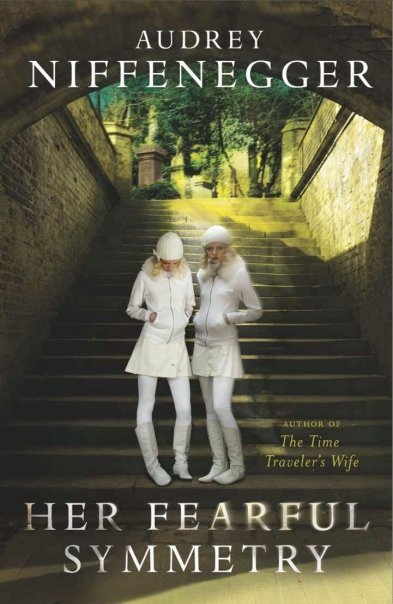
If you somehow stumbled upon this review without first seeing the warning in this post, I want to reiterate that I have a non-spoiler post that you can read here. This post is not going to do you any favors if you are planning on reading the book. And honestly if you have not read the book I do not want anything that I have to say to help formulate your opinion for you. I sincerely ask you to walk away and read the book for yourself. Go read my non-spoiler review if you want a general idea of how I felt about Her Fearful Symmetry.
You’ve been warned.
A brief synopisis (those of you who have read Her Fearful Symmetry can skip the next paragraph. I only include it as a foundation for those who will ignore my warning and read this anyway):
Her Fearful Symmetry is an ensemble piece. It is a book about Elspeth, twin to Edie, and what happens to her after she passes away and suddenly finds herself haunting her own flat. It is a story about Robert, Elspeth’s lover, and how life goes on…or in this case doesn’t…when you prematurely lose someone you love. It is a book about a small apartment complex, inhabited by Robert, by Julia and Valentina–twins who inherit their aunt Elspeth’s flat…and by extension, her ghost, and by Martin, a man with severe OCD, who cannot leave his apartment. Her Fearful Symmetry is a story about what happens when Martin’s wife Marijke can no longer live in a world imprisoned by the effects of untreated OCD and leaves. It is a story about the very real Highgate Cemetery, a place the reader cannot help wanting to go visit immediately upon opening this book. It is a story about loss, about the nature of identity, particularly in juxtaposition to being in some kind of relationship. It is a story about love and selfishness and sacrifice and choices. And quite honestly it is about so much more.
The one thing that I can say unequivocally is that within the first few pages of Her Fearful Symmetry it became obvious that The Time Traveler’s Wife was no fluke. Audrey Niffenegger can write, and write well. In reading Her Fearful Symmetry I found myself having to imbibe portions during stolen moments here and there. Those stolen moments were deliciously agonizing in that I was so glad to be able to read a few pages and yet so disappointed when ‘real life’ interrupted causing me to have to lay the book aside. My mornings, nights, and portions of my day have been swallowed up with the act of immersing myself in a very minute portion of London, and I’ve enjoyed every minute of it. To allay any remaining suspense, I really enjoyed this book, and at the same time I have a few significant complaints about it. But we will get to those.
Audrey Niffenegger’s strength, in my opinion, is in crafting characters to inhabit the world she creates. The use of ‘inhabit’ isn’t a random choice of words. I mean exactly that. These are not two-dimensional characters. They are not words on the page. They live and breathe and move right there as you hover over every word. Niffenegger also creates a vision of a piece of London–a cemetery, a street, a flat–that is so subtle that you do not even realize the moment that these inanimate places become characters in and of themselves. It is a beautiful gift and one that certainly makes me wish that I didn’t have to wait so many years for her next novel. I loved Highgate Cemetery. Very early on in my reading of Her Fearful Symmetry I downloaded the Google Earth software to get a bird’s eye view of the area. I spent a good long while exploring the neighborhood in and around Highgate, pinpointing where I thought the flat might be situated. It is an exercise I highly recommend for those reading the book.
The story is filled with unexpected revelations and story lines that I didn’t see coming. And while there were plot elements that I guessed at before they happened, it in no way effected my enjoyment of the manner in which Audrey Niffenegger weaves the various plot threads together.
As I mentioned, the characters in Her Fearful Symmetry were incredibly well realized. What strikes me as I sit here, roughly an hour after having finished the book, is that I am not really sure that I liked many of these characters. Not because they were flawed, and these are certainly flawed characters…many a well written character is flawed…but because I’m just not sure I feel any of them made decisions worth celebrating or being happy about as a reader. The exceptions being Martin and Marijke.
They too were flawed, and I was certainly sad for both of them when Marijke made the very understandable decision to leave Martin. I work in the mental health field and honestly could not imagine living with someone who is so trapped by their illness. It truly must be exhausting. Audrey crafted such a realistic portrayal of the illness (from my layman’s perspective) without making Martin so tragic that you couldn’t relate to him as a reader, nor so lovably quirky that you felt angry at Marijke for walking out on him. I loved their interactions with each other throughout the book and I also really enjoyed Martin’s interactions with Julia. In fact it was only with Martin that I really liked Julia, which makes Martin’s character a very interesting one to study. How is it that a man with so many obvious flaws seems to bring out the very best in those he interacts with? Audrey Niffenegger proved with A Time Traveler’s Wife that she could write a heart-tugging romance and it is that same talent that she brought to the story of Martin and Marijke. Their story really satisfied me…mostly.
I was slightly disappointed that their denoument was so quick. It felt very rushed. I would have loved to see Martin’s journey to Marijke take a little longer. I really would have liked to see Niffenegger’s obvious ability to generate emotion put to better use during Martin’s journey ‘home’. When that was over, though my heart smiled for these two characters (and my how I loved Martin’s final line! It just socked me in the gut emotionally), I felt like Niffenegger had decided she just needed to get on with the story and rushed these two away.
Where my reaction to the book begins to get muddled and confused is with the rest of the ensemble. I just don’t know what to think of them. At times I thought I liked Julia better, at other times Valentina. And in the end I don’t really like either of them. I’m not sure if I felt like they were both too selfish or both to weak to make a triumph of their lives without resorting to the decisions that were made. Perhaps I hoped that their relationship wouldn’t be as tragic as that of Edie and Elspeth…and perhaps the point of the story is that it isn’t. Are both Julia and Valentina ultimately happier now? Certainly Valentina’s story had a very fairly tale ending that felt good for her…and yet maybe not. I think it all depends on what you as a reader wanted from it. And Julia seems to be given a chance at a fulfilling romance and maybe a more fulfilling life not having that internal twin bonding that seemed to make her feel the need to control everything about her and her sister’s lives. Do either of those endings make me like the characters more? Not really. Not today anyway.
And what of Elspeth and Robert? I began the story feeling very emotionally attached to both characters. How can one not feel something for two lovers tragically separated by death? Anyone how is or has been in a relationship can certainly relate emotionally to the sadness of those opening chapters. As the novel progressed, however, I became much more ambivalent about both Robert and Elspeth. One of the entertaining and thought-provoking ambiguities of the novel is wondering about Elspeth’s motives and at what point she truly sets things in motion for her return to the world of the living. Another interesting thought is wondering about when Robert realized what might occur and the decisions that he made, or didn’t make. Again, this made for engaging reading but I certainly didn’t feel a strong attachment to them…I kind of matter-of-factly realized that I just didn’t care for them. Is part of the story about communication and the ridiculous lengths we humans go to just not to have to actually do the hard thing and talk about our feelings with one another?
And their ending? What was it really all about? Was Robert’s ‘obvious’ decision simply that he came to the realization that he felt just like Valentina did all along and that, like her, he just needed to leave? And what are we supposed to feel about him as a man, who desperately wanted to hold on to a relationship with a dead woman, impregnates her once she is resurrected, and then just leaves? Was it some kind of gift that he gave her, a second chance at being a mother? Or is he just another deadbeat dad? And I cannot help but wonder if he just left, or if he went out an ended his own life. Maybe it is just me, but I wasn’t sure what to think of that. It was way too abrupt and certainly not a satisfying ending for me.
Not because it was tragic. There are a lot of great tragic endings. The Time Traveler’s Wife had a great tragic ending. Because Elspeth and Robert were not characters that I ultimately liked, their ending just didn’t satisfy me.
The previous paragraphs might leave you thinking that I really did not like the book after all. Far from it. Do you know that electric feeling you get when you’ve read something really good? That feeling that you’ll be thinking about this book for several days and that it won’t just easily let go of you? I have that feeling. I have it very strongly. Audrey Niffenegger wrote a story that certainly deserves to become a best seller and will no doubt have people lauding it…and people lambasting it as well. It is a story with a smoldering gothic feeling. The sense of impending doom simmers just beneath the surface. And for me, it was a true page turner from start to finish. As she did in TTW, Audrey Niffenegger weaves interesting pop culture references and real world details into the story in a manner that increases the enjoyment of the story.
As I mentioned in my non-spoiler review, I did not once compare the book to The Time Traveler’s Wife while reading Her Fearful Symmetry. It was fairly easy not to compare them. It had been years since I had read TTW, for one thing, and these were such wildly different books that it just never occurred to me to have TTW in mind while lost in Her Fearful Symmetry. I didn’t actually start comparing the two in any detail until just now.
Stephanie, who so graciously lent me her ARC (Bless you Stephanie!!!) and I were just having an email conversation about this book. I agree with her assessment that books like The Time Traveler’s Wife and Diane Setterfield’s The Thirteenth Tale are MUST READS. In viewing those books in that way I would have to say that Her Fearful Symmetry is more of a PROBABLY SHOULD READ. It is certainly a book that one should make up one’s own mind about. Other than a few personal qualms about rushed endings and some characters who do not leave me wanting to revisit them, I believe it is an incredibly well-written book. It was a true pleasure to read and I am not disappointed by it in the way that I was more recent ghost-centric books like The Mystery of Grace, Ghost in Love, or The Brief History of the Dead. While I doubt I’ll ever re-read Her Fearful Symmetry I feel quite confident in giving it a 4 to 4.25 out of 5 star rating. I also strongly suspect that this book has already lodged itself in my subconscious, like The Secret History by Donna Tart, and will be a book that stays with me for decades to come.
Audrey Niffenegger is an impressive author. I will no doubt be picking up her next novel at the earliest moment possible, even if it takes her another 5 or 6 years to publish one.
(Feel free to leave spoiler comments, disagree with me, etc. This is one book I really want to talk about!)
I felt like Robert was just not a fully realized character. He’s there, but after a while he starts to feel like a placeholder, and I was never sure what he was thinking or what was motivating him.
But I liked Elspeth a lot. I loved it when Robert told Valentina that there was something missing from Elspeth now that she was dead – and then we had that borne out when Elspeth took over Valentina’s body. And it was fun watching her figure out the parameters of being a ghost, particularly in the scene where she first kills Kitten, accidentally.
Jenny: The way you describe Robert makes me begin to see him as a sort of ghost to some degree. He quickly does begin to fade away and becomes less of a dimensional character as the story goes along.
I agree with you, those were all very fun scenes and I do think Elspeth is a very well written character. She just didn’t do anything to endear herself to me because of those things you mention. Her motivations seemed either very selfish and manipulative or at the very least came out of that ‘something missing’ that I ultimately didn’t feel like her story was any kind of thing to celebrate. Of course that wasn’t really supposed to be the point, but I’m not sure how to better word the fact that while I really think the book is an amazing achievement I only ended up liking two of the characters. But that probably isn’t important. Not every book has to be about closing the pages and having characters that feel like old friends that you want to revisit again and again. Some books, like this one for me, are there for a really good one time read and that is it.
You know, I think that the storyline of Martin and Marijke could have been a novel itself – again a story about two people in love like The Time Traveler’s Wife but with very different (and real) issues.
I didn’t notice until you pointed it out above that you are right about Julia – I only liked her character when she was with Martin – seems like she was a much nicer, more nurtuing individual when with him.
All in all I found the book to be highly enjoyable, but as far as gothic tales, The Thirteenth Tale is definitely superior.
Stephanie: It was funny because I didn’t come to that realization about Julia either until I was sitting there typing the review. It is an interesting study of personality and how humans interact with one another. What were weaknesses in her relationship with Valentina became strengths in her relationship with Martin. She was the same person with each of them but Martin, a strong character in his own right despite his battles with OCD, made her seem less controlling even though she was trying to control him every bit as much as Valentina. I just knew this was going to be one of those books that made me think and think and rethink things. 🙂
I thought Martin and Julia’s relationship was interesting because he and Julia were both working to figure out how to be their own people. That’s why it seemed so unfair for Valentina to do what she did – Julia was working on sorting herself out! Valentina spends the whole book railing at Julia for being selfish (and she is), but Valentina is equally selfish (and less self-aware, I think).
I just finished HFS, so this may not make much sense. I agree with your comment about the book being electrifying. Seriously, I think I was shaking when I finished it, which is an unusual reaction for me. Part of me wants to tuck it away and never look it again, and the other part wants to just start it all over again right now.
I loved Martin and Marijke _ they felt the most real to me, I think. Robert was solid at the start but gradually became a cipher as Elspeth and Valentina took more and more. And Oh! I felt SORRY for Valentina. Honestly, I think my heart broke for her a little bit – when the Kitten of Death died, and then when SHE died and Elspeth and – okay. Now I”m babbling.
I don’t even know what to say. I need to re-read The Time Traveller’s Wife, that’s for sure.
I loved it; I loved the Gothic feel, and that the cemetery comes alive like it does, and the way the characters fade and redefine, and … sigh.
I finished HFS a little over a week ago and I definitely agree with everything you said. It blew my mind-but I don’t necessarily mean that in a good way. I did like it, but I had many problems with it too.
Two of the main problems I had with it mirror your own; the ending and the characters. I will say right now, without one doubt, I hated Elspeth. Maree says she was shaking at the end. I was too. With anger. I was just SO MAD that Elspeth just got away with it all. And the ending felt very cut off to me. I have so much more to say, but I do have to write my own review – once I decide exactly what I think about it.
Great review Carl. It was nice to see many of my own thoughts put into words! It definitely will be a book that will stay with me for quite awhile.
She didn’t get away with it.. Robert left her.
I finished this book about a week ago and I still can’t decide what I think. I loved parts of it — Martin and Marijke, the twins when they were separate, the people at Highgate Cemetery. I liked that I didn’t see where the plot was going, and I was shocked after what Elspeth did. I mean, in a “no she didn’t!” sort of way, really surprised. And I was mad she got away with it, and at Robert for letting her, and Valentina for thinking it was a good idea in the first place… lots of thoughts. Thanks for your review, it was interesting to see you muddle through things like I think I’m going to have to do in my review.
Kim: ‘muddle through’ is certainly right. Like you I am finding that my opinion and thoughts on this book keep morphing and shifting and I too do not really have a firm grasp on what I ultimately think of it.
Heather: I guess I wouldn’t have minded Elspeth getting away with it so much had I felt the ending was better. Many a memorable story is such because the bad guy got away with something. And those can be satisfying reads if done well. While this is a well-written story, I guess there wasn’t enough meat to the end of Elspeth and Robert’s story to make me feel any strong feeling about what happened to them. I like what you describe though as I certainly had my own frustration with it as well. Had I had stronger feelings for Valentina I would have been very outraged, but she ended up being a much weaker character…In My Opinion…that I had a hard time being too frustrated for her and what Elspeth did to her.
Maree: Love your description of Robert as a cipher. That is so dead on. I too was shaking when I finished it and if I stop to reminisce about it the heart rate starts going again and the gears in my head start whirling. Again, quite the tribute to Niffenegger’s talent despite it not attaining the level of love, from me, that TTW did.
Jenny: I think you are completely right. I hadn’t quite thought of it in that light but Valentina’s reaction..or overreaction…in her efforts to live a life separate of Julia were really selfish. It struck me how poor the characters’ communication skills with each other were. What ever happened with just trying to work things out? Martin, though diagnosed with a mental illness, was far more stable and communicative and open than any of the other characters, which makes him a fascinating character in the book.
I just finished reading the ARC last night and must say I also have mixed feelings about this book and the characters and the ending. I did not immediately see the twist the book was going to take (where Elspeth’s ghost decides to inhabit Valentina’s body instead of letting Valentina’s ghost re-enter her own body) but once I realized what was going to happen, I immediately had a dislike for Elspeth. Or maybe the dislike started a bit earlier, when we discovered about the “switch” Elspeth & Edie concocted years earlier. Why would someone do something like that and let it continue for so long? Made me view Elspeth as a bit of a conniving, selfish woman.
The whole relationship between Julia and Valentina was at times too unhealthy for me. But I’m not a twin so maybe I can’t totally relate to what it’s like to be a twin.
And I agree that I was also perplexed by the ending involving Robert. Perhaps he ultimately realized the wisdom/truth in that old saying “Be careful what you wish for.”
Really good review and thanks for letting me add my two cents to this conversation.
Baba: It is great that you came over and shared your thoughts. I did see the twist coming with her taking over the body and part of my disappointment now that I think about it is that I was hoping I would be wrong and that somehow that wouldn’t occur. As it is, you are correct, she is very selfish and conniving. I lost my empathy for her as a character at that point and didn’t really have much left over for Robert either.
Be careful what you wish for is right.
What bothered me about the ending was the pure selfishness of Elspeth…she was Valentina’s mother, even if she did not raise her..I just cannot see a mother doing that to her own daughter…especially after the time they were together with Elspeth as a ghost..Robert did warn Valentina, but this was before he knew that she was Valentina’s mother.
In your review, you mentioned three of my top 5 books of all time: Time Traveler’s Wife, The Thirteenth Tale and The Secret History. I have a feeling that I would enjoy recommendations made by you – can you give me some must-reads?
Interesing review! I agree that this is a ‘probably should read’. I enjoyed parts of it, but struggled with a lot of it.
I disagree with you about the characters. I didn’t think they were well developed. I didn’t like them, but I felt that there were too many characters for any of them to be developed properly.
I have been reading through the comments on this post have have come to the conclusion that the more I analyse it the more I find to dislike – that isn’t normally the case with a book. I really hope her next book is as good as TTW, but I worry as it is going to be about a child covered in hair.
Carl, I have just posted my review of the book and wanted to stop off and read your review. You may be interested to know (I wrote this in my review) that the book was originally about Martin and then it took on a will of its own. Yesterday I posted about two Audrey Niffenegger events I attended this week: one a reading/Q&A/signing and the other a guided tour of Highgate Cemetery (I posted photographs).
I liked Martin as a character and felt his and Marijke’s pain and longing; theirs was an engaging love story and my favourite parts of the novel (as well as those in Highgate Cemetery and those with Elspeth as ghost and the Little Kitten of Death). There are most definitely parts that I am dissatisfied with, especially the ending, but for the most part I did enjoy it.
I know I’m late to the party but I wanted to discuss it with someone. I’m writing up my review tonight. I’ve put it off because like you I have a hard time grasping it too. I keep thinking I hated it but then change my mind.
I just don’t understand why Valentina thought this was a good idea. So much, obviously, could go wrong. Plus, she was breaking her parents’ hearts! And Elspeth is selfish to have gone along with it. Like Jennifer says, she’s her mother. It’s a cop out to say there was a perfectly good body there so why not take it. She kind of knew what would happen. I think she was just evil deep down and didn’t want Valentina to have Robert. I think he figured that out at the end.
For a moment, I thought the kitten might have been in Valentina’s body! It would have served the whole crew right if it had.
Interesting discussion….I really enjoyed the book and as one reviewer said it was deliciously creepy…however I thought it was fairly predictable. As soon as Robert warned Valentina about Elspeth I knew that she would take over the dead girl’s body.
Setting Julia up with Theo at the end was also a bit too predictable. I didn’t mind the ending. We knew that Robert was under Elspeth spell when she was alive as well as dead. He himself felt she had lost something of her character in death. I was only surprised that he didn’t leave her sooner.
I throught the explanation of the switch between the older twins was confused. Jack wasn’t entirely sure which twin he had actually married, does he live with both of them at different time during that time in London? The babies are at the airport when “Edie” leaves for the States? Has Jack been living with the wrong woman since he has been married and why was he surprised to find he was actually the father .. did he think the children were fathered by some other man we never hear about?? It was not well explained and as this was the big secret we have been waiting to hear about that was disappointing. Robert said his “head was about to explode” I think mine did as I am still confused. Can anyone help?
However it is just a book and a great read….I will be recommending to friends, but it’s not in the same league as the Tine Travellers Wife.
Great character study of a total control freak — the dead Elspeth — who cannot relinquish control of others even in death. It was chilling when she killed the kitten. Even then, though, I did not realize the extent of the horror to come. Great read, terrific book, but, oh, poor Valentina! Though she seemed happy — fulfilled, even? — at the end — it was one of the saddest endings I have ever read. Do read it!
I’m with Jenny. Can someone please clear up the Edie/Elspeth/Jack mess for me? Who did he marry? Why was he surprised to find out the twins where his?
Mostly I enjoyed the book but I got bogged down with the side plots.
Love this discussion. Thanks for letting me join in.
YES! I like “smoldering gothic feeling” – exactly.
Did anyone notice how Julia and Valentina’s relationship was mirrored by Elpeth and Robert’s? Julia and Elpeth are esentially the same controlling character who eventually push away their counterparts. I would like to think that Robert eventually killed himself just like Valetina, which makes it kinda tragic. I also thought that Elpeth’s decision to take over Valentina’s body had something to do with her relationship with Edie. Edie appeared to be the bossier twin(much like Vaentina) and forced Elpeth to play tricks on Jack. I felt like Elpeth’s decision to take over Valentina’s body was her final bold move as a twin(if that makes any sense?).
*much like Julia*
What do you think Robert did after he left?
I got the impression that he went off and killed himself, but I’m not entirely sure. I certainly felt like that was what the book pointed to.
That’s what I thought as well, since he finished his manuscript, but left it behind.
I imagine him going to Highgate to do it.
Aja: Me too.
Great points all. My two cents:
I felt like Elspeth had a significant shadow side to her which was only hinted at. I think that Robert left because he couldn’t bear the idea that Elspeth had taken Valentina’s body (how much of this he knew beforehand, I’m not sure of). I think that her selfishness ultimately alienated him from her, as well as her manipulation of getting to Sussex. He realized that he didn’t want to be controlled by her any longer. That’s what I think anyway. He gave her the child she wanted, to replace the ones she gave away, and then left.
I also agree that the characters were mostly selfish — and obsessive — in many ways. I think Martin was my favorite character. I was so glad he and Marijke were reunited.
I couldn’t sleep after I finished this. Mostly because I was so disturbed by Elspeth’s careless handling of The Little Kitten Of Death, and then her even considering doing the same to Valentina. I certainly didn’t hate Elspeth but I found these moral gray areas to be disturbing. And I just felt so sad for Kitten, even though he has Valentina again. That whole situation made me so sad.
I also wondered why the parents were not supposed to come to the flat. Surely both Edie and Elspeth knew their history, so what was the secret? Robert had the diaries, so what would be the harm of them coming to visit? And what was the significance of the one-year stay in the flat? Elspeth didn’t know she was going to be a ghost, so what’s the big deal? She didn’t know she was going to get to know them. I don’t think, anyway.
however, all criticisms aside, I loved the book. Curiously the next book in my stack is Ghost In Love, and you mention The Secret History, which is another of my favorites…
And, oh! Robert killing himself never even entered my mind, although that sort of makes sense now.
Daphne: I’m sorry to have put the Robert killing himself idea into your head.
I think you are right on in regards to your take on Elspeth. I felt like Robert very quickly grew to regret her presence in his life as he started being interested in Valentina. Thinking back on this I can still recall quite vividly how selfish I feel most of these characters are. It is well written, to be sure, but makes it a book that I cannot ever imagine coming back to and reading again.
I listened to this audio book on a long road trip two weeks ago and have been mulling over ever since. I read with interest your review which is very thoughtful. I was eager to know the thoughts of others, particularly about the ambiguous ending. I too thought that Robert probably killed himself at the end. As I was actually reading the book, I liked him as a character, but after some thought I have decided that he was weak to the point of being evil in allowing Elspeth to take over and persuade him to help her and Valentina in Valentina’s crazy plan. I believe he suspected Elspeth’s motives all along and instead of refusing to participate he allowed himself to be manipulated by both women. In the end Elspeth managed to strip of him of everything, even his sense of himself as a good person. He was overwhelmed with guilt for what happened, and she pried him from the Highgate which he loved and where his few remaining friends were, so he finished his manuscript, which at this point was the only thing he had of worth to leave behind (except, perhaps his son). What is truly unforgivable is that Robert consciously left his infant son in the hands of a woman who had already perpetrated such a terrible thing on her own daughter.
One of the main themes of the book seems to be where the line of weakness spills into outright evil. Valentina was weak, and her plan to escape Julia’s dominance was weak, there were other less drastic avenues of escape. But at least she did finally escape and her “end” suggested true freedom.
Marikha decided not to allow Martin’s weakness and dependency drown her and conceived a much more reasonable though painful method of escape than Valentin’s, her strength made it possible for Martin to finally find his.
So IMO Elspeth and Robert were weak to the point of becoming evil (Elspeth in her jealousy and wanting something that did not belong to her, I believe she loved Valentina up to a point but she gave in to her own selfishness).
Valentina was weak/dependent to the point of self destruction, and creating misery for Julia and her parents.
Only Marikha found the strength to escape her own co-dependent relationship in a healthy way which created room for Martin to free himself from the grip of his OCD.
The book left a lot of room for interpretation of the character’s motives, particularly Elspeth’s and Martin’s. Elspeth in particular was a likable character until I began to really ponder her personality and actions and realized that she possessed an almost casual sinisterness, there are hints along the way that are easy to overlook.
I also did not understand why Valentina went to such drastic lengths, and I still don’t unless it was just her immaturity and simply a passive aggressive act taken to extreme.
I did enjoy the book so much and I agree with you in that the characters really seem to inhabit their world and I loved the way she makes you feel as if you are really there in London, Highgate Cemetery, etc. Also that the “climax” of the plot was rather anticlimactic and the end felt rushed, it did not seem to “pay off” in the way I would have liked, not that it needed a happy ending but I do wish it had ended less ambiguously and more in balance with the incredible build up the first part of the book provided.
Wonderfully put, Scarlett. I hadn’t gone so far as to analyze strong vs. weak characters in this way but I do agree wholeheartedly with your analysis. I agree that it didn’t need a happy ending, but I was hoping for one that was more satisfying than the one that we got, especially given the author’s talent and the number of years it took to write the book. Perhaps it is unfair to judge it that way, but I felt like I put a big emotional effort into my reading of the book and was not rewarded in any kind of fulfilling way for that effort. I will certainly pick up her next novel, as she is very talented. I just hope the next one has a more completely realized pay off.
I just finished the book and share many of the thoughts and feelings expressed by everyone to date. I’m not an avid book reader nor good at analyzing characters, plots, etc.. but while reading HFS and since finishing it, I still wonder if perhaps Valentina secretly plotted and/or hoped that she would not be able to be put back into her body. She always seemed unhappy, looking for an escape, there was talk that she had suicidal tendencies, etc.. to me, her being a ghost almost fits her personality and I can see how she would love it. I wonder if that thought took shape when E took the cat’s spirit the first time and solidified when she took it permanently. What are your thoughts around this? Is there any plausibility around this in your opinions?
Im not convienced that Valentina was suicidal. . . E used the idea as a tool to manipulate R into going along with the plan. V always expressed her desire to live her own life, pursue an education and career.
still reeling from the novel.
I agree Nick, I think being a ghost did fit her personality. I certainly think she was always looking for an escape and whether she purposefully planned this escape or not I get the feeling that ultimately she would be happier as a ghost and, if given the choice, would have probably stayed that way rather than getting back into her body and having to deal with life…she certainly wasn’t very good at that and there is no indication that just because she severed ties with her sister that she wouldn’t end up right back in another relationship where she was being controlled and directed, etc.
I really thought I could accurately predict the ending: Valentina flying on a crow was going to land in Sussex and be the reincarnation of Elspeth’s son, thus mom would have her daughter back in her son’s body. I was so shocked when I was wrong and was wracking my mind trying to figure out what the ending meant. I loved this novel and could not put it down, but the ending left me completely unfulfilled. I wanted MORE!
I’m with Daphne…it never occurred to me that Robert went off and killed himself. I don’t knkow – I think I was still so stunned over the whole Elspeth taking over V’s body, and Elspeth being pregnant (can we say disturbing!??)–I guess my mind wasn’t even open to thinking about what happened to Robert. I’m surprised though that Elspeth didn’t have twins at the end. That would have wonderfully ironic, I think, and a great ending. I’m working on my review of this, but I just HAD to finally come read your spoiler review, Carl. I’ve been waiting a year:)
I could have written this review myself. Literally just finished the book, and needed to have someone else to allow me to comprehend what just ”happened”.
I dislike practically all the characters- but this doesn’t stop the book from having left a part of itself in me- I can’t get rid of the essence of the book. It’s like the soul of that apartment block has lodged itself in my chest.
I hate Elspeth. Okay, maybe hate is the wrong word. I just can’t understand any of her decisions. At the beginning, when she is just dead it was like ‘‘feels bad for the dead one”.
But the feeling I got from her- even as she started off being a ghost- was negative. And then…
She murdered her own daughter so that she could live. The epitome of cruelty.
And the end–I automatically assumed he killed himself. I think he didn’t expect to become a ghost, even though that might be poetic, I feel that Robert may have had enough of the irregularities of mortality. I think he just died.
He was too weak a character to have started a new life anywhere; he has too much on his conscience. The clue to his suicide is quite obvious- his thesis. Years he’s been working on it, through deaths and births and all sorts of changes. If he was just leaving, he would go back to London and finish it, but the fact that he completed it so determinedly in those last months proves that he had his own end planned. He was, after all, always able to look at death from such a far off perspective. (I understand that this argument isn’t completely stable, but there it is.)
All through the book there is a strong theme of death, beginning with Elspeth’s and ending seemingly with Robert’s.
Alongside this the theme of love is quite well depicted, whether it’s the unexplainable love between sisters, or that of a man and woman.
These two enigmatic ideas help to carve the gothic feel to the story.
I understood that both concepts, death and love, were, in this story, erratic and unpredictable. Death was not necessarily enduring, and love was created in the most unexpected of places. On top of this, both love and death acted in the most irregular ways, unbecoming of their true characters, almost as though they switched over, each acting like the other, but not quite the other… remind you of anything?
Sorry if tl;dr
Valentina was sort of dead from the start, death ‘suits her’. Julia was always burning with life, and the twins are where they should be.
The mirror imagery in this book is such a strong undercurrent. The way Elspeth and Robert’s relationship mirrors Julia and Valentina’s. (Something else that hints the Robert kills himself.)
There is also a definite similarity between the undeveloped characters of Elspeth’s baby and Theo.
Of course the relationship of each set of twins is another duplicate.
There is the other issue of control. This is tragically embodied with Martin’s Obsessive Compulsive Disorder. However, the story seems to raise the idea of a person controlling another, and the manipulative acts of a stronger character.
This is similar to the extreme selfishness that riddles this book. Each and every character displays this characteristic.
I could go on, but I’m stopping because my thoughts are moving to fast for my brain to translate them.
I loved this book but found the ending profoundly unsatisfying. The twist when it came was completely unexpected (I was literally on the train with my mouth open aghast) but it felt like the story hurtled to the end with people conveniently playing along – Sebastian the undertaker who completely accepts Robert’s story and agrees to prepare Valentina’s body so that she can be reincarnated; Jessica, who takes it all on board and puts it down to human folly. But all in all an excellent book and I am just in awe of Audrey Niffeneger’s imagination and the power of her writing
I was browsing for a site that would help me understand the ending, and after reading most of the above comments, I think I’ve come to my conclusion about what happened to Robert.
The book’s titled Her Fearful Symmetry. This symmetry is played out in obvious ways of course, but in subtler ways, such as Martin’s obsessions with symmetry (which I saw as a personification of the symmetrical theme), the kind/hurtful sides of Julia, the live, ghost-like Valentina and the ghost, live-like Elspeth, both lovers of Robert. But I believe the ending is intended to be a mirrored beginning: the book began with the death of Elspeth, and ended with the death of Robert and the birth of their child resulting only because of the death of Elspeth’s child. And this wasn’t a drastic switch, Robert, the “alive” character became more ghost-like as the story went on, while Elspeth became more live-like. I feel this completes the “circle” of the book so to speak. It gives you that delicious feeling of infinite you get when standing between three mirrors and seeing reflections in the reflected reflections. I disliked Robert, Elspeth, Edie, Jack, and had only a mild tolerance for Valentina and Julia, yet I was gripped until the end, and am still thinking about it, and can honestly say I thoroughly enjoyed reading the story. That, to me, marks it as a great book.
I just finished the book, and had a “what!??” feeling at the end. I was so mad at Elspeth!! She took her daughter’s beautiful life for her own— the daughter that had dreams, goals, ambitions… for what? so she could live again? She died; she should have known it was past her time. Right when they started talking about the “plan” i began to hate Elspeth. Manipulative rat. Then, I hated Robert for going along with it. How dare he? Now that he knows what kind of person Elspeth really is? And Edie… Shameful. Martin was the only reasonable character in the entire novel. I was highly aggravated throughout the read. Valentina should have gotten a chance at the life she craved; mother, wife, fashion designer… Who is to say she “likes it better that way?” What about her dream of having children? Oh, wait, her mother stole that from her too. Sick and disturbing. I think it is sad when a book has so much potential and turns into a book I glare at in the bookshelf. Why would you do that to all of those beautiful characters? Why? The only beautiful part in that book was Martin and Marijke.
Many thanks for these insights, everyone. I have a question and a comment.
The ghosts Elspeth and Valentina are both trapped in their flat until they find a bodily way to exit. I figured they were trapped in the place where they died. But Elspeth died in hospital. Why wasn’t she trapped there? Any explanations out there?
And I do not think Robert planned to kill himself at the end. Yes he leaves his thesis finished and untouched. But consider this: a) he went to see Jessica and told her everything. I can’t believe Jessica would have countenanced any inkling that he would end his life. On the contrary she would do all she could to prevent that, wouldn’t she? And if he planned to “off” himself, why would he go see Jessica anyway?
b) But he would have gone to see Jessica to consider with her how to leave. They had talked about this earlier, with James. In his conversation with Elspeth in Sussex, Elspeth says they have to leave and mentions foreign cities. He counters that they can’t — Elspeth doesn’t even have a passport. I think the author gave us this clue for a reason. Robert must have laughed when he realized that he could indeed go to foreign places – as he had considered earlier in the novel, when drunk on whisky, with Jessica and James. But Elspeth, as a kind of nonentity, had no chance of getting a passport.
Jessica ends her last conversation with Robert with the question, “Will you come back?” I take this to mean “to London”…or even, to England.
Re the thesis, if Robert was planning to “disappear” overseas, it would fit that he also planned to leave his entire history behind: the cemetery, his thesis: that life. He’d have to trust that Elspeth might contact Jessica, who would take on the thesis and its publication, or whatever.
Does any of this reasoning make sense?
This was a compelling book – like so many readers, I’ve been unable to get it out of my mind. There was much that was unrealistic – I had to suspend disbelief halfway through, which is too bad — but much to offer that made it worth the read.
I just finished the book, and found it quite disturbing. One question, and I am surprised this hasn’t come up yet: Just as Elspeth’s ghost (and later, Valentina’s) is imprisioned in her flat, Martin is imprisoned in his. I know this symmetry means something, and has some relevance to the story, but I’m not entirely sure what it is? While I have sympathy for Martin, I can’t say I liked him, and I was very frustrated with him throughout the book. Perhaps because he (unlike Elspeth) was alive and technically able to control his destiny (and his location) in a way that Elspeth could not? Thoughts?
Ariel: I’m not sure if the symmetry is any deeper than just what you mention, a look at both a live and dead character who are trapped. As for Martin, I would imagine that anyone who has been trapped by OCD and understands that it as an illness would argue the idea of Martin being able to control his destiny. I think with most people for mental illness the beginning of being able to control their own lives is often a willingness to accept some kind of help, which is what Martin was able to do. He knew he was being slipped the medication but I believe his ability to not fight that and actually accept that help, even deceptive help, was his first big step in actually consciously choosing to control his own life. He is a frustrating character throughout much of the book, but I think that is a pretty accurate portrayal of what people with OCD and what the people who live with OCD sufferers actually go through. It must be devastating until real change, often through a combination of medications and therapy, is achieved. In that sense I found Martin to be the most real character in the book and the one who I liked most because I felt like the ultimate choices he made were healthy and worthwhile as opposed to everyone else. Just my thoughts.
Tamara: Thanks for your thoughts. I am still firmly of the belief that Robert was going off to kill himself to try to be with Valentina. I think the question about coming back was not to London, but would Robert come back as a ghost like Elspeth had and Valentina was. But that is just my interpretation. The great thing about stories is that often they are open to this kind of thing. Not always, but Her Fearful Symmetry is certainly open to multiple viewpoints.
Devastating. Thanks for the blog and conversation. I had trouble processing this book and did a web search to see if others had the same reaction. It’s a relief to see others were as shaken by the book as I was. I wouldn’t have been bothered if it was not so well and beautifully written.
With a little time to read all these helpful comments and reflect, I would add that what it is so disturbing is the convincing way Elspeth transforms from a sympathetic character (I was rooting for her to develop her ghost skills and connect with Valentina) to a murderous mom worse than a cartoon villain (even Darth Vader sacrificed himself for his estranged son) who manipulates her daughter’s pain to kill her and take her place, and then glibly says she didn’t want to let the body go to waste. It would also be better if she were a cartoonish sociopath. That she feels some remorse, but clearly not nearly enough, makes it somehow even worse.
Having spent HOURS reading the book, unable to put it down each time I picked it up, I closed it with a frown, and a “Hmmph”. There was something so intriguing but ultimately dissatisfying with the ending.
I too went from feeling bad for Elspeth to despising her. She shocked me with what she did to Valentina. I’m still not sure whether Valentina really didn’t want to come back to life, or not. It’s not entirely clear. The riding on a crow part of it also seemed too sickly sweet – a nice imagery on its own, but too childish of an ending for Valentina, I thought.
With Edie and Elspeth and their (rather confusing and also (I thought) rather pathetic back story) it seems that Edie was the weaker, less confident twin, which essentially made Elspeth the dominant twin. So Elspeth was Julie, yet she took over Valentina. I thought that was rather interesting.
Robert’s relationship with Elspeth started out as a tragic love story and ended as a broken relationship with a woman he realised was controlling his life. It brings up ideas about endings and when they should stay as endings. If Robert had never communicated with Elspeth after she died, he would have eventually moved on, and always remembered her with love.
Then again, having said that, perhaps he never would have been free of Elspeth? In which case his final act was his way of cutting free? That brings up more questions about people having to die in order to be free. Which I don’t like.
I loved the characters of Martin and Marijke. They were the only ones able to overcome their fears and become stronger, and stay in love, without resorting to death. They chose life! They were the only ones who communicated and stayed honest, and they were rewarded with happiness. Perhaps that’s the moral of the story? That to love, and to live, you must be honest? That to be free of deception is to be truly free?
“Having spent HOURS reading the book, unable to put it down each time I picked it up, I closed it with a frown, and a “Hmmph”. There was something so intriguing but ultimately dissatisfying with the ending.”
That sentence perfectly sums up my experience with the novel. I couldn’t put it down either, and then was so disappointed with the story when it ended.
I don’t like the whole ‘you have to die to be free’ message either. That isn’t a hopeful message in my mind.
Martin and Marijke are definitely a worthwhile part of the story. I like what you have to say about honesty and love and I totally agree.
I am so glad to have found your site! I found it partly through the book, then finished the book and had a bit of a hard time finding it again.
I have one question. When Elspeth release Valeria, did she do know knowing that Valeria would never make it back into her body? Did she hope Valeria would? I am of two minds.
The other thing, what happened to Robert? Near the end he says (paraphrase) ‘The solution was so easy, he even laughed’. What was his solution?
I am convinced that his solution was to kill himself. I believe Robert thought he could then be with V. if he did so.
I see Elspeth as a pretty evil person, ultimately, and I think she knew that she would be stealing the body.
* releases / * do so
This book is imperfect, I did not love the end either. But it is SO haunting!
Also the flying part at the end reminded me of The Lovely Bones and I felt it was somewhat of a cop-out.
I waited until the book was bargin-binned before purchasing. Although the TTW was amazing, I do not love books with tragic (no matter how appropriate) endings, and feared that this would be similar.
I did not find the ending tragic at all. I found it to be just.
One of my favorite parts of the book is when James was telling his “ghost” story. I thought it beautiful. I was enamored with Jessica and James themselves, as well. The gracefulness of their aging was nice contrast to both the fits that Julia and Valentina were prone too, as well as death that seemed to surround them both in Highgate and in Valentina & Elspeth.
Martin & Marijke were lovely. Martin’s fidelity to another person was refreshing and healthy (especially given his condition) versus the way the other relationships seemed either self gratifying or almost incestuous.
Again – sorry for coming so late to the party, but thought I’d throw in my two cents while I was here.
Other things that bothered me:
I don’t see why Julia went to bed at peace with herself, it was too soon. She who couldn’t be alone without Mouse for even a minute without discomfort suddenly went to bed feeling fine. Not realistic.
Why didn’t Theo call his parents? And, it would have made more sense to me for Theo and Julia to even just try to clean out some of the boxes upstairs or even just the papers on the landing.
I would LOVE to read the rest of Martin’s and Marije’s story. A SPLENDID idea for another book.
I’m so sorry for all these posts, I feel like I have found a group of friends! 🙂
Ruth: I’m glad you found this again. You have pointed out some of the flaws in the book to be sure, and you are correct in that despite the flaws it is still very haunting.
I have read other opinions on Robert’s “solution”. My opinion is that he committed suicide. His death would allow him to be with Valentina.
I pretty much credit Elspeth with being selfish and knowing exactly what she was doing.
I agree with you about Julia. There is no way she wouldn’t be devastated for a very long time, at least the way she was presented in the book as being so clingy.
I would like to know more about Martin and Marije myself. They were by far my favorite characters and were the most realistic and well written of the book.
Don’t apologize for all the posts, that is what this is here for and you are very, very welcome to post comments as much as you want to.
gelasakura@yahoo.com
I read this on holiday so it was a good read as I had little else to do. I have all the same feelings about whether I though Elspeth was a baddie or not and how quick Martin was able to leave the flat and how no one seemed upset by the swap etc etc….BUT the thing I cant stop thinking about is how she had this baby? Maybe she had it at home and no one knew about it (as in who had a baby?…someone with a fake passport and birth certificate). How did they register the baby with a mum who doesnt exsist? i know this is a small point considering how unrealistic the whole thing was and I will just have to susspend my disbelief a bit further!
I hadn’t thought about that Emily. Wonder if anyone else has any opinions about it. It does seem in today’s world that it would be hard to get past that problem.
Hello,
I’m sorry for being “late”, but the book just arrived a few months ago to my country (Portugal) and I’ve just finished reading it.
I would only like to share with you a couple of thoughts that I haven’t seen shared before and so leading me to believe that I understood the book differently that other reviewers.
Lots of people ask what happends in the end, wether Robert kills him self or simply goes away. Well, actually, he is dead on the sceene. Is lying there next to it’s thesis and that is why he doesn’t take it with him. Elspeth says that after a few days she realised he was not going back, because he was dead and his ghost din’t came back to her.
Elspeth was not evil or conniving, the was dead and lonely and bodyless and the man she loved was unreachable and yet wright there. And she was strong-hearted, unlike Valentina that thought of death as a way to escape her so difficult life.
I cried when the book ended… because I expected unconditional love from Robert. I hoped that their love for each-other would redeem them from their actions.
Sorry for my english and best regards to all.
Your English is just fine, thanks for coming over and sharing your thoughts. Unfortunately for me it has been so long since I’ve read this book that I cannot accurately picture the scenes you are referring to so I can’t say for certain whether or not I agree or disagree with your thoughts about Robert and Elspeth.
But then again that doesn’t really matter because I think this is one book that, more than most others, leaves some things open to interpretation. I know for a fact that when I read it I was convinced that Robert’s solution was to take his own life and I didn’t see Elspeth as a sympathetic character at all. But again I could see that there could be a different interpretation for this because I didn’t think Niffenegger spelled everything out cleanly. Some people like that sort of thing, others don’t, but despite my ultimately not loving the book I do recognize that Niffenegger’s work on this was still brilliant.
Just because I didn’t like what she did with her characters doesn’t change the fact that she is an amazing writer. I so wish that she would write faster as I’d love to read more novels from her.
Interesting to hear other analyses. Here are some of my thoughts/observations, also some explanations for some of the questions raised by other people in the discussion thread.
Jack/Edie/Elspeth: Jack explains to Robert why Edie and Elspeth played tricks on him. He says that Edie pretended to be Elspeth then flirted with him. He said it was because Edie was insecure and she was testing him. He got mad but then played along with it, but he doesn’t say why. Maybe he was curious to see what would happen. He is pretty sure he married his real fiancee but then says the switch happened when they went back to Chicago and he was on the plane with Elspeth, who was pregnant. He didn’t realise that he had slept with Elspeth at the party in Knightsbridge so all along he didn’t realise that he was actually the twins’ dad. That he accepted this unquestioningly is a bit strange.
Elspeth/Valentina: When Elspeth and Valentina are both ghosts and Robert brings Valentina’s body back, the book says “Elspeth could not put the decision off any longer”. Elspeth is holding Valentina’s ghost in her hands. Then it says “Elspeth made her decision and opened her hands. A white mist gathered over Valentina’s body. Elspeth watched it hover, waited to see what it would do.” I agree with everyone that Elspeth had sinister motives. However, I think you could interpret this passage as Elspeth making her decision to “open her hands” (ie let V’s ghost go) and give V a chance to reclaim her body. When V didn’t/could’t, E jumped in. Maybe this is a more charitable perpsective than E deserves but it just occurred to me on re-reading that section.
Robert, wondering what to do when Elspeth says she wants to move to Sussex: he says “the answer came to him, and he laughed out loud at the obviousness of it.” Well, it might have been obvious to Robert but from the many perplexed discussion threads I have read, it is not so obvious to the rest of us mere mortals. Carl, I like your suggestion that Robert decided to kill himself to go back to Highgate. I’m just not quite sure why that required a full confession to Jessica and what purpose that fulfilled.
Edie/Elspeth: in Elspeth’s last letter to Edie, she says “you got to live my life”. Maybe that’s how she justified to herself taking someone else’s life? ie V’s.
Great to read your thoughts, Polly. It has been awhile since I’ve read this, so I don’t recall all of the details, but it is funny because the timing of your comment coincided with me seeing a copy of the hardback of this book on the bargain shelf at BN. Despite my frustration with the book I nearly bought a copy yesterday. Which of course put the story in my mind at about the same time your comments came through.
No matter how I slice it I just can’t give Elspeth the benefit of the doubt. She was probably doing some justification, but I still believe she knew what she was doing. But that’s my interpretation, of course.
Niffenegger is such a talented writer, I do hope her next novel makes me feel like TTW did instead of the way HFS did.
I know this thread is dead, but I just finished the book and need some place to vent.
As soon as I finished this book I felt that I had to get it out of my sight. I loved it and hated it, and felt quite disturbed after its conclusion.
What bugged me the most was Valentina’s character and I think she was the worst of them all. Instead of feeling any compassion for her sibling, she decides to make the most selfish decision of all and make all her loved ones think she is dead so that she can feel free. Hellooooooo! Wake up! Try talking it out, it’s amazing what expressing your feelings can do to fix relationships and build understanding. She was weak all along and never grew as a character. I’m actually sad that the author chose to write Valentina’s part this way. The whole time I thought that the reason Valentina could see Elspeth was that she was close to death. It made so much sense to me…her asthma, her bad heart. I wish that she had died naturally, so we all could mourn her. Instead, I say good riddance. I don’t particularly like Elspeth either, but holy, Valentina sure didn’t capture my heart.
Welcome Tamera, this is the thread that never truly dies! LOL. So glad you came by to vent. I felt the need to do the same thing when I finished the book.
Like you I loved and hated the book. Still do after all this time. I felt that much of what makes Niffenegger an amazing author was there and the story was rich in its texture and characterization. But in the end I hated the decisions she made with some of her characters. In the end, and especially after this much time, I am not very fond of the majority of the characters in this book.
Time Traveler’s Wife is very special to me. This is one I’m glad I read but will never feel the urge to re-read.
I fear I’m being literal here, but 1) what actually happens to Robert at the end (just leaves…goes to Jessica and James…dies/suicide…dies because his soul has be completely transferred into his thesis…) and 2) why wasn’t the ghost of Kitten a misty, useless, unreinsertable blob right off the bat?