In the morning, you’re no longer quite sure who you are.
This is the story of the intersection of the lives of two women on a space station named Longevity. In the far distant future the dominant culture is Galactic, represented as the more ‘civilized’ world-view. Longevity is an independent station of Asian influence that acts as a tourist spot throughout the Galaxy. Quy is a young Asian woman who is called in on her day off to return to the family restaurant to help her uncle negotiate a business deal with an important Galactic visitor. Agnes is the wife of this businessman and it is apparent from the very beginning of her story that something is desperately wrong. In Bodard’s future people make use of an Immerser, a piece of Galactic tech with various intensity settings that allows the user to overlay an Avatar while also instructing the user how to act and react while feeding the brain cultural signifiers. Quy and her sister are not fond of the immerser and the way in which it homogenizes interactions and reduces culture to something simplistic for tourists to navigate. Anges appears to have become increasingly dependent on her immerser for her day-to-day existence and she is only dimly aware that something is being lost, perhaps irreparably. As “Immersion” unfolds the reader is presented with a very intimate story that carries within it a larger context of cultural identity and an examination of the effects of colonization. Aliette de Bodard’s story places the reader into a fully-realized world that seems both exotic and familiar. Without resorting to judgment “Immersion” makes a case for embracing and maintaining cultural identity in the face of ever-growing globalization.
What follows is a more detailed and spoiler-filled discussion of the story. “Immersion” is not an overly long short story and is well worth reading. Please click over here and take a few minutes to enjoy Aliette de Bodard’s story and then come back and take the jump.
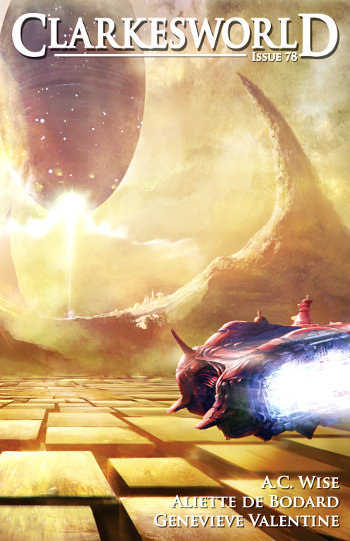
It’s Friday! And that means Short Fiction Friday over at SF Signal! This week I review the March issue of Clarkesworld magazine. Editor Neil Clarke had quite the coup this month, featuring three female authors who have had outstanding stories published over the last few months.
Interestingly the three stories have a slightly related theme and yet all three are very different.
Clarkesworld also includes a number of nonfiction articles each month. Wanna feel old? Check out the essay about the film Videodrome on the occasion of its 30th anniversary. Yikes! Debut author M.C. Planck discusses his novel The Kassa Gambit and how he has been influenced by genre-great Jack Vance. Fairy tales in their original dark and later sanitized versions are examined in light of what children in today’s world are exposed to by the entertainment industry. And editor Neil Clarke shares an exciting announcement.
The best thing about today’s Short Fiction Friday? All the content is available free online.
Week eight (of thirteen) in the episodic release of the novel The Human Division puts paid to John Scalzi’s assertion after last week’s dog-sitting episode that “things get rather more serious again next week”. There are no cute fluffy puppies here.
Heather Lee is a Lieutenant on the CDF ship Tubingen. After quelling a small rebellion on the Colonial Union colony on Zhong Guo she and her compatriots are given shore leave. The last thing she recalls is stumbling out of a bar, lightly intoxicated. Awakened with a slap she finds herself blindfolded, naked and tied to a chair.
Not exactly a good way to end shore leave.
For those not wishing to be spoiled I bid you adieu until next week’s episode, “The Observers”.
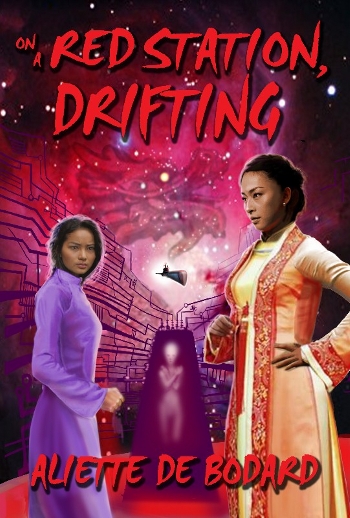
For generations Prosper Station has thrived under the guidance of its Honoured Ancestress: born of a human womb, the station’s artificial intelligence has offered guidance and protection to its human relatives.
But war has come to the Dai Viet Empire. Prosper’s brightest minds have been called away to defend the Emperor; and a flood of disorientated refugees strain the station’s resources. As deprivations cause the station’s ordinary life to unravel, uncovering old grudges and tearing apart the decimated family, Station Mistress Quyen and the Honoured Ancestress struggle to keep their relatives united and safe. What Quyen does not know is that the Honoured Ancestress herself is faltering, her mind eaten away by a disease that seems to have no cure; and that the future of the station itself might hang in the balance…
I don’t often post a book’s copy as the means of beginning a review but in the case of “On a Red Station, Drifting” I believe the quote sets the stage far more succinctly than I ever could, for Aliette de Bodard’s novella is one that invites incoherent fannish babbling while at the same time inspiring one to write a review worthy of her story. I will make a valiant attempt, and I will fail, but in the effort I hope to convey some of what I took away from this unique work of fiction.
“Night creeps over the forest and the frogs begin their mating calls in earnest. The croaking rises to a din, and the kids pause and listen. The glorious stars emerge, and I’m not sure if it’s my imagination, but the frogs seem to plead to them, over and over again, “Save us, save us, save us!”
In Matthew Kressel’s “The Sounds of Old Earth” we are introduced to Abner, one of the remaining holdouts on a decayed and dying Earth. Abner lives in a small wooded area behind a protective screen of his devising in an ancestral home listening to the frogs croak on the nearby pond, reliving memories from when Earth was a vibrant place. Most of Earth’s inhabitants have been transferred to New Earth, while some of the less fortunate live on corporate-owned orbital platforms. Abner wants nothing to do with New Earth and aches as he sees his children and grandchildren so easily abandon the home of mankind. Matthew Kressel’s short story visits the small tragedies and triumphs that make up a life and in the process presents a touching narrative on what it is that makes a home.
If you haven’t taken the time to do so, please read “The Sounds of Old Earth“, and then come along after the jump for a more detailed discussion of the story.