“If cultural imperialism is what it takes to make the world a better place, then we’ll happily arrange the world’s information to ennoble the human race.”
In “The Perfect Match” author Ken Liu serves up a story of paranoia and control, crafting a tale that takes the age-old idea of our creations rising up and ruling us and making it more plausible by predicting a not too distant future when social media and online information consumption can be used not only to track our tastes and make recommendations but also to suggest beforehand what we might like and think we need.
Liu’s is a slightly different take on “Big Brother” stories and if you enjoy the thrill of people fighting back against control as happens in films like Gattaca, Minority Report, Equilibrium and a whole host of other books and films then I have no doubt you’ll enjoy this story.
“The Perfect Match” is featured in the December 2012 issue of Lightspeed. Click on the link above and give it a quick read and then come back for a spoiler-filled discussion.
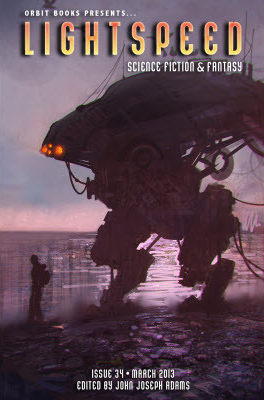
A really nice cover by artist Matt Tkocz is the highlight of a disappointing issue from Lightspeed, which I review for Short Fiction Friday over at SF Signal.
This is the first issue of the magazine that I’ve struggled with since I began reading it late last year. There were a couple of stories that I rated highly because they are structurally sound and well-told, but the subject matter was not something I connected with. However the majority of the stories, particularly the science fiction offerings, were either disappointing in their execution or were painful to drag myself through.
If you are interested in my struggles to be objective in the midst of my own personal pain, please join me for this week’s Short Fiction Friday review.
Episode nine of The Human Division returns readers to the crew of the Clarke, in particular everyone’s favorite lieutenant, Harry Wilson, and the chief diplomat Ambassador Ode Abumwe. Only four more episodes remain and it is beginning to feel like there is a lot of story left to be told, leaving me curious as to how John Scalzi will use these remaining episodes to tie previous events together while bringing us the climactic reveal.
For the second time the crew of the Clarke is treated to visitors from Earth, this time to allow Earth’s representatives to witness a negotiation between the Colonial Union and the alien race known as the Burfinor. The purpose of the observation is to demonstrate transparency in the dealings between the CU and Earth.
Nothing ever comes simple for the crew of the Clarke and once again Harry Wilson will be called upon to perform duties outside of his purview in order to keep everything from coming apart…if he can.
In the morning, you’re no longer quite sure who you are.
This is the story of the intersection of the lives of two women on a space station named Longevity. In the far distant future the dominant culture is Galactic, represented as the more ‘civilized’ world-view. Longevity is an independent station of Asian influence that acts as a tourist spot throughout the Galaxy. Quy is a young Asian woman who is called in on her day off to return to the family restaurant to help her uncle negotiate a business deal with an important Galactic visitor. Agnes is the wife of this businessman and it is apparent from the very beginning of her story that something is desperately wrong. In Bodard’s future people make use of an Immerser, a piece of Galactic tech with various intensity settings that allows the user to overlay an Avatar while also instructing the user how to act and react while feeding the brain cultural signifiers. Quy and her sister are not fond of the immerser and the way in which it homogenizes interactions and reduces culture to something simplistic for tourists to navigate. Anges appears to have become increasingly dependent on her immerser for her day-to-day existence and she is only dimly aware that something is being lost, perhaps irreparably. As “Immersion” unfolds the reader is presented with a very intimate story that carries within it a larger context of cultural identity and an examination of the effects of colonization. Aliette de Bodard’s story places the reader into a fully-realized world that seems both exotic and familiar. Without resorting to judgment “Immersion” makes a case for embracing and maintaining cultural identity in the face of ever-growing globalization.
What follows is a more detailed and spoiler-filled discussion of the story. “Immersion” is not an overly long short story and is well worth reading. Please click over here and take a few minutes to enjoy Aliette de Bodard’s story and then come back and take the jump.
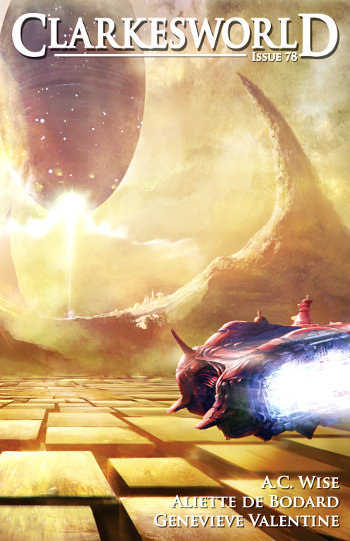
It’s Friday! And that means Short Fiction Friday over at SF Signal! This week I review the March issue of Clarkesworld magazine. Editor Neil Clarke had quite the coup this month, featuring three female authors who have had outstanding stories published over the last few months.
Interestingly the three stories have a slightly related theme and yet all three are very different.
Clarkesworld also includes a number of nonfiction articles each month. Wanna feel old? Check out the essay about the film Videodrome on the occasion of its 30th anniversary. Yikes! Debut author M.C. Planck discusses his novel The Kassa Gambit and how he has been influenced by genre-great Jack Vance. Fairy tales in their original dark and later sanitized versions are examined in light of what children in today’s world are exposed to by the entertainment industry. And editor Neil Clarke shares an exciting announcement.
The best thing about today’s Short Fiction Friday? All the content is available free online.