For years now the name Philip K. Dick has been synonymous with films about the future, laced with paranoia about government control and Big Brother watching our every move (The Minority Report, Bladerunner, Total Recall, Imposter). His latest work adapted to film, A Scanner Darkly, while containing many of the same central themes, is actually quite different than the other film adaptations I have seen.
The story is based on the book of the same name and has something of an autobiographical nature to it. A Scanner Darkly is the story of Bob Arctor who, unbenownst to his household of substance abusers, is an undercover police agent named Agent Fred who is attempting to discover the source of a highly addictive drug called Substance D. As Arctor becomes addicted to Substance D himself the left and right hemispheres of his brain begin to function independently. This causes Arctor to lose the ability to distinguish between his job and his drug-using life to the point that he actually begins investigating himself (a plot point that I didn’t entirely comprehend during the film). The control and paranoia aspects of Dick’s work is manifested in the technology that allows everyone to be monitored at all times and provides special body suits that agents wear protecting their identity not only from the general public but from fellow officers as well.
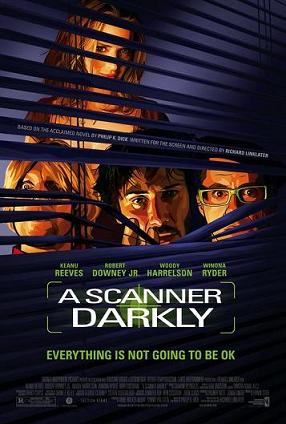
A Scanner Darkly is a film by Richard Linklater using the animation method rotoscoping in which the actors are filmed and the animation is done overtop of the film, a method he used in his film Waking Life and more recently seen in a series of insurance commercials on television. While I initially thought it might be distracting I found that I really enjoyed the rotoscoped look. It gave the film an odd presence that enhanced the mood and tone of the film. It was very well done with the actors looking very recognizable. I really liked some of the things they did with the background images, at times animating in a very sparse way and doing things to give the film a three dimensional look.
The film itself was very different. It does not have the blockbuster appeal that most of Philip K. Dick’s other adaptations have had but that is not to say that it isn’t good. What A Scanner Darkly is, is a film that is certainly not for everyone. The actors (Keanu Reeves, Winona Ryder, Woody Harrelson, Robert Downey, Jr., Rory Cochrane) all did a fantastic job in their various roles…drug users of course not being a big stretch for Harrelson and Downey, Jr. Rory Cochrane was actually outstanding and very funny. The story held my attention throughout and there were several surprisingly laugh-out-loud-funny moments in addition to some interesting plot twists that I didn’t expect. Where the story becomes autobiographical is that some of it is based on a period in Philip K. Dick’s life in which, after his wife left him, he spent a majority of the time between 1970 and 1972 living communally with a group of drug-addicted teenagers in his home and becoming addicted to amphetamines himself. What A Scanner Darkly ultimately becomes, in my opinion, is a rather poignant commentary on substance abuse and the ineffectual methods of law enforcement to deal with the drug epidemic.
In that it succeeds. The end scene and the quote in the credits following left me feeling the sadness of one of the film’s messages. While it was quite fun to laugh at the increasing paranoia and bizarre behavior of many of Bob Arctor’s “friends”, the reality of parts of the story penetrated the film barrier and really made me think about peope that I see all around me every day.
I enjoyed A Scanner Darkly but saying that I won’t recommend it as a must-see in the theatre. I predict that the majority of people who see the film will come away with a “that was really stupid” view of the end product. Maybe I’m wrong. It helps that I went with Jeff and John to a free screening of the film. Not paying for a movie affords one the luxury of actually being somewhat entertained regardless of the quality of the film. My feelings a day later is that the film is well done. I wish more time would’ve been spent exploring what was happening to Arctor/Agent Fred as Substance D was affecting his reality but I don’t think that is the aspect of the story the film makers wanted to focus on. Instead of focusing on the more ‘science fiction’ elements of Dick’s story they chose to focus on the more factual elements and made a film that has a message and makes you think without beating you over the head or being preachy. The book and the film were dedicated to “some people who were punished entirely too much for what they didâ€Â, a sentiment that the film actually conveys quite well.
It was a fun experience and drives home the fact that I really need to go back and read many of the Phillip K. Dick stories that have been turned into films that I enjoy.