The New York Trilogy ~Paul Auster
–published 2006 (this edition)
–308 pages, Penguin Classics
–4/5 stars
“In the good mystery there is nothing wasted, no sentence, no word that is not significant. And even if it is not significant, it has the potential to be so–which amounts to the same thing. The world of the book comes to life, seething with possibilities, with secrets and contradictions. Since everything seen or said, even the slightest, most trivial thing, can bear a connection to the outcome of a story, nothing must be overlooked.” (City of Glass)
Having recently discovered Paul Auster via Travels in the Scriptorium, and recalling that I actually had purchased a copy of The New York Trilogy earlier in the year based on end-of-the-year reviews, it was easy to choose which book to move to the top of my reading pile. The New York Trilogy has an interesting premise–three novellas of a mysterious nature set in and around the city of New York that somehow overlap and tie in to one another. Knowing what Auster was capable of because of Travels, I knew it would be far less simple than this–and I was correct. There is more going on in each of these three brief stories than one can deduce in a first reading.
It does not take more than a brief foray into the works of Paul Auster to realize that he is a brilliant writer. In The New York Trilogy he manages to tell a story that is both accessible to the casual reader and tantalizing to the literary critic. I don’t aspire to sit on that particular throne. I am in no way denigrating myself or insulting my own intelligence when I admit that what I know about the forms and structures and deeper meanings of literature is a mere shadow of what someone schooled in this particular discipline knows. And I am perfectly okay with that. I feel happy to be an intelligent reader who can glean insight into and make deep connections with literature and yet am not dissecting it to its core. I would not want to have that kind of critical eye. I want to be able to read for the sheer enjoyment of the story.
I say all this to admit that I do not understand all of what is going on in a Paul Auster story. I can read the introduction to this edition of The New York Trilogy or read about Mr. Auster on various literary sites and be content to acknowledge that I do not fully comprehend his work the way these scholars do.
But I am here to tell you that it does not matter. Paul Auster tells a good story. Before I continue let me give you a brief overview of each of the tales that comprise this trilogy:
City of Glass– This opening story tells of one Quinn, a lonely writer, who pens detective novels under the name of William Wilson. An apparent wrong number one evening finds the caller asking for the services of detective Paul Auster. As days pass Quinn regrets letting the caller go and when another call goes through Quinn decides to assume the role of Paul Auster, detective, and take the case. His job is to protect a young man by the name of Peter Stillman from the assumed vengeance of his father, also Peter Stillman, who is soon to be released from prison. Stillman Sr. allegedly locked his young son away in a dark room without any stimulus in an attempt to recreate the language of creation which he believes can be achieved via this experiment. Quinn proceeds to devote his entire self to following Peter Stillman, sr., along the way discovering the papers and theories of Stillman (themselves an intriguing story-within-a-story). The more Quinn devotes himself to the role of detective Paul Auster, the more he begins to lose touch with himself…
Ghosts– This is the shortest of the three stories. In Ghosts a detective named Blue is hired by a mysterious figure named White to follow a man named Black. He takes an apartment directly across the street from Black and is instructed to follow his every move and to submit a weekly report. His pay will continue to arrive via mail so long as the reports continue to arrive. What sounds like an easy assignment becomes an exercise in sanity as Black rarely leaves his apartment and spends most of his time either reading Thoreau’s Walden or writing something–what, Blue does not know. As time wears on Blue begins to wonder if perhaps he is being followed as well and so he begins acting in such a way to test his theory…
The Locked Room– In the final story of the trilogy a writer gets an unexpected call from the wife of a man he grew up with, Fanshawe, who used to be his very best friend. It seems Fanshawe has disappeared. Upon further investigation it is discovered that Fanshawe wrote several novels and poems that he never allowed to be published but has instructed that in the event of his death, the narrator is to be given full reign to produce his works. This writer, who has been unsuccessful in his own attempts at fiction, discovers that Fanshawe’s works are masterpieces. He also finds that Fanshawe’s wife and newly born child are just the family he is looking for. What follows is the story of a man who takes on the work of a friend he no longer knows and in the course of this work begins taking on the man’s life as well. But is Fanshawe really dead? And if not why did he leave in the first place?
Each of the three stories is interesting in and of themselves and each of the three stories certainly follow some of the patterns of a typical detective novel, however they are anything but. These are stories of obsession and the unraveling of man. They are stories about how we observe the world around us and how words effect us and mold us and shape us. These are stories about how the choices we make can lead us down a road of ruin, even when one sees it coming. These are by no means happy stories, but they are not complete tragedies either. Instead they are multifaceted and interesting voyeuristic looks into the mind of man…especially men who write. In Auster’s stories one realizes that the narrator is an ever-present character, practically reading the story over one’s shoulder. These stories smolder with suspense and you cannot help but go from one to the other in the hopes of solving the overall mystery–what is this book about?
I do not often read what I would consider “challenging” books. And I am not sure I would consider Paul Auster’s books “challenging” in a way that means that any ol’ reader cannot pick them up and enjoy them. I do not believe that. First and foremost I enjoyed these stories just for the stories themselves. I was sucked in to the lives of the three characters presented in these novels and did not want to put the book down. It is unconventional to be sure, but like Travels, I found it an immensely satisfying book. In some ways books like these are all about timing. I think you have to be in the mood for a book like this and if you are it just flows so very well.
As with Travels in the Scriptorium, there are so many references and layers in these stories that they feel like they have so much depth, even if you the reader are not exploring each aspect of that depth. In The New York Trilogy there are references to Poe, Hawthorne, Thoreau, Melville…in City of Glass there is a fascinating section on Cervantes and Don Quixote. Books and writing and the act of writing play a big role in these stories.
“Quinn did all his writing with a pen, using a typewriter only for final drafts, and he was always on the lookout for good spiral notebooks. Now that he had embarked on the Stillman case, he felt that a new notebook was in order…He looked through the pile, trying to decide which one to pick. For reasons that were never made clear to him, he suddenly felt an irresistible urge for a particular red notebook at the bottom. He pulled it out and examined it, gingerly fanning the pages with his thumb. He was at a loss to explain to himself why he found it so appealing. It was a standard eight-and-a-half-by-eleven notebook with one hundred pages. But something about it seemed to call out to him–as if its unique destiny in the world was to hold the words that came from his pen. Almost embarrassed by the intensity of his feelings, Quinn tucked the red notebook under his arm, walked over to the cash register, and bought it.” (City of Glass)
Another interesting aspect of these tales is the act of observation and the irony of the fact that each character’s devotion to observing certain people inversely affects their ability to observe what is truly going on around them.
I found these stories intriguing and fascinating to read. They are the kind of stories that I want to put down and then go find someone else who has read them to discuss the various endings of the three stories and theories/ideas behind just what was going on.
If these thoughts in any way sound appealing to you I recommend picking up The New York Trilogy. In addition to all the things I have mentioned the book also acts as a sort of travelogue/love story to the city itself as we the reader follow these characters on long walking tours of New York City.
I look forward to further explorations of the work of Paul Auster in the future.
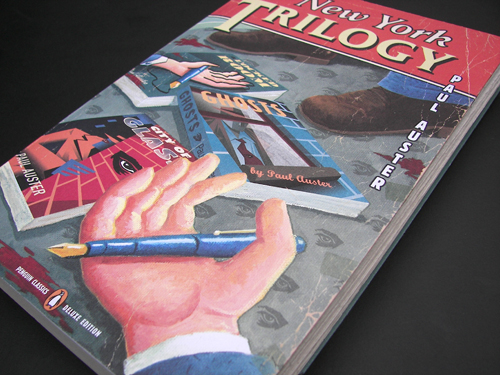
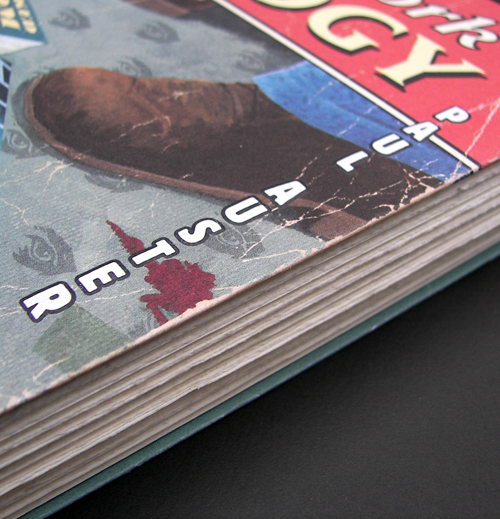
One final note, this edition of the book is a thing of beauty. The Art Spiegelman cover is wonderful and the book itself is well put together. I am a fan of books with the serrated edges…these Penguin Deluxe Classics are all very enticing and I had actually seen this book before and wanted to pick it up just for the cover. I am glad that I finally did.
_________________________
 My third book in Annie’s What’s In a Name Challenge. This one if for the “A book with a place in its title” category.
Oh, I loved this book too, Carl. It was all so mysterious and intriguing, and utterly engrossing, even if I didn’t always understand it all. The multiple layers of stories within stories that bent backwards onto each other was fascinating and mind-bending!! I really need to make a point of reading more Paul Auster.
“I feel happy to be an intelligent reader who can glean insight into and make deep connections with literature and yet am not dissecting it to its core. I would not want to have that kind of critical eye. I want to be able to read for the sheer enjoyment of the story.”
Amen, brother!
I love books that operate on multiple levels – they’re the ones that become like old friends or favorite places, you turn to them over and over again and find something new each time.
Great review, another one for the list…
Paul Auster is an author whose name is very familiar to me, as to most people, and yet for some reason I’d always assumed I wouldn’t really enjoy his stuff. Don’t ask me why, it was just one of those irrational assumptions we make sometimes. But now you’ve made me reconsider. My library has quite a few of his books…I suspect I will be bringing one home with me sooner rather than later.
You’ve made it impossible to resist. Impossible.
No Debi, don’t do it! You’ll have to give me another point!!! 😉
Nymeth: I certainly think if I’d have read a review of his books rather than just picking one up on a whim I might have felt the same way. I really enjoyed both of these books and at the same time wouldn’t want to read this type of thing exclusively.
Ken: I too love multi-level, multi-faceted books…or at least ones that I personally can see multiple meanings in. If there are layers of story present it does tend to make it a memorable reading experience.
CdnReader: Mind-bending is a great description! Glad you enjoyed this one as well.
Would you like to try Auster’s “Invention of Solitude” next? It’s another one that gives a good kick to the chest – and proves YET AGAIN that THE MAN CAN WRITE.
It’s more autobiographical, but the stories he tells are amazing.
Hmmm. I’m not sure if this one sounds like it’s up my alley but I’m glad you liked it. I do love the cover and the page edges. I can defiently see why you picked it up. I just feel overwhelmed with whatever I already have on my TBR pile right now plus what I know I’ve already ordered and/or know is coming out this year to even imagine adding another book to the pile. You saw how I was at the Lazus sale the other day. I’m gun shy to add anymore to the pile even when it’s almost being given away. 🙂 Too much stress this year is cutting into my reading focus as well. Work, money, family health, etc. It’s all I can do to just focus on my comics right now in order to make me feel I’m getting some reading accomplished. On a good reading note I started reading ” The Hobbit ” out loud to the kids tonight. Now that was a lot of fun. This is my first reading of it since the 7th grade. I remember trying to listen to it last year on audio and not etting into it but reading it aloud tonight to the kids just made the story come alive. It was so fun and the kids seemed to enjoy it as much as I did. 🙂
Jeff: That sounds fun, I am glad they are enjoying it. Tori wants me to read that one to her sometime.
I certainly know how you feel about being overwhelmed, it is all getting to be a bit much!
Dark O: I’ll keep that one in mind. I am sure to read more Auster in the future.
Sounds like you’ve a new author to enjoy 🙂
I really enjoyed the mind-bending challenge of these novellas too — so much so that I taught it in a high school English class on noir fiction. It was the piece the students argued the most about — each passionate about their own interpretation. I think too, they were secretly pleased to have been trusted with a challenging novel.
You teach some of the coolest classes, Midori! If I lived closer you would tempt me to go back to school!
I loved this when I read it too. I’m like you, I don’t necessarily get all the layers but enjoyed the stories for themselves. Haruki Murakami’s style reminds me of Paul Auster and vice versa. Did you know that City of Glass has been also done as a graphic novel?
http://www.amazon.com/City-Glass-Graphic-Paul-Auster/dp/0312423608
I liked your whole review, but especially your comments about being in the right mood for this kind of read, and wanting to discuss the book with someone else. I don’t know that I could ever write this kind of book, but I like discovering it. When I finish reading, I immediately go and look up reviews to see what other people thought.
Peter Straub books are often that way for me. I like talking to people who have read Shadowland. I don’t want to know if they liked it or hated it. I want to know what they thought about it. Almost how they decoded it. I’m definitely going to pick this up.
J Scott: “Decoded” is a fantastic word for books like this one as it is definitely a book that can be enjoyed on one level and yet begs for decoding, especially as each story reaches its end. There is an unraveling that happens with the characters at the end of each of the three stories that in turns gives the story a feeling of coming unraveled and that is where I see a large part of the meat of the story, the behind the scenes stuff, taking place, much of which I am not ashamed to admit does not immediately become obvious to me.
–> I say all this to admit that I do not understand all of what is going on in a Paul Auster story.
I definitely agree with that statement of yours. Paul Auster is a favorite but I need to be in a right frame of mind to read him, not in those few minutes of free time just before sleep. It’s not everyday also that I get to read a review about Auster in blogs. This is a wonderfully review; I’m pretty sure you’d enjoy reading his other books.
I’m SO glad you enjoyed this one as much as I did. It’s brilliant and wonderful, and the edition is simply stunning. Now read one of his memoirs…maybe Hand to Mouth. Great stories from this personal life and writing experiences.
Thanks Andi, I’ll check that one out, sounds fascinating just knowing what the subject matter is about.
Thanks you Lightheaded, I completely agree that this is not an author to catch a few pages at a time. I have really enjoyed both of my experiences with his work now and look forward to reading more in the future.