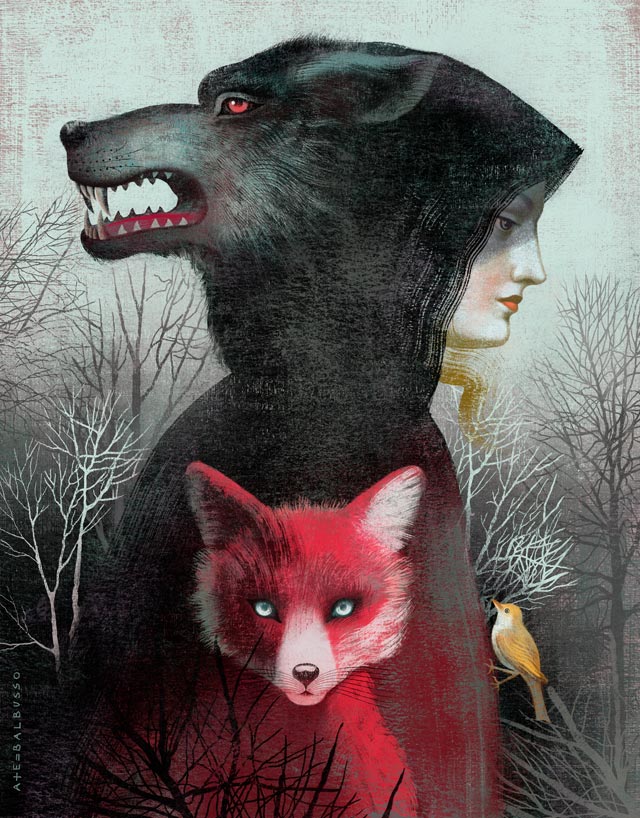
Earlier this week Tor.com released a short story by Shadow and Bone author Leigh Bardugo as a companion piece to the second novel in her series, Siege and Storm, that was released on the same day.
What struck me first on navigating to the Tor.com website was the piece commissioned to accompany this story. If you know me at all you then you know that I find the cover illustration to be a significant factor in the reading experience. This image is striking in its use of specifically-placed color and its overall design. My immediate thought was “I want to read this story”. Never mind that I had not read the author’s work before.
(Illustration by Anna and Elena Balbusso, click to enlarge)
I knew immediately that this was what I would be reading on my lunch break; and I did just that–and enjoyed it immensely. My first experience with Leigh Bardugo will not be my last. For those of you who are already fans of her work, you can relate. I know I said that I would not be returning to the posts where I pick and discuss in detail a short story until next Sunday after Ken Liu’s award-nominated story “Mono no aware” became available (June 11th on the Lightspeed website), however, this story captivated me and there was no way I was going to pass up sharing it with you. That night I went home and read the story aloud to Mary and she enjoyed it every bit as much as I did.
“Too-Clever Fox” is written in style of folk story that is at once comforting in its familiarity. Author Leigh Bardugo builds upon that familiarity as she unveils the story of a sly, clever, endearing fox and the ways in which his wits sometimes get him out of trouble, as well as into it. Leigh Bardugo demonstrates her own cleverness with the way in which she can turn a phrase. The story is well worth your time and it would be great if you would follow this link to give it a read and then return for a spoiler-filled discussion after the break.
Disclaimer: I am no expert on the symbolism nor the deeper meanings present in fairy or folk tales. I am certain there are layers that I am missing in Bardugo’s story and would be happy to hear the opinions of others on what those might be. The opinions I share on “The Too-Clever Fox” are just that, opinions, and are meant to reflect what I took out of my readings of the story. I am happy to entertain your opinions even if they disagree with mine, so don’t be shy in sharing them.
What struck me immediately was the way in which Leigh Bardugo establishes who her character is from the opening sentence. Not only does she use the opening of the story to demonstrate just how clever our protagonist is, but that first sentence reveals to the reader that this was the first trap he escaped from, a statement that indicates that there will be additional traps to follow.
The second thing that demanded my attention was Bardugo’s voice, the way in which she crafted this story so that it had that rhythmic flow of a good folk tale. Her use of repeating phrases, like “a lesser creature…” gives it a memorable quality, a pattern that makes it feel as if it were a story passed down from person to person, as all good folk stories are.
Koja is born clever, with an ability to see beyond the surface and marshal his thoughts into the words that can manipulate a situation to his advantage. That ability could quickly make Koja an unsympathetic character, so I was impressed at how early we see Koja get into real trouble in his inability to discern and avoid the animal trap on Tupolev’s farm.
Of course he ends up using his ability to get free of this trap, but not without a significant sacrifice. Koja’s cleverness does not preclude him from experiencing pain nor does it provide a life devoid of consequences. To escape from Ivan Gostov [isn’t that a great name for a bear?], Koja bargains with the fleas for help and then must run with the trap attached all the way back to his home.
There is no magical healing. Koja must endure not only the pain of a damaged leg as it slowly heals, but must also endure the discomfort of a family of fleas for an entire year. In this we see that Koja is also a fox who keeps his word. If he makes a commitment he honors that commitment regardless of the cost to himself.
This part of Koja’s experiences also has what may be my favorite line in Bardugo’s tale:
Koja was untroubled. “I can bear ugliness,” he said. “I find the one thing I cannot live with is death.”
Which brings up another example of the point I am trying to make, which is that Leigh Bardugo has written a very balanced character. Certainly, he is born clever. But he is also born ugly. He is small, has a ragged coat, and is yellow of eye. These are not things that we see change overmuch throughout the story.
It would have been easy, and perhaps expected, to establish Ivan Gostov as Koja’s nemesis, setting up a scenario in which Koja would repeatedly have to best the beast. I am so happy that Leigh Bardugo instead gives Koja a good friend in Ivan Gostov. Koja knows it was not Ivan Gostov that caused him to step into the trap, and so he enacts his revenge on the appropriate party by leaving the fleas in the bed of Mr. and Mrs. Tupelov and then steals food and drink from their home to make his peace with Ivan Gostov.
One could argue that this was simply the fox being clever once again, manipulating Ivan Gostov to the fox’s ends. While there is truth in that I also think Koja truly wants friendship and he finds that in Ivan Gostov.
Of course any story entitled “too-clever” tells the reader that Koja’s cleverness is going to lead him into overconfidence and eventually trouble. When winter comes and Koja’s friend goes missing, along with many other animals in the surrounding woods, the reader has the foreboding sense that this is where Koja’s strength may be his undoing. Koja’s bravery and concern for his fellow forest-dwellers is on display as it is revealed that the infamous hunter, Lev Jurek, is in the area. Koja’s friend and his family both appear to have been lost to this hunter, facts that Koja later confirms in his investigation.
Lev Jurek and his sister, Sofiya, are a formidable mystery. While Jurek appears to be the enemy, astute readers will immediately sense that there is something discomforting in the mystery that is Sofiya. Readers of fairy and folk tales are often meant to get something out of the experience, some life lesson, and as such the reader often can see things the characters in the tale cannot. Leigh Bardugo does a masterful job of not entirely tipping her hand as she establishes the mystery surrounding the relationship between Sofiya and Jurek. When Koja decides that Sofiya is the key, although it has not been made clear, the reader wants to warn Koja to be careful. As these meetings with Sofiya continue and she begins to bring food into the picture, all of the reader’s senses are on high alert, knowing Koja’s increasing trust is a mistake, knowing that his cleverness has lead to a degree of pride and that pride comes before a fall.
And by that time Leigh Bardugo has built Koja into a character that you care about. No one is looking for the fox to get his comeuppance. Like most of the other animals in the forest the reader is looking to Koja as the solution to this problem and yet it appears that he is being lulled into a sense of trust with a character that we are unsure about. Even then it is a surprise to the reader, as well as Koja, when he awakes to Sofiya’s knife.
Throughout “The Too-Clever Fox” Leigh Bardugo makes good choices, leading the story to the place where it could honestly go either way. Koja could live or Koja could die and the story would have impact. I am so happy she made the choice to have Koja survive, and am even more pleased that it was friendship that saved his life in the form of the bird, Lula.
Looking back over the story we see how Bardugo establishes the character of Lula. This is no deus ex machina rescue that Koja undergoes. Instead we see that Lula and Koja have had a relationship throughout the story. Bardugo also establishes Lula as a wise and involved character who looks out for the creatures of the forest. It is Lula that is sent to search and discover the source of the animals’ disappearance. It is Lula who confronts Koja on his behavior with Sofiya. It makes perfect sense that Lula would be keeping an eye on the proceedings and thus it is not at all out of character for Lula to be on the scene as Koja is about to die and thus becomes the instrument of his salvation and the ultimate protector of the creatures in the forest. As Bardugo tells us, Lula was not only clever herself, she was also wise.
Thus we end the story as we began it, with Kojo in a trap that he ultimately escapes from, but this time because of the intervention of someone who cared about it and not because he was able to use his cleverness to outsmart his opponent. The folk tale lessons are there if we want them, lessons about relying too heavily on one’s own strengths, lessons about listening to the feedback of others and lessons about how pride can cloud one’s judgment. What is also present is one highly entertaining story. Leigh Bardugo has created characters that endear themselves to the reader, she has used a familiar style of storytelling to ground the reader in the world she has created, and she builds tension and mystery by revealing portions of the story to the reader before the protagonist recognizes them while at the same time keeping the reader guessing.
Most impressive.
I want to take a moment to return to the art by Anna and Elena Balbusso. The Italian twin sisters have won numerous accolades for their work, including three consecutive Gold Awards in the book category from the Society of Illustrators. If you take a look at their portfolio you can see that the two use a combination of color and design to create images that in themselves tell a story.
In their work for “The Too-Clever Fox”, you can see how they emphasize the two colors that are prominently mentioned throughout Leigh Bardugo’s tale: red and yellow. While they forgo a direct interpretation of Koja–we don’t see a patchy coat or yellow eyes–they work the color yellow into Sofiya’s hair and Lula’s feathers. The red of Koja’s coat is repeated in the eye and tongue of the wolf and in Sofiya’s lips in a way that balances the image, a triangle of red. And we see that balance, an element of good design, throughout the illustration. The leafless winter trees, representative of the time period in the story where the climax occurs, allow the more bold colors to stand out.
I think the way in which they interpret Sofiya’s coat is also brilliant as it not only is accurate to the story but gives a reverse of the “wolf in sheep’s clothing” that is unsettling and foreboding. The image doesn’t immediately reveal that Sofiya is the wicked character in the tale, after all she looks somewhat sad, and yet it plays with that idea all the same. I think you can see why the image drew me to reading the story in the first place.
Art and story can be married to great effect, the fact that this does not always occur makes me sad. I appreciate the fact that even with these free short stories, the art team at Tor.com–and here I tip my hat to Irene Gallo– understands that great illustration can enhance the storytelling experience for the reader.
Kudos to Leigh Bardugo for crafting a story that showcases her talent and makes me want to read more of her work, and kudos to Anna and Elena Balbusso for creating an illustration to accompany this story that draws the reader in and reflects what the author wrote.
Be sure to head over to Lightspeed on Tuesday, June 11th to avail yourself of the free version of Ken Liu’s story “Mono no aware” and come back next Sunday to discuss it.
In the meantime, don’t miss out on this wonderful story by Leigh Bardugo.
You say this is the first you’ve read from Leigh Bardugo? I’m guessing, then, that you haven’t read Shadow and Bone (the start of the series)? Shadow and Bone is amazing. I just reread it and then read Siege and Storm, and both are brilliant (though I do like the first book better). They are fast reads, but very layered, and very complex. I’m off to read The Too Clever Fox, which is referenced in the second book! 😀
That is correct. Love the covers but haven’t picked them up…yet. I can tell you that I really want to now. Hope you’ll come back and share your thoughts on the short story.
I did end up really enjoying the story. I was surprised by the end – not the part with Sofiya (that was just as I expected) but the part where Koja actually lives through the ordeal. I expected him to die at the end, rather than living with the injuries given. I especially expected it because of the way the story is mentioned, briefly, in Siege and Storm. (Dont’ worry, this is not a spoiler for the book!) The narrator briefly recalls the story, saying it’s one about a fox who is clever enough to escape one trap, but not clever enough to know he is getting into another. From that description, I expected Koja to eventually be undone in this story. I’m glad he wasn’t – I preferred the ending this way – and honestly I hope it is a good omen for the books themselves! I can definitely see how this story mirrors, in some ways, the books. I won’t say more about that, though. 😀
I wonder if she had already written this story when she put the reference in the book, if it was just something kicking around in her head, or if the inspiration hit when she wrote that line. Interesting to think about.
I prefer this ending too, but wouldn’t have been surprised had it went the other direction.
So as my go-to-expert, given that you are the first one to post on this that has read her work, is this story pretty indicative of the way she writes?
Nice review Carl. As usual. I haven’t read this author either. Is there any indication of meaning in the name Koja? Is it intended to be the animal’s (or foxes in general) name for himself or his species?
Yes there is (SPOILER):
It means “handsome” and is given to him as a joke.
This sounds like a great series! Love. The. Cover!
I need to check it out, apparently, as this was a great sampling of what she can do.
I just bought this. 🙂 I read Shadow and Bone last year and really liked it. I am waiting for the sequel to slowly makes its way to me in the mail… While getting this I also found The Witch of Duva. It is another companion story.
Thanks, I will be checking that out. Here is the link for those who want to read it:
http://www.tor.com/stories/2012/06/the-witch-of-duva-a-ravkan-folk-tale
Another great Balbusso illustration to go with it too!
I had a FB conversation with Irene Gallo the other day, sharing my wishes for a print collection of these stories with accompanying full color illustrations. She said what I expected, which is that it would be too pricey of a venture. However a subsequent question revealed that *maybe* a digital version is not out of the question.
I’ve had this on my to-read list since I first learned she was coming out with a new Ravkan tale. I haven’t read The Witch of Duva, yet alone The Too-Clever Fox, but being a huge fan of her Grisha series, I definitely intend to read both… Though I think I’ll wait another few days for finals to end. Looking forward to reading this!
Yes, study hard for those finals, and best wishes to you. This story would be a great way to celebrate the ending! If you do read it soon I hope you’ll come back and share your thoughts. I’ll be reading The Witch of Duva soon myself and probably buying Bardugo’s novels this week.
Skipped the spoilers but just had to agree on the cover art. It’s beautiful!
Good, I hope you’ll check out the story then, the art really does it justice.
I too love this art work. I am glad you posted about this because I hadn’t heard about it prior. I need to check out tor.com more often that’s for sure. Such good content. The art work is beautiful. Which would also draw me to this book. Books to me are such a wonderful platform for art. I love covers!
I so agree with you about books and art. Yes, Tor.com is a wonderful resource for so many things. They really have upped the standard for what a SFF publisher’s website can do. And the quality of art and storytelling on their free shorts is incredible.