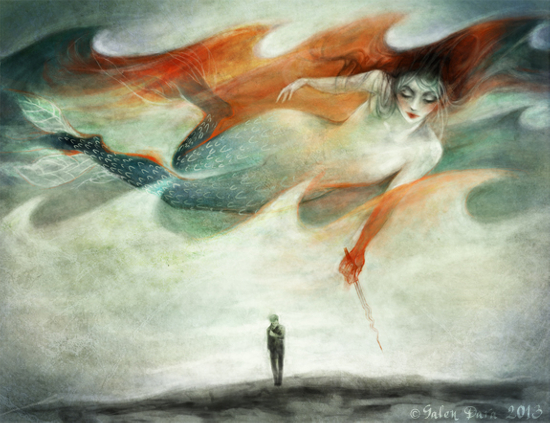
(Image created for this story by artist Galen Dara)
To call Genevieve Valentine’s “Abyssus Abyssum Invocat” a re-imagining or re-purposing of the Little Mermaid mythos would be to rob it of some of its tragic splendor, however, it must be mentioned as a bedrock upon which this story of obsession and longing is built. The appeal of sailor stories has always been this idea of the sea as siren, beckoning men to its seemingly endless waters. Valentine’s story takes the vastness of the sea and pares it down to something more intimate in its portrait of a mysterious but plain school teacher and the pull her presence exhibits on a young man named Matthew. “Abyssys Abyssum Invocat” is pleasing in its rhythms; in the way in which the words evoke the sounds of waves crashing on the rocks and the taste of sea salt on your tongue.
Like the story by Hans Christian Anderson there is a deeply melancholic aspect to Valentine’s story that draws upon deep emotion and reflects both the beauty and tragedy of life.
Genevieve Valentine’s short story “Abyssus Abyssum Invocat” was printed in the February 2013 issue of Lightspeed magazine and can be read online free. The following is a more in-depth discussion of the story that will contain spoilers.
Next Sunday’s story will be “The Cambist and Lord Iron: A Fairy Tale of Economics” by author Daniel Abraham. It is a really fun fantasy story with a very likeable protagonist, not the least of which because he is a voracious reader. I do hope you’ll take some time to read it this week so that you can join in the discussion.
In the meantime, lets talk about mermaids.
Hans Christian Andersen’s “The Little Mermaid” is, as you may suspect, a far cry from the image that title may conjure of a singing redhead and her chaperone, who happens to be a talking crab. There are surprisingly several similarities, though in Andersen’s tale the mermaid in question not only falls in love with the man she saves from drowning but also desires the gift of a human soul so that she may spend eternity in heaven, a destiny not fated to her kind. The soul will be rewarded upon the receipt of true love’s kiss but the mistaken identity is never cleared up and the prince ends up marrying the woman who he believed actually saved him. She is given the chance to return to her mermaid form but opts not to commit the murder that would be necessary to procure her this reprieve. Instead she is dashed into foam upon flinging herself into the sea. Hans Christian Andersen took an unfamiliar turn with this story in that after he had finished with the tragic end he added on to the story to give the little mermaid a convoluted “happy” ending, with the promise of an eternal soul as her reward.
Valentine’s story pays homage to Andersen with the opening stanzas for each section, telling a slightly altered version each time of a mermaid who makes a deal with a Sea Hag in exchange for the chance to walk among men. It is interesting in contemplating Hans Christian Andersen’s story that the little mermaid makes the classic ‘deal with the devil’ but with a twist, in essence selling her soul to obtain a soul. From the very start of Valentine’s story the tragedy is writ large as we see the pain the mermaid is willing to subject herself to, the price she is willing to pay to assuage the longing that she feels for something outside of what she already has–something she is not naturally fated to possess.
Not surprisingly we are soon introduced to the object of her–I’m not sure “affection” is the right word here–perhaps “obsession”? Matthew is a sixteen-year-old young man and it is clear that there is a draw he feels towards this woman that the story is quick to point out is quite plain. She is a mystery from the very beginning, appearing as if from out of nowhere, and the attention that she appears to give to Matthew ignites something within him so that she slowly becomes his obsession as well. I cannot pretend to be anything approaching a scholar when it comes to analyzing story. I am a happy amateur dabbling at trying to more closely examine stories that call out to me. As I look at Matthew’s story I see that there is probably a strong ‘coming of age’ thread woven throughout, an awareness of burgeoning sexuality that is hinted at by Matthew’s age, by the references to the season of “spring”, and by the thoughts of Matthew himself even if he is not fully aware of what is happening with him. We can all relate in one way or another to that draw of first love, those blossoming feelings of sexual attraction that occur in our adolescence and the way in which those heady chemicals and strong emotions draw us seemingly without any agency of our own towards the object of our affections.
The setting of Valentine’s story reflects that idea of longing and obsession so poignantly for anyone who has had the experience of reading stories and/or watching films in which the sea is portrayed as an almost sentient being, a mistress whose draw is more powerful to men (in these old tales) than is even any genuine bonds of love they have towards a woman on shore. As I read “Abyssus Abyssum Invocat” for the first time I could almost taste the salt on the air and could hear the waves breaking on the beach. I did not grow up anywhere near an ocean but have always enjoyed the water. There is something peaceful and relaxing and soothing about lakes and rivers and something so mysterious and powerful, scary yet seductive about the vastness of the world’s oceans. My younger self, that one that is still very much alive within me, can still feel that exciting pull towards adventure that a good ocean daydream can exert. Valentine’s school teacher embodies that siren nature of the sea in such a skillful way. Matthew feels that pull almost instantly and though she warns him early on:
“I don’t love you,” she said. “You mustn’t think that. You’ll go mad if you do.”
it is a foregone conclusion that by the time he is sitting in front of her to hear this speech the madness has already taken hold. He is a drowned man in all but name at that very moment. Oh the sweet agony of that first touch of madness.
I enjoy the story-within-a-story element of Valentine’s tale, the way in which the teacher captivates Matthew on so many levels, including with the stories that she leaves for him and him alone. Theirs is a tame courtship by today’s standards but given the time period in which Valentine sets the story the illicit nature of their interactions is tangible. It is innocent and so very dangerous at the same time.
I am no doubt giving the impression of viewing this story through a pair of sex-focused glasses and if I am I apologize for my clumsiness because that really is not what I am trying to convey. My use of the coming of age analogy is meant to focus on the idea of longing. At many times in a person’s life, but especially during the formative years of adolescence, there is profound sense of longing. Not merely sexual longing but a longing for freedom, for wanting to set one’s own course, for direction to know what that course might be. There is a tearing away of ones self from the bonds of childhood and the rudderless feeling of not knowing where one is headed, reaching out for something to anchor to. I see that in Matthew’s reaction to his teacher.
What I see in the teacher is another form of longing and of obsession. If she is the mermaid in question then the allusions to Andersen’s tale makes it clear that she is craving an existence beyond the confines of the one she has known. She is drawn to the land, drawn to this school house and then drawn to Matthew and she expresses her longing in subtle ways with the lingering attention that she gives and then more directly with the stories that she slips into his book. At the same time she seems to have an awareness that things cannot end well and she makes some token effort to warn Matthew off, or at least discourage him from the path that a more ardent affection will lead him down.
Genevieve Valentine paints a picture with her words that reminds me of connections I’ve made with the work of Catherynne Valente, Terri Windling and Angela Carter. Each of these women, in their own unique way, taps into the poetry of fairy tales and brings out their essence. I wish I had the skill to better describe why this writing has such an attractive quality, but I feel inadequate in knowing how to convey this other than to say that Valentine’s story, like so many of these other authors, riveted me to the page from the very beginning. Reading the opening lines was like hearing the haunting melody of that mythical siren song and before long I was lost to the rhythm of her words. Part of this has to do with my affection for stories that re-tell or re-examine fairy tales. Additionally, with this story, the fact that the deep and mysterious ocean is an ever-present character, just out of frame for much of the story but whose presence is always sensed, excites me. Lastly it is that all too common experience of obsession and longing that I think we all can relate to which permeates Valentine’s story. There is something simultaneously beautiful and tragic here.
Abyssus abyssum invocat, deep calls unto deep. I have heard the cry and am lost. Genevieve Valentine is one to watch.
Those are some of my initial impressions, what are yours?
In the words of Ron Weasley- bloody brilliant! I love this review I really do. I will definitely head over and read this now – was just awaiting your thoughts.
Thanks Carl.
Lynn 😀
Then you must come back and have a chat with me, let me know what you thought, where I missed it, what you saw, etc. I’m well aware of the eyes I am seeing this through and would love other opinions. Especially given the fact that I know this type of story is not one that clicks with everyone.
Wow. I loved it. I would never have probably read this as I tend to not pick up short stories but this was beautiful and actually brought tears to my eyes!
I love fairytales retold and this is really quite captivating. Valentine has a beautiful story telling voice and my only quibble was that it ended too soon.
I was gripped with the stories being told as she went along and which one was actually true and equally, I was intrigued with the whole Matthew ‘thing’. It’s almost a conundrum on both sides, why is this 16 year old boy interested in her and why is she interested in him? It’s so easy to read so much more into this and that’s what I really like about the story – it makes you think. It’s such a small story and yet has an impact and I think that’s impressive.
Spookily, whilst reading your review and all the talk about waves and sea air I was actually picturing Cornwall – I’ve been to Cornwall on holiday so many times that literally I know my way around the place like a second home. I love it there with the rugged coast – it’s a beautiful place with quaint villages and tiny coves and it’s easy to see why so many people – not just authors have taken inspiration from it. Daphne DuMaurier being an obvious author that springs immediately to mind.
I really enjoyed that and will go back and reread it again – more slowly, savour it a little.
Thanks
Lynn 😀
So happy that you took the time and that you enjoyed it. I really only touched on one of MANY aspects to this story and could have written three times as much exploring other things.
It is very exciting to me that you have actual places you can picture that you’ve visited. I have to admit that I pictured England when reading this but not because of having every been there. I also couldn’t help but picture the island of Hegg as pictured in the film The Decoy Bride.
Daphne duMaurier is a really good call, this story most certainly shares a vibe.
There is an interesting aspect about what is true here. Also, why the three separate but similar mermaid stories? Has she done this before, is this a pattern several mermaids have went through? Is it just poetic license to tell the story three ways or are these three separate but similar tales she has written and then given to Matthew, each one just drawing him in a little more?
It feels like she’s drawing Matthew in a little more with each story really doesn’t it? I mean, she even warns him not to fall in love even though it seems inevitable. And she feeds his obsession with these stories she gives him, she singles him out for attention but in a very secretive way so that he starts to hunger after this and want more. I’m just going to have to go and have another look!
Lynn 😀
I enjoyed reading it again this morning before writing this.
Speaking of Valentine, her novel Mechanique created a lot of award buzz last year and I think I’m going to have to add it to my list of books to read for Once Upon a Time.
I might just join you with that. I’ve checked it out and it looks really good. Anyway, based on this short story I’m definitely willing to give it a go.
Lynn 😀
Hey Lynn, if you didn’t read it you MUST check out this brief interview with Valentine that was in the same issue and was in reference to this story. Its good:
http://www.lightspeedmagazine.com/nonfiction/author-spotlight-genevieve-valentine-4/
Thanks for that – its a good interview and interestingly reveals that the author has also retold The Twelve Princesses fairytale – I love that story. I’ll have to watch out for that.
Lynn 😀
I’ll be on the lookout for that one myself.
I didn’t read your whole review because I’m totally reading this story now based on your first few paragraphs and that art for sure! That art is simply gorgeous!!! Just went and checked B&Ns site and I can get it through them 🙂 Think I may just have to subscribe to this magazine…looks fantastic! Just checked out their website too. Thanks for the heads up Carl!
I was thinking of you the other day when I read this, Chris, as one of the people I know that I thought would like this story. I actually need to email you and Debi a link to another short story that made me think of you guys when I read it last month.
It really is a great magazine. I’m reviewing it monthly for SF Signal and it has been such a great discovery.
Gorgeous review of a lovely story, and you needn’t apologize. Reviewing is in itself a bit of a clumsy act, sorting and reconsidering what an author has written, and you have done an excellent, intimate job of drawing us in.
I went on and read the story, and I, too, must now add Mechanique to my “To Read” list.
Thanks so much for this article!
Thanks Alison! I really appreciate the kind words. This one was easy to write just because of how inspiring the story was, but it is still a gamble to put one’s thoughts out there because I would be the first to admit that I don’t always interpret stories in the same way as others.
I’m looking forward to reading Mechanique. It really sounds like a winner.
Great post, I had to read the story after reading your thoughts on it!
**Spoilers in case anyone is taking a peek at the comments in advance**
The story was very evocative and I thought more sinister the second time through. When it talked of the teacher wanting Matthew, I got the feeling she wanted him not as a lover but more as a possession. I think the mini stories acted as her siren song. Luring Matthew in- to fall in love with her, then the sea, and finally to fall in love with death. Following the same path the mermaid in the story took. I also think they desensitized him. The mermaid becomes more in control and more responsible for the violence as the stories go on. First she’s killed by others, then by her own mistake (or choice?), and finally she is doing the killing
Loved it!
There is a very sinister vibe here, Shannon, you are right. I see the possession angle very much. Like you I didn’t get an impression necessarily that she loved him but that he was her latest obsession, and not even necessarily for him specifically but just as the person that she got a response from.
I hadn’t thought about the killing/being killed switch that is going on here but now that you mention it I can see that. That is very interesting…I have a feeling I’ll be reading this story yet again.
Two things. One: I realized I’ve never read the original. As a kid I didn’t read a lot of stories and fables, which I find odd. I can’t remember my parents reading to me, yet everyone in my family are big readers. They must have read to me and I just can’t remember. Two: I love the artwork! I’m reading this first thing in the morning and wow, I stared at the artwork for a good minute before I read the review.
Okay, here is my confession: I’ve never read the original either (thank God for Wikipedia!) and I’m not certain that I’ve ever read a Hans Christian Andersen story. If I did it was when I was very, very young.
That is a really nice art piece to go with this story, I fully agree.
Thanks for pointing this story out, Carl.
I just read it a few days ago and it is just as great as you say in your review. Genevieve Valentine stole my heart last year with Mechanique and her style is something I’ve never seen before. Her use of brackets to inform the reader of things the characters may not know is brilliant and engrossing and magical.
If you’ve read Mechanique, I highly recommend “Study, for Solo Piano”, a short story set in that same universe but immensely touching even without knowing the backstory. So what I’m saying is, read it anyway.
Your comparison with Catherynne Valente is understandable. Although I feel they differ in style, they both manage to immerse their readers immediately and paint wonderful pictures with words. They are two writers that make me truly jealous and wish I could create stories the way they do.
P.S.: You should really read Andersen’s original. If you like your fairytales dark and melancholy, you can’t go wrong with him.
Thanks for your input Nadine!
I too believe that Valente and Valentine’s styles are different. It may be unfair but I have a tendency to want to categorize, for myself and other readers, and I see them as part of a similar ‘style’ I guess, for lack of a better way to put it.
I have not read Mechanique but it is on my list for this year’s Once Upon a Time Challenge and I’m hoping to encourage some others to read it so we can have a nice discussion of it. I will definitely check out that other story too, so thank you immensely for pointing it out!
And I really should read Andersen’s original, especially why this story is fresh in my mind.