“Many years later Cat still remembered the damp twilight on her skin and the way the dewy grass prickled and snapped beneath her bare feet as she ran up to the edge of the forest that surrounded her home.”
How could she possibly forget that firefly-lit night, the night she sneaked up to the screened-in porch to find a stranger sitting there with her father? An inquisitive child, Cat quickly overcame her shyness and was soon introduced to Finn, a being she would later grow to understand was an android. But before that understanding came Finn would be settled in to the family primarily as an assistant to Cat’s father, Dr. Novak, an expert in the field of cybernetics, and secondarily as a tutor to young Cat. Yes, that was a special night, a night that would not fade from her memory, for that night which started out like any other ordinary night would be the night that changed Cat’s world forever.
There was no hesitation on my part when I first read of Cassandra Roses Clarke’s upcoming novel, The Mad Scientist’s Daughter, a few weeks ago. I promptly made an appointment with myself to be at my local bookstore on the day of its release. When they did not have it I just as promptly ordered it for the Kindle–there was to be no waiting. I read 49% of the novel that first night (at the risk of outing myself as an uber-nerd I must admit the percentage read feature is one of the things I love best about Kindle reading). I had not previously read anything by Ms. Clarke nor had I sought out any early reviews of this work. The novel’s tag line was enough for me. I am very fond of robot stories. Beyond the fascination I have with the dreamed up creations of folks like Isaac Asimov all the way across the spectrum to the very real and intriguing robot Curiosity that is at this very moment fulfilling its functions on the surface of Mars, I like robots because their examination in story often reflects back profound truths about humanity. This is what I expected Cassandra Rose Clarke to deliver and she did not disappoint.
There are many directions in which to take this type of novel. It is a love story, true, but even given the expectations we bring with us as to how a love story will unfold we don’t know until we start down the path what direction the author will lead. In the lovely collaboration between Robert Silverberg and Isaac Asimov, The Positronic Man (adapted from the Asimov short story, The Bicentennial Man), the focus is on the robot Andrew, his increasing sentience, and the way in which the world is forced to adapt to created beings becoming human. In The Mad Scientist’s Daughter Clarke starts out with a slightly wider view that encompasses young Cat, her parents, the android Finn and their rather insular world. The story becomes more insular as Cat’s decisions draw the reader’s focus to isolate on her. While Clarke includes elements that let the reader know that the greater world is dealing with the issues of whether or not sentient creations have rights, the focus never strays far from Cat. This is her story much more than it is Finn’s, but the ways in which their stories intersect allow the reader to become intimately involved with them both.
Cassandra Rose Clarke is an able writer. There are themes of love and loss woven throughout the tapestry of The Mad Scientist’s Daughter with such precision that at times the reader feels the possibility of being overwhelmed by both the joy and the pain but is never drawn inexorably over the precipice. There is a complexity of human emotions that stands out when juxtaposed against Finn, who is a robot, and Cat whose choices lead her to becoming ever more robotic herself. The reader experiences that shift during the middle portion of the novel. Clarke has engaged us in such a way that as Cat’s life seemingly grounds to a halt we want reach into the story and shake her out of her trance. Clarke very artfully reflects humanity on the printed page. The reader sees Cat comes to her realizations slowly and sometimes painfully, the way it happens to us in real life.
I feel the need to interject something here. There is something magical about any good novel. The way in which the author can capture a moment, or a lifetime, with words in a way that retains and perpetuates a living energy is nothing short of magical. Clarke weaves her own magic here but does not do so with the shortcuts typical of the girl-meets-boy, girl-falls-in-love-with-boy, chaos-ensues, manner of the romances we are inundated with in much of our entertainment. Instead she turns the focus on Cat and refuses to turn away even when Cat’s actions frustrate and exasperate the reader. We aren’t exasperated with the story, our feelings come with the ease in which we identify with Cat and wish she could see now with the eyes of experience that we ourselves have only gained from the wondrous and tragic passing of years. The Mad Scientist’s Daughter is the kind of novel that asks that you make an emotional investment and Cassandra Rose Clarke makes that easy by creating characters that you root for right from the start.
Clarke has set her novel in an indeterminate future; one that is not unrecognizably different from our own and yet one in which certain technological advancements put the characters in a place that is certainly not the present time. And yet she creates this wonderful sense of imbalance by incorporating artifacts that feel very much as if they were pulled from the 1950’s. We see a prevalence of smoking, for example, and women who seem to come dangerously close to practicing 50’s era gender roles but without the disparity of identity present in many of the novels, particularly genre novels, written at that time. Most of the novel felt wonderfully anachronistic in that way and I cannot wait to ask her if this was a purposeful creation or something that is simply my own associations coming into play. It is an aspect that I hope would occur to every reader because of the way in which it overlays a sense of enchantment on to a sometimes raw narrative.
The Mad Scientist’s Daughter is science fiction in the manner in which The Time Traveler’s Wife may be considered science fictional. I suspect there will be comparison’s between the two because of their literary foundations and their focus on relationships and love, not to mention the similarity in the structure of each novel’s title. While the association is tenuous at best, I make it here to provide some context to the readers of this blog. The Mad Scientist’s Daughter is not typical of the majority of science fictional works that I review in that I believe it is the kind of novel that a passionate science fiction fan can pick up and enjoy while at the same time will appeal strongly to those who hold firm to the idea that they do not like science fiction.
The Mad Scientist’s Daughter is a character-driven story that takes an intimate look at the complexity of human relationships. It does not shy away from the reality that we all make myriad choices that lead us to places where we look back and wish someone would have told us to ‘snap out of it’ before we wasted so much precious time. At the same time it paints a picture of hope because the reality is that it is never too late. When I finished The Mad Scientist’s Daughter I wanted to embrace my wife and daughter while simultaneously calling all of my family and friends to tell them how much I love them. All because of a young girl and a robot. You have got to love the power of the written word.
_____________________________________________
Cassandra Rose Clarke is a speculative fiction author whose debut novel, The Assassin’s Curse, was published in 2012. The Assassin’s Curse is the first in a series of YA novels with the second due out later this year. The Mad Scientist’s Daughter is her sophomore effort and I feel confident in predicting that she has set the bar very high for all of her future endeavors. I requested and was granted the privilege of interviewing Ms. Clarke for SF Signal. I will post here on the blog when that interview goes live and I hope you, dear readers, will join us over there. In the meantime, get out there and read this novel.
I am not normally a scifi fan, but this sounds like a really good book! I’ll be on the lookout for it.
Wow! You got in here before I was even able to go through and catch all my typos and fix them. LOL! It is a good one Amanda.
Yes, that may be the perfect tagline. At least to get a certain set of readers. I’ve put it on my digital library wishlist.
What I love about it is that it tells you right there, in few words, what you can expect from the novel. It is a tag line that, along with the title, opens up all kinds of possibility while not engaging in any false advertising.
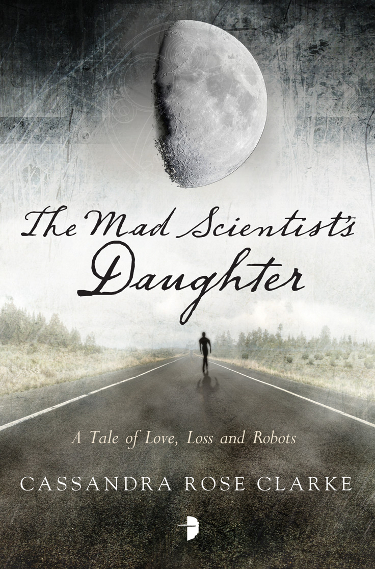
A great review, very thorough. And you convey your enthusiasm. My husband has added this to his list of books to look for. We both like the cover, and that probably influenced him somewhat.
Oh the cover was a selling point too, Tracy! 🙂 I hope you both enjoy it.
Very interesting. I like the sound of a book that is sci fi in a similar vein the sci fi contained in The Time Traveller’s Wife. Reading your review for this immediately put me in mind of Asimov – even before you’d mentioned Positronic Man. I was remembering the third book in the Foundation series where – and really sorry here but I can’t remember names – but there was a young girl in the story who was evesdropping when a visitor called to see her father – I realise that’s a really tenuous link but the start of this review just really strongly brought it to mind. This sounds really good. I must make a note to self.
Thanks
Lynn 😀
There was no way I could come at this one without bringing all of my Asimov experience with me. And to the credit of the novel I don’t believe she was making any effort to tie into Asimov at all (based on a comment at the end of the book in the afterward) and so it in no way feels like she was riffing on his work but at the same time shares some similar passions and themes.
Now that I’m done I wish we had group read this one. I think we would have been happy, and annoyed, and hopeful, and sad, and joyful, etc. together as we would have read through the book.
I’ll be interested in that interview with Cassandra Rose Clarke. She sounds like a writer we all should be reading.
Me too. I gotta admit that I am worried about coming up with good questions.
What an excellent review. I’m certainly going to add this to my ‘must read’ list.
Thank you Susan. With a book this good they kind of write themselves.
This sounds fascinating, Carl, I shall scoot off and see if I can locate it over here. Lovely thoughtful review btw.
Thank you. I had such high hopes for this book and am pleased that it met them.
And I’ve found it and downloaded it to my Kindle app!
Squee!!!
As soon as I saw the cover art for this book I was intrigued, but when you added the context of Asimov’s ‘The Positronic Man’ – well, that sealed the deal. This sounds interesting: I love “robot stuff” (by the way, have you read Alastair Reynold’s “House of Suns”? – best robot novel written in YEARS – that is, in my humble opinion), and so I’m sure I’ll be checking this out sooner or later.
Fantastic review: I liked your discussion about the science fiction-ness of the book, and the problems that seem to arise when you add more “literary foundations” to the genre.
Not that I am in any way discouraging reading this…after all, I thought it was great…but just keep in mind that my comparison to The Positronic Man was more of a contrast really because the focus is not on the robot as much as it is on the human protagonist.
And no, I am so freaking lame when it comes to keeping up with the latest stuff and even though I grabbed House of Suns from the library as soon as it came out I didn’t get around to reading it. I have 6 unread Reynolds books in my house right now. Argh!!!
I’m really making a solid effort this year to keep current with the three SFF mags I subscribe to (Lightspeed, Clarkesworld and Asimov’s) as well as trying to read at least 2 newly published novels a month. So far so good for January and I’m well on the way to reaching that in Feb. too.
I will be very interested in seeing if this book has an appeal for those who are more hard line in their SF reading. I could see some backlash. I will be curious if Clarke brings up any of this in the interview I am conducting with her. I am not sure when it will go live on SF Signal but I do hope you’ll pop over there to give your two cents.
Carl, I am reading this book at the moment (about half way through), and can’t wait to see where Clarke takes her characters. The beginning of the novel certainly grabbed me and I’m enjoying her writing style. Clarke is revealing the world her characters inhabit in small doses as the story progresses, and I’m enjoying the discovery process.
Great, I’m excited to see someone else giving this a read.
The opening chapters were very gripping, weren’t they? Not so much in an intense way but in a way that you felt the story wrap itself around you and pull you in. I found the parts with Cat as a child and adolescent to be lovely and heart-breaking at times.
Clarke certainly takes the reader on an emotional journey as the story continues and I’ll be interested in having a more in-depth conversation about the book, if you are game, once you are done.
Hmmm. An interesting premise, a wonderful cover, and indeed, a great tag-line, too. I’ll have to give this some thought. Great review, Carl. Thanks.
Thanks Logan. It really is a fantastic cover. I particularly love the moon.
Squee! ?? Are you channeling David Brin today? Ha. Sorry to say it, after your thoughtful review and praise for the cover, concept and writing, but this is one I think I’ll skip. Not every book can hit the sweet spot, I guess.
No, spent the weekend listening to SF Squeecast. Completely understand Richard. Wouldn’t be quite normal if we all read the exact same books all the time.
Well, gosh darnit, I thought I was safe here. Robots just don’t generally do a lot for me, but yeah, I totally have to admit you have me wanting to read this one.
Lots of relationship dynamics and stuff here. Less robot stuff. 🙂
Wonderful review, Carl. I’ve been looking forward to this one since I first saw the cover and read a brief description of the story.
Thanks Gavin, it was a pleasure to read and I hope you enjoy it.
Sounds like she’s off to a great start with her career. Not bad for a second book. And I’m curious about the robot love story.
Yes, I think so too. She will have had three books published in less than a year when the second of her YA series comes out in June. I asked her about this in my interview and look forward to reading her answers.
Wonderful review. And you hit the nail on the head with ‘Cat whose choices lead her to becoming ever more robotic herself’! I’d caught Finn’s growing humanity as it were, but I’d never thought to mirror that with Cat’s increasingly stunted and withdrawn emotions as her being robotic.
Again, looking forward to the interview!
Thanks Mieneke. I’m glad I cam across your review in site hopping to you from today’s Mind Meld (which was an excellent one). I’m looking forward to the interview myself. I’ve sent off an initial round of questions and am anxiously awaiting her answers.
I’m in the middle of this one right now and am loving it so far, especially seeing how Cat builds her childhood relationship with Finn and the loss of innocence that begins as she realizes what others think of him. The book is not at all what I expected, but in a good way.
I’m glad you are enjoying it. I was quite pleasantly surprised with it. That book and Love Minus Eighty are two of my favorite SF reads (favorite reads in general) for this past year.