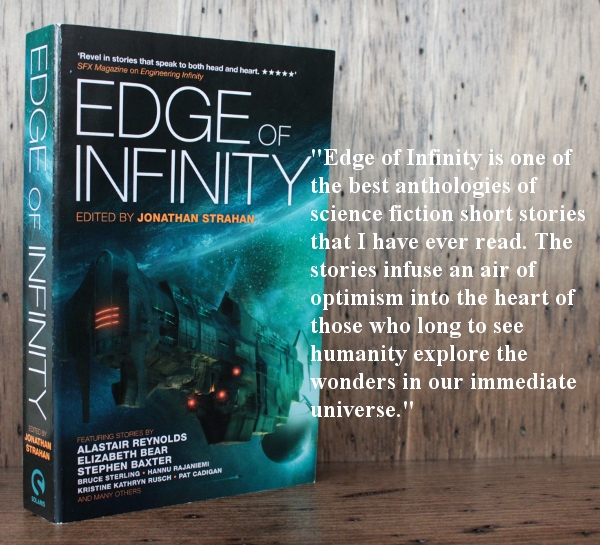
At a Glance: An anthology containing thirteen all original science fiction short stories by some of the genre’s brightest that focus on humankind’s future, not out in the farthest reaches of outer space but here within the framework of our own Solar System.
Pros: New, previously unreleased works; accessible hard sf; plausible sense of wonder
Cons: Two stories feel as if they are outside the theme
My Experience: Having grown up with the surety that we would be traveling the reaches of space in my lifetime, inspired by childhood exposure to Star Wars and Star Trek, this anthology breathes on that flicker of foolish hope with several exciting stories. Many of the authors in this collection bring the common experiences of life to an imagined future with an aura of plausibility that makes these stories accessible to those who do not regularly read science fiction while instilling a sense of wonder in all who look to the stars and long to see the marvels of our Solar System first hand.
My Rating: 8/10 stars
In the introduction to his previous original SF anthology, Engineering Infinity, Jonathan Strahan coined the term “fourth generation science fiction” to describe where he feels science fiction is and will go in the second decade of the twenty-first century. I feel obliged to note here that Strahan’s introduction is a perfect example of what an introduction should be. It does nothing to spoil any of the joy of reading that is to follow and instead references the purpose of the anthology and posits many interesting things about the future of science fiction. It is a must-read.
Jonathan Strahan references the idea that science itself brings about the “science fiction is dying (or already dead)” wail that is heard with alarming regularity within the SF community. Jonathan Strahan is not decrying science or the wonders revealed by scientific study, but he posits that “this constant barrage of fact can be the enemy of romance, and science fiction needs romance to survive”. Fourth generation science fiction then is fiction that is meant to merge the “romance of science and the romance of fiction” into stories that move SF away from the realm of Earth-bound dystopian futures and inspire both readers and scientists to embrace our love affair with tomorrow, to look to our own Solar System as the next great frontier of exploration. For the most part the choices Jonathan Strahan made for this anthology reflect this dream beautifully.
The anthology opens with Pat Cadigan’s “The Girl-thing Who Went Out for Sushi”, a story about a Jovian Operations crew of asteroid miners and a possible next-stage of evolution that would allow humankind to live and work in the harsh realities of space. It is a story that very cleverly examines the kind of sacrifices that not only have been made for our past efforts to move beyond Earth but those that might be necessary to continue that journey. Pat Cadigan gets the anthology off to a fun start. (A-)
________________________
Elizabeth Bear is an author of notable talent whose work I have enjoyed before, but this is not one of her best and feels very out of place the further one gets into this anthology. In “The Deeps of the Sky” an alien being is heading towards the Deep Storm, hoping to have a successful mining journey and impress his superiors. When he discovers a strange bird that turns out to be an out-of-control space vessel he must weigh the risks to his own ship in mounting a rescue attempt to save the humans on board. Bear’s story spends too much time in descriptions while ultimately revealing very little of who these beings are, where they come from, or what they are actually doing. This inclusion blurs the focus set forth in the introduction and should have been saved for a later anthology with a more open theme. (C-)
_______________________
“Drive”, by the writing team known collectively as James S. A. Corey, steers the anthology back on course with an emotionally charged tale of one man’s efforts at improving space travel. The story is set in the early days of their Expanse universe (Leviathan Wakes, Caliban’s War) and shows how the Epstein drive came about. “Drive” has a nice love-story element as well. (A+)
________________________
“The Road to NPS” by Sandra McDonald and Stephan D. Covey works very nicely as the kind of straight forward adventure story that could be set at any place in any time in any real or imagined universe. That quality combined with the elements of the everyday struggles of a working man makes this imagined future feel plausible, and that plausibility brings with it an undercurrent of hope.
With a paranoid assurance that he is doomed from the start Rahiti, “The Crazy Samoan”, begins a treacherous journey across the frozen wasteland of Europa (Jupiter’s Moon) on a gamble that he can haul a record load of cargo to its destination more cheaply than is accomplished with the current shipping methods. If he wins he can return to Earth to see his wife. If he loses he will be indentured to the company for many years to come. An unexpected guest and surprises he did not plan for conspire to end his journey before it has even begun. (A)
_________________________
If I told you that “Swift as a Dream and Fleeting as a Sigh” by John Barnes is a story about two humans and their interactions with an artificial intelligence acting as a therapist it may give you the mistaken idea that this story is somehow both far-fetched and humorous. To correct those misconceptions I would have to spoil what is a thought-provoking, surprising and emotionally stimulating story. (A)
________________________
“Macy Minnot’s Last Christmas on Dione, Ring Racing, Fiddler’s Green, the Potter’s Garden” is set in Paul McAuley’s Quiet War universe. Mai travels to the moons of Saturn to honor the last wishes of her estranged father and in so doing she discovers the pioneering spirit of those who make the sacrifices necessary to bring life to the edges of our Solar System. A lovely story that paints the portrait of a rich tradition of space exploration. I enjoy being surprised by what can be accomplished in the short story format. (A+)
________________________
“Safety Tests” by Kristine Kathryn Rusch puts the mundane role of the driver’s test instructor in space, increasing the danger and thus increasing the excitement. I had no clue where this story was going to go but was happy to go on the ride. In the end Rusch surprises! (A)
________________________
Gwyneth Jones’ story “Break, Sticks, Straw” may be the most tenable offering in the anthology, positing the exploration of our solar system via an orbiter remote-controlled by software-based avatars. When a solar storm apparently wipes out the orbiter programming, the avatar of Sophie awakens to discover that she is not only self-aware but must outwit the other avatars who have decided that their “lives” are more important that the mission to return their data to Earth. There is an intriguing story here that occasionally gets lost in Jones’ poetic tech-speak. (B)
________________________
The futuristic fantasy elements in Hannu Rajaniemi’s “Tyche and the Ants” are evocative of Alice in Wonderland and were initially so incongruous with the rest of this collection that I felt frustrated with its inclusion. As I read on the science fictional elements became evident. I truly believe I would have enjoyed this story of (an advanced genetic child? Some sort of human/alien hybrid?) raised by an A.I. more had it been in an open-ended anthology. It is an imaginative tale that is hampered by its abrupt end. (B-)
_______________________
Stephan Baxter’s story “Obelisk” tells the story of the captain of a doomed space voyage and his partnership with a clichéd American entrepreneur as they partner together to speed up the evolution of Mars as a viable civilization in its own right. In Baxter’s future the machinations of men remain much the same as they do today and the unchecked pursuit of something bigger and better is juxtaposed against the personal price of pursuing a vision at all costs. A fascinating look at how the wheels of progress are greased was ultimately undone by an ending that felt contrived due to the lack of focus on characterization. The kudos I would give for a strong representation of one culture are tainted by the stereotypically shallow representation of another. (C-)
_______________________
Alastair Reynolds’ “Vainglory” examines art and the price of fame vs. obscurity in the guise of a conversation between a private investigator and a women inadvertently used as part of a stunt that resulted in the deaths of several innocent people. Reynold’s description of a massive sculptural undertaking in space sets fire to the imagination. (B-)
_______________________
In “Water Rights” by An Owomoyela a terrorist act does significant damage to the water supply of near-Earth and a spacer with a large water reserve must decide if she is going to sacrifice her own goals to risk being a solution to a problem too big for an easy answer. Owomoyela paints an interesting picture of off-planet life and introduces characters that you feel belong to a greater overall story. Too slight to be considered great, but a slice of future life worth the brief visit. (B-)
_______________________
Archaic male-female social structures, planetary mining, a water shortage and the truly radical idea of bicycling come together in Bruce Sterling’s “The Peak of Eternal Light”, a social satire that is a real hoot. The reader is presented with the culture of the civilization that has settled within the planet Mercury through the eyes of Mr. and Mrs. Peretz on the occasion of their tenth wedding anniversary and the subsequent death of one of their planet’s highest rulers. The Peretz’s speak and act as society dictates in a manner that makes Ward and June Cleaver seem positively licentious. In presenting their story Sterling examines how societal strictures arise from a place that was likely necessary in founding a colony on a hostile world and yet remain long after they have any basis in practicality. He does so with wry humor that had me chuckling throughout. How can you not enjoy a story with lines like: “Whenever women said the opposite of what they so clearly wanted to say, hell was at hand”? (A-)
_______________________
I first became aware of Jonathan Strahan with his Eclipse series of SFF anthologies and have followed his work ever since, buying Edge of Infinity the moment it was released. As so often happens it sat languishing on the pile until I saw a review praising the book on SF Signal while trolling the site’s archives. I agree most heartily with Paul Weimer’s assessment of the book and want to thank him publicly for the much-needed kick in the pants to move it up my to be read pile.
Edge of Infinity is one of the best anthologies of science fiction short stories that I have ever read. The stories infuse an air of optimism into the heart of those who long to see humanity explore the wonders in our immediate universe.
______________________________________________________

Jonathan Strahan is a World Fantasy Award winning editor and publisher of numerous science fiction and fantasy anthologies featuring both original stories as well as reprints. His Eclipse project has moved from print format to the online world and can be found on the Night Shad Press website. His blog and podcasts can be found at Notes from Coode Street. Strahan’s newest anthology, Fearsome Journeys: the new Solaris book of Fantasy, will be released in May featuring twelve original works of fantasy. Jonathan Strahan makes his home in Perth, Australia.
Cover artist Adam Tredowski first caught my eye a few years ago with his fantastic cover illustrations for Interzone magazine. Many of his works feature science fictional constructions in a state of decay, giving them an aged appearance that draws the viewer in as he/she contemplates the story contained in the image. Of Polish descent, Adam Tredowski currently lives in England.
Thanks for reviewing this. I’m a big fan of the Coode Street Podcast, but haven’t actually read any of Strahan’s publications. I should remedy that this year.
This really is a fantastic place to start. I generally enjoy short story anthologies but its been a while since I’ve read a science fiction focused one that entertained me this much.
I don’t listen to the podcast often enough but whenever I do I am blown away by the knowledge these guys have. I feel so inadequate to even talk about books next to them.
looks like a great anthology. I sometimes wonder if parameters aren’t stretched a bit to garner a name, which can be frustrating when one is really looking for the stories to fit.
And I agree, those are the kinds of Introductions I prefer, too.
It really was, and of course it is presumptuous of me to judge whether or not I felt like a story fit the parameters the editor set up. There were some really nice stories here though.
I was hoping the introduction would be online, it is a really nice optimistic essay about current and future science fiction.
I set a goal last year of reading 366 short stories and after a series of failures in reaching such reading goals I managed to over-pass that one. This year I set a similar one, only that 2012 was a leap year and this year I’ll go for 365 short stories. I must admit that in both years the SF short stories were few and far in between. I guess that in the end it is reduced to the genres I enjoyed the most. But I definitely need to diverse the reading of short stories too, I did it with longer fiction why not with the shorter form. This anthology sounds like an interesting one to be add in the reading pile.
Thank you for a wonderful review, Carl! 🙂
Thanks Mihai. I have a goal to read more short stories this year myself and thus far am ahead of the game in reading an average of one a day, even though I haven’t actually read one each day. This collection is a great one to add to the pile.
I would also encourage you to keep Lightspeed Magazine on your go-to list as every week they post new fantasy and science fiction short stories from their magazine of the month. It is a great resource for stories from established authors and the up and coming authors as well and they consistently have high quality work up there.
I wish you all the best in reaching your goal this year. I don’t find as many people who keep short story reading as a priority and it is a pleasure to find out about your goal and the success you had last year.
Two A+. That’s pretty good. I’m working on a short story, so maybe I should read them for insight and guidance. I don’t write science fiction, but I don’t believe you can only read within one genre to learn about writing. And I’m still waiting for my flying car that the cartoon The Jetsons promised. I used to love that show.
There are some really good ones here. I would also recommend checking out this story online:
http://www.lightspeedmagazine.com/fiction/with-tales-in-their-teeth-from-the-mountain-they-came/
It was in the most recent issue of Lightspeed Magazine that I reviewed and it is a lovely story about words and the importance of words.
I’m madly in love with the title of this collection. But more importantly, you really made me want to pick up one of the handful of short story sci-fi anthologies I’ve already bought because of you. All of which, btw, are edited by Strahan. I’m not sure why I go for such long periods without reading sci-fi, when I’ve proved to myself (thanks to you!) that I really do enjoy the hell out of it.
Rich would probably really enjoy the first story in this collection (and some of the others too). This 3 volume “Infinity” series he is doing is a great idea. He announced recently that his next one features stories about the men and women actually making those first steps out into the system and that sounds very exciting to me.
I’d love to have you and Chris both read the story I linked to TBM above. I thought of both of you when I read it because it reminded me of The Book of Flying (which I cannot recall if you have read but know Chris has).
I ordered EDGE OF INFINITY the moment I finished reading your review. Sounds great! I’ve read a few of Jonathan Strahan’s anthologies and enjoyed all of them. I’m really looking forward to this one!
Cool! I think you’ll enjoy it. It was my first experience with several of the authors and I’ll look for more of their stuff.
A note tying in with your guest post: I really like the cover for FEARSOME JOURNEYS.
I know, isn’t it fantastic, Richard? I would want it just for that but am even more excited given it is a Strahan anthology.
This looks wonderful. I haven’t been reading much sf recently but have been meaning to since I read Babel-17 by Samuel R. Delaney last year and found it to be brilliant and refreshing.
It was a very enjoyable read. Exceeded my expectations. I have Babel-17 downstairs on my pile of books to read.
Carl, what are you doing to me? I read a lot of anthologies throughout the year because I love to find new-to-me writers that way. I saw this review and recognized some favorite writers in there, a few I don’t recognize, that plus your great review means I ordered it already. 8/10 is excellent for an anthology of this size.
Cool! I’m glad you did. Jonathan Strahan is doing some wonderful things within the genre to get short stories into the public eye and this is a stellar, pardon the pun, collection to hold up as a success in meeting that goal.