Its Suggestion Time!!!!
For the journey we are all undertaking in the:
Challenge
It was probably the height of folly to include other categories and not just call this a ‘fantasy’ challenge. The four categories that I wanted to highlight mix and intermingle in ways that can often be indistinguishable. In addition, fantasy has a seemingly infinite number of subgenres. So why list four categories? The primary reason was to avoid the common misconception among those who don’t read fantasy literature that books of High Fantasy, like the Lord of the Rings trilogy, or purely magical books, like the Harry Potter series, are the only kinds of fantasy available.
Nothing could be further from the truth. One of my goals was to provide an avenue for all of us to share with each other the wonder that is fantasic, mythic, magical literature in its myriad forms. And while many of these 4 categories can be found present in a number of the books I may recommend, I will at least attempt to categorize some suggestions for those who are either new to the genre, or those who are just looking for something good, and different, to read. Keep in mind that the books I place in categories are my own, non-expert opinion. Many are easily a blend of more than one of these four. In fact, it may be more helpful to consider this a Fantasy Challenge with 3 subgenres: Mythological Fantasy, Folklorish Fantasy, and Fairytale Fantasy.
To start with, I will provide a dictionary/wikipedia definition of each category which will be italicized, followed by my interpretation of each category in bold print. Let’s start with…
Fairytale:
Wiki: A fairytale is a story featuring folkloric characters such as fairies, goblins, elves, trolls, giants, and talking animals, and usually enchantments. In cultures where demons and witches are perceived as real, fairy tales may merge into legendary narratives, where the context is perceived by teller and hearers as having historical actuality. However, unlike legends and epics they usually do not contain more than superficial references to religion and actual places, persons, and events…
Carl: I define fairytales for the purpose of this challenge as books containing fairies, the fair folk, or have some contact with the realm of Faerie. Fairytales are also any books that have elements along the lines of the childhood fables we are familiar with: Cinderella, Sleeping Beauty, etc…stories that often had an object lesson.
Books I would recommend in this category:
1. Stardust by Neil Gaiman
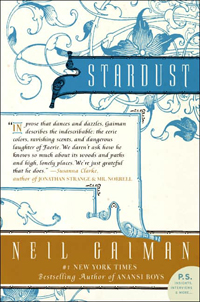
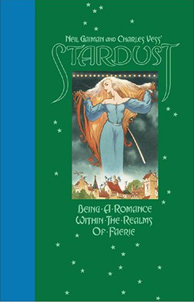
Stardust is the book that I recommend most highly for this challenge. It is a superb book to begin one’s exposure to this kind of literature. Its amazing. Since it largely takes place in the realm of Faerie and has many classic fairytale elements, I classify it here.
2. A Midsummer Night’s Dream by William Shakespeare.
It is all about fairies toying with man.
3. Widdershins by Charles de Lint

Charles de Lint is a wonderful author and his entire Newford series could be placed here. I consider this fairytale again for the simple reason that fairies encroach on the lives of everyday people in the modern world. There is a great deal of Native American folklore in de Lint’s Newford tales as well. I picked this book up because, though it is a tale about characters established in other Newford books, it was touted as a book that could be read as a stand-alone novel. Having read the first quarter of it, I can attest to the ease with which de Lint introduces you to these characters. It is also billed as a love story, which peaked my interest.
4. Tithe by Holly Black (link takes you to my review)

Teen/Young Adult book. A darker take on the realm of faerie. Once again this takes place in modern times with overlap between our world and the world of faerie.
5. The Goose Girl by Shannon Hale (link takes you to my review)
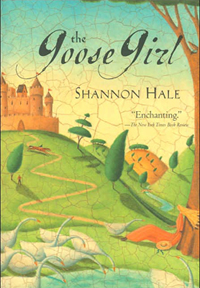
Shannon Hale is a wonderful author and her books are expanded takes on classic fairytales. There are currently three books that take place in the land of Beyern. They are not true sequels and each can be read as a stand-alone story.
6. Fables by Bill Willingham
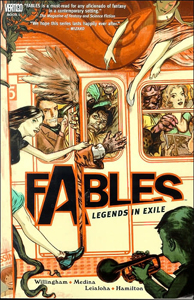
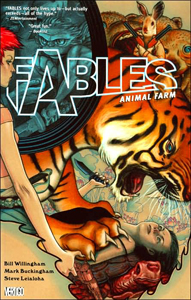
Graphic novels count? Why certainly! In fact, I would love to see some participants who haven’t given comics/graphic novels a shot to actually do that with this challenge.
Fables is a simply amazing ongoing story featuring the well-known and little known stock characters from childhood fables. The various fables are driven out of their lands by an unseen adversary and his legions and they are forced to settle in the world of the Mundys (that’s what they call us, mundane). Humans live in a magically protected section of New York City while the various animal fables live on a similar protected farm in upstate NY. Romance, adventure, political intrigue, drama, comedy…this series has it all. Very well written and the art is terrific.
Folklore:
Wiki: Folklore is the body of expressive culture, including tales, music, dance, legends, oral history, proverbs, jokes, popular beliefs, customs, and so forth within a particular population comprising the traditions (including oral traditions) of that culture, subculture, or group.
Carl: In my mind folklore seems more mystic, more historical, than fairytales. For some reason, probably related to the books I am recommending in this category, I tend to see folklore as something a little more dark and sinister.
1. Hellboy by Mike Mignola
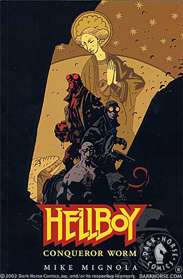
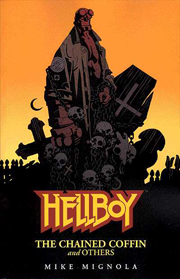
Hellboy ranks among some of the very best novels I have ever read. In addition to fantastic artwork by Mike Mignola and his trademark dry wit, the stories featured in the Hellboy graphic novels have deep ties in the folklore of various countries. Reading them in graphic novel format is great for a number of reasons, one of which is that Mignola talks about the folk tale inspirations for each story.
2. Anansi Boys by Neil Gaiman
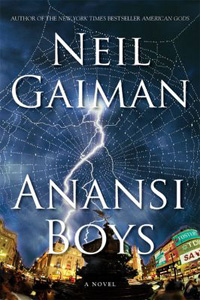
A comic adventure in the spirit of authors like P.G. Wodehouse with fantastical, magical elements. I include this one in the folklore category because the book takes its inspirational roots from the African folk tales of Anansi, the spider god.
And….Wow, everything else I originally had listed for this category fits in sooo much better elsewhere. This is a just a testament to how much these categories overlap. The aforementioned books of Charles de Lint easily fall into the folklore category as well as the fairytale one.
Any suggestions from you guys for this category would be most welcome.
Mythology:
Wiki: A mythology is any body or cycle of myths – a narrative, oral tradition, or a popular belief or assumption, based on the legendary heroes of a culture. Mythology sometimes involves supernatural events or characters to explain the nature of the universe and humanity. Mythology is also branch of knowledge dealing with the collection, study and interpretation of myths or fables.
Carl: Its all about the gods. Though that is somewhat of a narrow definition (after all, J.R.R. Tolkien set about and succeeded to create his own mythology with Lord of the Rings and The Silmarillion), that is how I define mythology for this purpose. I also see anything that has to do with the legend of King Arthur and similar myths and legends as falling into this category.
1. American Gods by Neil Gaiman
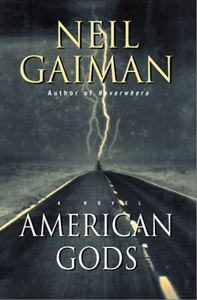
(editor’s note: you’ll see alot of Neil Gaiman recommendations in this post. Sorry, he’s my favorite author, after all.)
American Gods could easily fit in both this category and the folklore category. It is a tale of gods, with particular emphasis on the old Norse gods, American folk tradition, and kitsch culture. This is certainly the most adult of the Gaiman books I am recommending. It is a rich, involved, and very entertaining story.
2. The Forever King by Molly Cochran and Warren Murphy
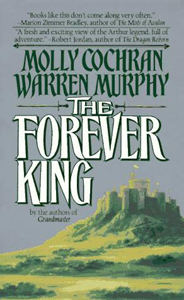
Jeff has this on his reading challenge list and it looks very interesting. The first of a trilogy that takes place in both Arthurian times and the modern world.
3. The Once and Future King by T.H. White
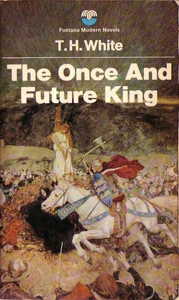
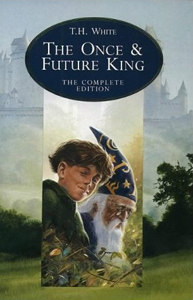
(I love the images of both the old and new covers)
This description from the Barnes and Noble site is great:
The whole world knows and loves this book. It is the magical epic of King Arthur and his shining Camelot; of Merlin and Owl and Guinevere; of beasts who talk and men who fly, of wizardry and war. It is the book of all things lost and wonderful and sad. It is the fantasy masterpiece by which all others are judged.
and finally, the uber-category…
Fantasy:
Wiki: Fantasy is a genre of art that uses magic and other supernatural forms as a primary element of plot, theme, or setting.
Carl: Fantasy itself is such a hugely subgenered category of literature that even Wikipedia could only offer a lame defenition. For the purposes of this challenge, fantasy is everything else that doesn’t more obviously fit into the other categories. Tales with knights, wizards, magical elements, castles, dragons, etc, etc.
1. Bone by Jeff Smith
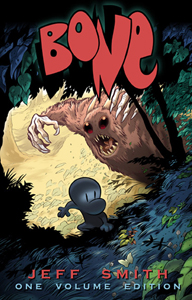
Yep, another grapic novel.
This is the culmination of 13 years of work, and it is wonderful. A combination of Scrooge McDuck, characters that look somewhat like Casper the friendly ghost, and an epic tale in Lord of the Rings fashion. It is funny and suspenseful and page turning…it is delightful. I highly recommend this one. The art is fantastic and Smith is a born storyteller.
2. The Wizard Knight series by Gene Wolfe (link takes you to my review)

Reading this two novel series was one of the most profound reading experiences that I ever had. I felt electric as I read it. My first Gene Wolfe experience, and it was amazing. Read my review, you’ll see that I loved these books.
3. Ombria in Shadow by Patricia A. McKillip
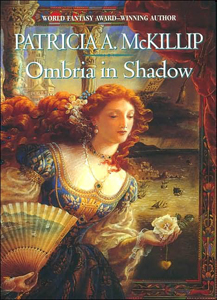
Patricia A. McKillip is one of my absolute favorite fantasy authors. Her use of language is lyrical, enchanting, magical. This is my favorite of all of her books and is, in my opinion, the most accessible. In addition, many of her books have cover art by the incredibly talented Kinuko Y. Craft (recent Friday Favorite post here)
3. The King of Elfland’s Daughter by Lord Dunsany
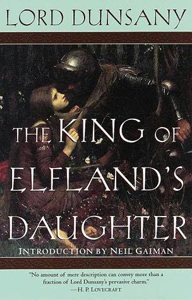
From Amazon:
All fantasy and horror fans owe it to themselves to read Lord Dunsany (1878-1957). The sword & sorcery genre was born in his early stories, and high fantasy was indelibly transformed by his novels. His profound influence on 20th-century fantastic fiction is visible in authors as dissimilar as Neil Gaiman, H.P. Lovecraft, and J.R.R. Tolkien.
I have this one and its on my alternate list. I hope to get to it during this challenge. It sounds great and looks to be a fairly quick read.
I feel I need to define this before I recommend these novels:
Wiki: Urban Fantasy: is a subset of contemporary fantasy, consisting of magical novels and stories set in contemporary, real-world, urban settings.
1. Neverwhere by Neil Gaiman
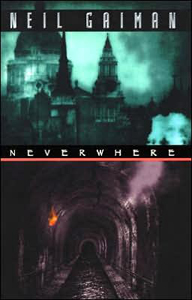
Eventhough I will admit that Stardust is slightly better written, Neverwhere is my favorite Neil Gaiman novel and is among my top 5 favorite novels. In fact I would probably classify it number two, just behind Bram Stoker’s Dracula. A story set in both real world London and in the dark, Alice-in-Wonderland-type world of London Below, this is a tale of what happens to people, places, and things when they fall between the cracks and slip away from the real world. It was my first exposure to Neil Gaiman outside of the Sandman graphic novels and it was a magical experience. I re-read it almost every year.
2. Greywalker by Kat Richardson (link takes you to my review)
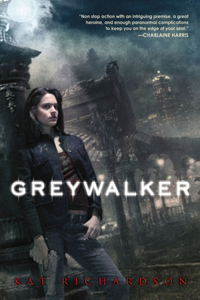
A worthy debut into the Urban Fantasy/horror hybrid genre. Very enjoyable. A quick read with a very likeable heroine. I look forward to the next book in the series.
3. the Rogue Angel series
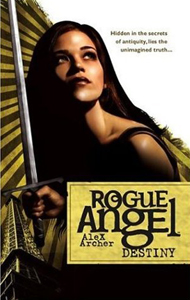
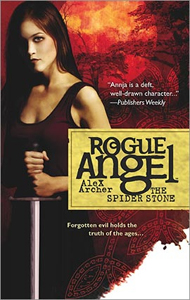
These come highly recommended by Angela, Sci Fi Chick. She graciously sent me an extra copy she had of the first one and it too is on my alternate pile.
Historical/horror/fantasy:
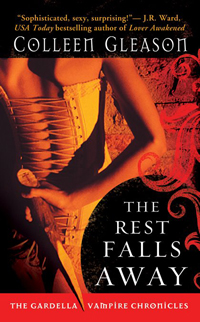
Colleen Gleasons’ fun debut novel, The Rest Falls Away (my review here), would definitely fall into one of the many subgenres of fantasy. If you haven’t, read it!
There are so many, many more, but I better quit and let you dear readers go about your lives!
Don’t let yourself get stuck in a rut when looking for material to read for this challenge. There are so many places to look for good fantastical fiction!
I’ve already mentioned graphic novels.
The horror section offers up books by the likes of H.P. Lovecraft that most certainly have a fantasy element.
The Conan books of Robert E. Howard (my review here) would be an excellent choice for the sword and sorcery subgenre of fantasy and they are amazingly written books that are not at all what you would expect if Arnie is what the name Conan brings to mind.
The young adult section of the bookstore offers up a world of terrific fantasy:
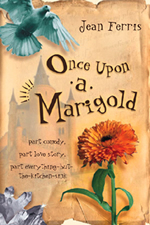
Once Upon a Marigold by Jean Ferris (my review here) is a very fun take on the stock fairytale/fantasy characters. I highly recommend it.
Of course you cannot go wrong with The Chronicles of Narnia series by C.S. Lewis or The Lord of the Rings trilogy by J.R.R. Tolkien.
The list could go on endlessly. And it practically does. Here is a link from Les in Nebraska that covers fantasy novels from A to Z.
And don’t forget, there is nonfiction as well! Bulfinch’s Mythology is a great place to start. There are also wonderful essays on folklore, mythology, fairytales, and fantasy at the Endicott Studio site here, some of which I may be referencing in future Once Upon a Time posts.
And speaking of Endicott Studio, their blog site and their former book review list are both marvelous places to find challenge list ideas!
To close (finally!!!), don’t forget to Sign Up in the Once Upon a Time post!
Post about it on your site, tell your friends, recruit your loved ones. Let’s make this a fantastic fantasy challenge!
_________________________
For those of you who requested it, I resized Angela’s banner for the challenge and retooled my own just a bit. Here they are:
and
Thanks for joining in everyone, I really appreciate it and I really appreciate you, your love of reading, and the enthusiam that you instill in my life every day.
Please offer your own recommendations in the comments section.
Thanks for the update and clarifications, Carl. I still don’t know which Quest I’ll follow and may not know until I’ve finished. I keep adding to to my list (a delightful exercise). My adventure begins today with Avi’s
The Book Without Words, a children’s novel which should go very quickly.
I’m just glad you’re along for the ride, JenClair! 🙂
Man, Carl, I am going to have to try and read the Gene Wolf books again. I started the first one and the main character just annoyed me! But, I will try again since you seem to read books that I would like for the most part, so maybe it will get better.
I agree with most of your choices, though, great books and good for people that do not normally read fantasy!
(I read The Forever King last year, very interesting book to the person that is reading it. It’s a trilogy in case you didn’t know, but I haven’t read the rest of it yet.)
Just a few recommendations: For the Fairy Tale catergory Mercedes Lackey has several books that are fairy tale retellings. There is also O.R. Melling who has put a lot of work into her books and is even rewriting them to modernize them a bit. Oh, and Robin McKinley, of course. And Dennis McKiernan has a quartet that is fairy tale retellings that I love, but he normally writes more of regular fantasy.
I don’t really know if I read anything really folklore related, but I do recommend Marion Zimmer Bradley’s Avalon series for a myth feel. There is also David Gemmell’s Troy trilogy which is really good. (I think that is sort of a myth).
Other good authors:
Anne Bishop
Maria Snyder
Patricia Brigg
Elizabeth Haydon
Jack Whyte
Okay, I’ll shut up now.
hm, O.R. Melling might be more folklore than fairy tale.
I’m a HUGE Orson Scott Card fan and I have to recommend two of my favorites of his. The first is an urban fantasy by the name of Magic Street. This is a wonderful tale that overlaps modern suburbia with A Midsummer Night’s Dream. Puck from the above mentioned Shakespeare work is a main character.
The second book of his that I recommend is Enchantment which is loosely based on the Sleeping Beauty fairy tale, but there is the element of time travel as well.
Both are delightful reads and I can’t imagine anyone disliking them.
Thanks for all the suggestions, Kailana. No need to shut up, I prefer a few long comments occasionally to balance out my loooong posts. 😉
I started to read Enchantment when it first came out and got distracted. I really need to get back to it, Chris.
I was just reviewing my potential list and several you mentioned are on it – The Once and Future King, Anansi Boys, Tithe… I have already finished (since I thought it started this weekend), A Dirty Job by Christopher Moore which is all about Death and the underworld and am currently reading The Good, The Bad and the Undead by Kim Harrison. With witches, vamps, Weres and pixies, I figured it had to count!
In my heart the challenge started on the 22nd, first day of spring I believe, so you’re right on.
I have Enchantment here to read. It looks promising. Another book of the same sort is Beauty by Sheri S. Tepper. I haven’t read that one either. This is why I recommend and don’t look at recommendations because I have too many books to read as it is… Mind you, I am now eyeing that other Orson Scott Card book mentioned.
So, just out of curiousity, how do you look on books centered around Arthur or Troy? Mythological or historical because it can really be both.
I definitely would consider those mythological, Kailana. If you gots ’em, reads ’em! 🙂
Well, Carl, You’ve done it again – added at least a dozen books to my “want” list. Some of those you mentioned sound so good! I’m just happy that I have read a number of them. Although it made me want to re-read Neverwhere. Wow, did I love that. I guess I’ll save that for the Halloween Challenge, that I’m guessing you will be doing again.
Oh yes, Pat, the R.I.P. Challenge will be seeing a second incarnation come this September.
I do hope to join in on this one, once I get a bit of time to get organised 🙂
Glad to hear it, Fence!
I loved “Enchantment” by Orson Scott Card. I may have to reread that one, as it’s been a long time! Very interesting retelling of the Sleeping Beauty tale. I read The “Forever King” back when it first came out and really loved it. I read the second in the series years later and just wasn’t as enamored with it. I never read the third. Another retelling that is excellent is Jane Yolen’s “Briar Rose”, which mixes the Sleeping Beauty myth with the Holocaust. It’s a haunting yet beautiful read. And “The True Story of Hansel and Gretel” by Louise Murphy is another mix of fairy tale and Holocaust using, obviously, Hansel and Gretel.
I would recommend to someone not familiar with these genres to try The Faery Reel and The Green Man, two anthologies edited by Ellen Datlow and Terri Windling. Theya re some of the best short stories I’ve ever read and an excellent introduction, not only to the genre, but to some excellent authors as well.
I also liked Rosalind Miles’s Guinevere series. Well, I only read the first one, but it was very good. Also in the Arthurian vein, I loved The Mists of Avalon by Marion Zimmer Bradley. Just read it for the second time last year.
I’m going to have to head over to Bookmooch and see if I can score any of these recommendations!
I have updated my list, making it official!
Thanks Shannin, I’ll make the change in the other post.
Thank you all so much for the great suggestions. Keep them coming.
I have the Faery Reel anthology on my shelf and I want to get to it during this challenge. Eventhough I don’t know them, I love Terri Windling and Ellen Datlow. They do amazing work and I love their spirit.
Me again. Since you are the Gaiman expert, what should I classify Coraline as?
Hmmm, I’m slightly scared, but also strangely tempted by this challenge, as this is an area of fiction that I’ve never ventured into, so I should really push the boundaries a little. I will go and investigate what my local library has to offer, and get back to you, if that’s OK!
Kailana….hmmmm…Coraline is probably more of an urban fantasy horror book, although the ‘Through the Looking Glass’ element of it could be used to argue that it is a fairy tale.
That’s great, Heidijane…will be exciting if you decide to join us and venture into a new area of fiction! Cool!
Holly Black is a favorite of mine as well as Patricia A. McKillip. But I liked ‘Winter Rose’ a little bit more than ‘Ombria in Shadow’ which was still fantastic.
this is a really great idea.
I picked up a ‘like new’ used copy of Winter Rose recently and hope to get to it soon so that I can compare the two. I’ve liked all her books. I think the reason Ombria clicked so much with me is the similarity of the ‘world within the world’ theme between it and Neil Gaiman’s Neverwhere.
I love this idea! OK, now I’m going to read some Neil Gaiman. I started The Odyssey about 2 weeks ago, and I’m sure that counts: all those gods and witches and sirens and one-eyed giants. I can recommend the Gregory Maguire books, starting with Wicked (the story of Oz from the wicked witch’s point of view). They’re all good. And odd.
Thanks for the challenge!
The Odyssey definitely counts! It is the foundational tale for all that followed. Glad you’re joining in and very excited that you are going to read some Neil Gaiman. I think you’d find American Gods very interesting as a follow up to the Odyssey.
Now I want to add Bone to my list!
I second the recommendation of Jane Yolen’s Briar Rose. It’s not only a very good twist on Sleeping Beauty, but it’s also an extremely moving and powerful holocaust story, slightly in the vein of “Everything is Illuminated”, (or rather, the other way around).
Kailana, I have Coraline in my list too – I’ve been meaning to re-read it for a while – and I put it under fantasy.
OK, you’ve twisted my arm and I’m throwing my hat into the ring. My tentative list is here:
http://adventuresinbookland.blogspot.com/2007/04/once-upon-time.html
Thanks for this post and giving us some guidelines to your sub-genres. Anyway, the book I’m reading now happily fits in everyone of these categories – Keepin it Real by Justina Robson. I’ll post a review when I’m done.