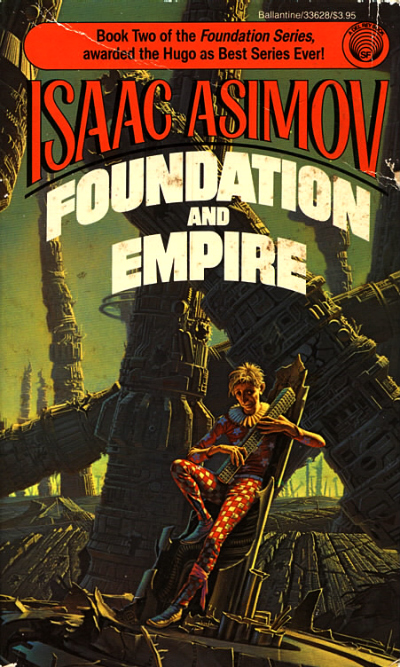
Our foray into Isaac Asimov’s Hugo Award winning Foundation trilogy rolls on with the final discussion of book two, Foundation and Empire. This is my second read through of the trilogy and this novel was every bit as good as I remember it being the first time, particularly the story line that we will discuss now, that of Toran, Bayta, and the Mule.
So come along and join us in the discussion, but be forewarned, major story spoilers are revealed hereafter.
1. While it didn’t break new ground, Asimov did have a female character who played a major role in this second half of the book. What are your thoughts on how Asimov portrayed Bayta?
First off let me say that I think it is a big mistake to judge literature of any kind without taking into consideration the time period in which it was written. What would often be inexcusable in contemporary literature may not exactly be without excuse in classic literature, but should at least be judged with an eye on the past. That being said, I think Asimov does a fairly adequate job in his realization of the character of Bayta. She is not a character who entirely shakes off the shackles of gender stereotypes but she does take an active role in the events of the story, particularly in the end in which she is the one who makes and executes the kind of hard decision that even in today’s literature might be considered to be unfeminine behavior.
There are times when Asimov comes dangerously close to crossing a line in Toran’s interactions with Bayta, but then he reveals a playful nature between the two characters and we see that even in behaving poorly they still love one another.
2. Now that you know the Mule’s identity, were you surprised or had you figured it out along the way? If you did figure it out, how did that affect your reading of the book?
I’m not the kind of person who naturally “figures out” the mysteries in any story that contains them. It isn’t because of a lack of intelligence. It is because I’ve never consciously tried. I prefer being carried along by the story and don’t get any special thrill from outwitting the author and figuring it out. Not that I have an qualms with those who do take pleasure in that. So the first time I read the book the revelation that the Mule was the clown threw me for a loop. Nothing in the previous Foundation story arcs had prepared me for any kind of twist like that and I was pleasantly surprised.
On this reading I was curious if that knowledge would lessen my enjoyment of the story and was pleased that it did not. I actually paid more attention to the clown’s concerts this time and figured out early on that it was those concerts which led to the relatively peaceful victories that the Mule achieved.
3. In previous posts we discussed the role individuals seemed to have in the unfolding of Seldon’s plan. How do you feel about the issue now that we’ve seen an individual derail Seldon’s plans?
There is a great quote somewhere within this portion of the reading which indicates that the previous individuals who had a big role in the Seldon plan were in some way vessels for the plan and that the plan actually accounted for that type of thing happening. What makes the Mule so interesting is that he is an individual who defies expectations and throws the Seldon plan for a loop. Or at least he appears to do so. I’ve forgotten more than I remember about the next book and so I can’t wait to see if or how what the Mule accomplished figures in to Seldon’s overall plan.
I don’t know about you, but while I was thrown off kilter with the protagonists when Seldon appeared and started sharing his insights only for the crowd to find that they didn’t match reality, what really stood out to me in that section of the book was that Seldon had appeared the previous two times with no one apparently witnessing what he had to say. Oh to be a fly on the wall. I can’t imagine something like that happening and no one being there out of curiosity to witness it.
4. Did it surprise you in the end that the Mule was allowed to get away? Did Asimov make you feel any pity or empathy for the Mule, either as the clown and/or when you discovered he was the Mule?
I recall feeling a little more pity for the Mule the first time I read it than I did this time around. Sure he reveals some horrible things from his past and it does continue to bring up some feelings of sympathy, but by and large he still represents the “bad guy” in our trilogy as he is working against the Foundation, and so I cannot entirely divorce myself of my animosity towards him.
I am surprised that the Mule got away but given the way Asimov set things up with being able to read people around him, it made sense that he might not be able to be killed straight on by any individual.
5. How do you feel this story compared to all the other stories that have made up the two Foundation novels we’ve read?
This is one of my favorite story arcs in the trilogy. I enjoy Toran and Bayta Ebling Mis and Captain Pritcher. One reason is that we get a bit of a change with a female character in an important role. Another is that this feels like a longer story and thus we get a little more time with the characters. In it we get the ongoing mystery of the Foundation with more hints about the Second Foundation, but we also get the added mystery of the Mule, a great enigmatic enemy.
6. What final thoughts do you have about Foundation and Empire?
My final thoughts start with the assertion that this is one really good middle book in a trilogy. Conventional wisdom seems to lean towards there being a drop off in middle acts of a trilogy, but in this case Asimov kicks things up a notch and really builds strongly on the ground work he laid in the first book. He changes things ever so slightly so that the reader gets the feel that they are in the same universe established in the first book but at the same time adds something fresh to this outing.
Continuing on, I am really impressed with Bayta and the way in which Asimov uses her as the character who is smart enough to figure out that to leave Ebling Mis alive even a moment longer would jeopardize everything. It would have been a painful decision for any character, but was of course more powerful when it turns out to be his female protagonist who figures it out AND delivers the fatal blow. Or bullet in this case. It was unexpected and it elevated the status of this novel in my opinion.
Asimov manages to reveal first that parts of the Empire still thrive and then in the second half shows us the waning destruction of the Empire, particularly the world of Trantor. The post-apocalyptic description of Trantor makes for some interesting visual imagery. And he continues to tantalize with hints of more mystery yet to be revealed.
I do hope you will join in on the reading of Second Foundation. An official sign up will be up in a few days and the reading will start on Saturday, February 11th with the first post due the next weekend. Please remember to put a link below if you post your answers to these discussion questions. Thank you all so much for participating. You make the reading of these books so much more fun.
In case you missed it, here is Part One of the discussion.
__________________________________________________________
This book is a selection for The 2012 Science Fiction Experience which takes place January through February and is also open for your participation.
I would have loved to know what Seldon said during the times when no one showed up. I thought that was an interesting twist, especially when Seldon is speaking of things that aren’t occurring.
Even though I figured out the Mule’s identity, it didn’t ruin my experience. I was more into figuring out how long it would take to “discover” him. And I was completely shocked when Bayta shot Mis. Totally didn’t see that coming. I found it interesting that the Mule didn’t use his powers on Bayta since he wanted someone to like him for who he was. I wonder if I would experience the same thing you did if I read this years later. Would I dislike the Mule more and not feel for him?
I actually liked the Mule, and I don’t think that it would be terrible if he won if he would learn when to use his powers to stabilize civilization and when to leave well enough alone and let people live their own lives. I guessed Mule’s identity early on in the section, and like you was waiting for everyone else to figure it out.
The leaving people alone might prove to be the Mule’s downfall. Once you have such a power over so many people it might be hard to let go.
I was going to say the same thing, TBM. I think it would be really hard for him to leave things alone, especially since society of any kind will tend towards low points and not utopia. Once he had meddled I cannot imagine that he would ever stop meddling.
I too was shocked by Mis’ death at the hands of Bayta and I give Asimov all kinds of props for that unconventional and unforeseen move.
It was a cool move by Asimov! These books are making me a fan.
I am behind now. I must try to squeeze the last bit of reading into today so I can post sooner rather than later!
We’ll be there when you do!
I liked Bayta’s portrayal, but I couldn’t quite figure out the scene where she’s pulling his hair and they end up rolling around on the floor with the chair. Was that supposed to be funny? Romantic? I can’t find it now to reread it.
I don’t like to figure things out, so when I think I know, I try to keep all other possibilities in mind. Even suspecting, there is enough in this story to look back on and have that satisfying “Aha!” moment(s).
This may be the quote you’re talking about: “We’ve been blinded by Seldon’s psycho-history, one of the first propositions of which is that the individual does not count, does not make history, and that complex and social and economic factors override him, make a puppet out of him.” (That one I marked, but not the chair kerfuffle, darn it!)
I hadn’t thought about the reputation that middle books have, but you’re right–this defies that expectation.
I think it started out as a fight but then they ended up being silly about it. Other than a few extremes it sounded a lot like young love to me.
I don’t like to figure things out either but I’m the same way in that the few times I have I want there to be good story wrapped around it and if so I still find myself satisfied with the experience.
Bayta shooting Ebling Mis was really shocking. I had to read through it 3 times to make sure I read it right. It was awesome! I didn’t think of mentioning anything about Trantor in my write up but I’m glad you touched on it. It was interesting to see in the beginnning of this book that it was still thriving, then at the end it’s nothing but an empty shell.
So far, this second half was the best and my favorite.
Hi Carl, sorry I’m late. I enjoyed your comments. Surprisingly I did feel sorry for the mule, probably more because I liked him as the clown. I was a bit stunned when baryta shot mis! I thought Asimov did a good job with baryta, there were odd bits where it slipped into something a bit more old fashioned but I’m not too bothered taking into account when this was written, plus the audience, and, after all many authors get a bit of aggravation for writing female protagonists and probably lose readers as a result so I have to applaud asimov for this character and for giving her such a good role. Thanks again Carl. Lynn 🙂