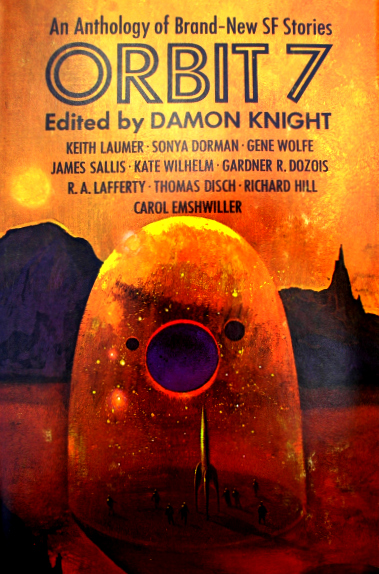
(photo of my actual copy)
In my ignorance of the history of science fiction anthologies I was unaware of Damon Knight’s long-running Orbit series until a late autumn 2010 trip to the treasure-filled Antiquarian Books in Missouri’s capital city brought this beauty to my attention. Artist Paul Lehr has only been on my radar for a few years now, but I’m a fan and slowly but surely plan to amass a collection of his works. Earlier this week I rescued it from the basement library as part of a potential January vintage reading pile and started in.
What is that saying? Beauty is only skin deep?
Despite a few strong entries, Orbit 7 breathes life into this old proverb.
This 1970 collection of 12 previously unpublished stories begins promisingly with Kate Wilhelm’s “April Fool’s Day Forever”. This brooding psychological story of a woman haunted by the ghostly crying of a non-existent child builds with exquisite unease only to lose steam as the science fictional elements of a secret immortality drug and a government coverup are unnecessarily rushed at the end. As the truth comes to light there are several interesting Philip K. Dick like elements that are simply not given enough time to develop. Usually I assume stories feel rushed because of constraints with the allowed word count, but given that Wilhelm was the spouse of the editor and the story length varies widely in this collection, I wish she had taken more time to deliver what would have been a terrific story. (6/10)
The first of two Gene Wolfe stories gives us the recollections of the robot “Eyebem”, for whom the story is named. Eyebem is from a generation of humanoid robots created to perform specific functions that will allow humans to live in the more safe, protected cities on Earth. Eyebem is programmed to take the place of a forest ranger, Mark, and when he gets his assignment heads out to spend some time learning the ropes from Mark. There is a sweetly comical scene in the cabin when Eyebem and a few of the other automated bots engage in shared banter. Eyebem worries that Mark must feel left out as he cannot contextually understand their reminiscing. On their first trip out Mark and Eyebem become stranded after the Jeep breaks down and a massive snowstorm hits. The ending feels unfair and sadly enigmatic. (6/10)
“Continued on Next Rock” is the story of a group of archaeologists on a dig in what feels like an Arizona or New Mexico landscape. The group of 5 soon becomes 6 when a man, Anteros, mysteriously appears the first night offering to help dig for artifacts. Anteros’ odd ability to predict what he is about to uncover is superseded only by Magdalen, one of the participating archaeologists, who appears to be able to predict everything. This story has a peculiar lilt to it that was startlingly familiar despite the fact that I had never read a story by R.A. Lafferty. Then it dawned on me, Neil Gaiman wrote that his story “Sunbird”, collected in Fragile Things, was his attempt to tell a Lafferty story. I can only assume this is one of the stories Gaiman had in mind when he was writing. “Sunbird” is not a retelling of this story, though it feels like a blood relation. You would not have to work too hard to convince me that Lafferty sat whispering in Gaiman’s ear when he wrote “Sunbird”. Strangely satisfying read that sputters at the end. (6/10)
The opening line of Richard Hill’s “To Sport with Amaryllis” paints a pretty fair portrait of the story about to unfold: “The neon lights of Fuzzy Lipschits’ Tit City Topless Taco Parlor and Ye Olde Donut Shoppe blinked expensively and seductively through the smog”. Mixing the late 60’s vibe with near-future imaginings, “Amaryllis” tells the story of a hopeless square, Harley, who will make any sacrifice to continue to sport with his sex-crazed love. Four decades after its inception, “To Sport with Amaryllis” has a nostalgic charm. It was funny to think that when this story was written my eleven year old self would not have entirely understood Amaryllis’ orgasmic attachment to Harley’s motorcycle, nor would he have appreciated the serendipitously timely political humor. For despite Harley’s willingness to embrace free love to keep his wife happy, his own twisted fantasies involve a desire to be an active part of the Republican party. At any other time it would be easy to write off “To Sport with Amaryllis” as a quaint but forgettable short, but in today’s political climate what essentially amounts to an extended joke is relevantly funny. (7/10)
I was excited to see a Keith Laumer story in this collection and while not the best of what I’ve read, “In the Queue” was nevertheless entertaining. The readers are not told exactly when or where this story takes place, but through the eyes of one Farn Hestler we learn that life for this section of humanity involves waiting in a hopelessly long line with the goal of arriving at a far distant window. Twists of fate and cunning vigilance can result in jumps in the line. As we meet Farn he is quickly approaching the window, which means freedom for him and for several members of his family. Though it is a humorous story, Farn’s description of a life spent waiting in line stirs up feelings of horror for the reader, a horror that may not be assuaged with Farn’s arrival at the window. A fun story, even if it makes you want to scream “noooooooo!!!!”. (6/10)
Sonya Dorman’s “The Living End” is short and strange and errs on the side of being vague when it could have been very interesting. Shades of a Philip K. Dick future with no substance. (2/10)
Gardener Dozois’ “A Dream at Noonday” is surprisingly similar to Wolfe’s “Eyebem” in being a story of recollected memories bookended by a specific event. In this case the recollections are that of young man whose thoughts are often presented in long run-on sentences, as if he is trying to tell his life story but knows that his time is limited. It sounds unsettling but it actually works quite well and you soon sense the rhythm of the memories. The remembrances of the unnamed narrator read like a 1940’s pre-war memoir and when it was done I had a hard time discerning how it met any definition of “science fiction”. The narrator’s story alternates with a secondary storyline which slowly reveals details that bring the two together, but discussing that in any fashion would reveal too much of the plot. (7/10)
“Woman Waiting” by Carol Emshwiller left me scratching my head, questioning not only what Emshwiller was trying to accomplish but also why it merited inclusion in the anthology. At a guess this story about a young woman waiting for a plane is meant to be an examination of her low self-esteem. Yet another story that would require a very broad and forgiving defining of the term “science fiction”. (2/10)
With lines like “the sphairikoi have no bazoos”, Lafferty’s second story in the collection, “Old Foot Forget”, is the literary equivalent to an acid trip. Wikipedia mentions that the Orbit anthologies “tended toward the avant-garde edge of science fiction” and that is readily apparent here. The story of a doctor and his fantastical patients reads like an adult version of a Dr. Seuss story without Theodore Geisel’s melodic rhyming. I have enjoyed some bizarre stories in the past, witness my praise of the work of Jeff Vandermeer, but “Old Foot Forget” started out strange and then rode the crazy train to an end that was only satisfying because it finally arrived. (2/10)
After a story with obvious science fictional elements, Orbit 7 returned to a story devoid of obvious sf elements with James Sallis’ “Jim and Mary G”. This time the result is a very brief but utterly terrifying story that is both well done and disturbing, especially if you are a parent. Jim and Mary have a darling little boy whose toddling presence makes you want to take him out for a day of fun. And this is just what Jim promises, a promise that both he and Mary know is a lie. I read this story in the early morning and hours later am still horrified by it. Sallis proves with consummate skill that there need not be graphic descriptions of violence and gore to be scary. It is the very sweetness of this story that makes it so devastating. (7/10 for skill, though I wish now I hadn’t read it.)
Thomas Disch’s “The Pressure of Time” opens with potential and then proceeds to waste it. Emma is a young girl who lives in a future not unlike our present, in which Ireland consists of a largely Catholic population. Where Emma and her family and friends live their lives, practice their beliefs, and eventually die, rumors abound that in London people are immortal. Emma’s mom secretly plots a move to London with the inheritance of a recently deceased relative. But what starts out promising for Emma soon takes a downward turn. Unfortunately the coherence of the narrative follows that same downward route, introducing details that lead nowhere in a story that ends with too many unanswered questions, the most obvious being, “Why?”. (4/10)
Before I discuss the final story of the anthology, let me go back to a brief discussion about the book itself. A common experience with collections of short stories, particularly anthologies containing multiple authors, is that the quality of the stories is as varied as the opinions of those who read them. The difference with an anthology as opposed to a single-author work is that a succession of less than satisfactory stories may cause you to lay it aside, whereas an anthology like this one, containing the work of well-known authors, makes you think that the next one may just be that gem that makes it all worthwhile. Or maybe it is simply that way with me. There were times during my reading where I wanted to lay this book aside never to return. An early succession of “fair” stories and the lack of re-readability of many that I liked coupled with several stories that I found largely worthless made me wonder if it was even worth keeping the book on my shelves even with my love of Paul Lehr’s cover. And then Gene Wolfe saved the day.
“The Island of Dr. Death and Other Stories” is a charming story of a boy and his love of reading. Young Tackman Babcock lives on an almost-island, alone in spite of the presence of his single mom and an older young adult who may just be hanging around the house for inappropriate reasons. One day this young adult, Jason, takes Tackman into town with him and does him a big favor. He swipes a book that Tackman Babcock admired for the cover image and presented it to him as a gift. The book, which presumably shares the same title as Wolfe’s story, sports a cover that in its description sounds just like many of Frank Frazetta’s wonderful paintings done for the covers of stories by Edgar Rice Burroughs. As Tackman Babcock begins to read the book the hero of the story, Captain Ransom, as well as various villainous characters, including Dr. Death himself, enter Babcock’s real world, arriving at times when it is apparent that they are most needed. For Tackman Babcock’s world is far from ideal. There are hints that home life for Tackman is not pleasant and that his mother is involved in questionable activities. But Captain Ransom and Dr. Death make it all okay. Among other things, Wolfe’s story celebrates the healing properties of a good story while also acting as a love letter to childhood reading:
“You put the open book face down on the pillow and jump up, hugging yourself and skipping bare heels around the room. Marvelous! Wonderful! But no more reading tonight. Save it, save it. Turn the light off, and in the delicious dark put the book reverently away under the bed…tomorrow there will be more, and you can hardly wait for tomorrow.”
Anyone who read as a kid has probably experienced similar feelings. Hopefully passionate readers continue to feel that way as adults. As the story ended I couldn’t help but think of the kids in the film Super 8 and also of the adventures of Herbert “Daring” Dashwood from the radio program in Fallout 3. There are elements of delicious nostalgia in Wolfe’s story that are echoed in these contemporary offerings. (8/10)
The anthology as a whole was a disappointment. I’d rate it a 5 out of 10 stars. The presence of stories that went nowhere and met no identifiable definition of ‘science fiction’ were a big part of the problem. Each author demonstrated a degree of skill in stringing words together, but too often promising starts fizzled out before the end or plots were so vague as to be nonexistent. While the first 5 stories of the collection were fair to good, none strike me as stories that I will return to in the future for a re-read. But Gene Wolfe’s final story saved the book for me, redeeming it to the point where I will not be keeping it solely for the cover image. “The Island of Dr. Death and Other Stories” is a keeper, and one that I will re-read in the future. It was an unexpected pleasure to be able to close the book with a smile after I had all but given up hope of doing so.
UPDATE: Turns out there is a podcast of this story online. I haven’t listened to it so cannot vouch for the quality, but if you are interested in checking out this story please allow me to direct you here.
___________________________
Read for The Vintage Science Fiction Month. Check out the tab at the top of Andrea’s site to see other vintage science fiction novels reviewed during this event and feel free to jump right in and participate.
This book is also a selection for The 2012 Science Fiction Experience which takes place January through February and is also open for your participation.
I have been wanting to delve into more short stories (still kicking myself that I couldn’t participate in your group read of short stories), but this does not sound like the best starting point for me. Before leaving Boston I picked up a couple of collections and one has stories by Robert Louis Stevenson, including the story The Body-Snatcher, which seems totally RIP worthy.
No, definitely not. I usually have pretty good success with short story collections so this was an interesting experience.
If you are looking for SF short stories I would recommend:
The Green Hills of Earth by Robert A. Heinlein
I, Robot by Isaac Asimov
Metatropolis edited by John Scalzi
The Science Fiction Hall of Fame (A and B) edited by Ben Bova
Space Lords by Cordwainer Smith
for Fantasy:
The Ladies of Grace Adieu by Susanna Clarke
The Ivory and the Horn by Charles de Lint
The Bloody Chamber by Angela Carter
Smoke and Mirrors by Neil Gaiman
general fiction (with perhaps some fantasy elements):
After the Quake by Haruki Murakami
Dandelion Wine by Ray Bradbury
Those are a good start anyway, I’m sure I’ll think of more.
LOL…I’m actually proud of myself–I’ve read one on your list, I Robot. I loved it. I’ll keep an eye out for these collections. And yes, I’m positive you will think of more!
Another one I found interesting which is a bit more literary in quality is The Love We Share Without Knowing. Read that one a couple of years back and really enjoyed it.
By the way, I haven’t listened to it but there appears to be a student project podcast of the story I really liked, The Island of Dr. Death, that can be found here:
http://podcastle.org/2011/08/23/podcastle-171-the-island-of-doctor-death-and-other-stories/
The ORBIT series featured plenty of award-winning stories. And, I really like that Paul Lehr cover, too! When Damon Knight started the ORBIT series, anthologies of original stories were relatively rare. Most the SF anthologies of that time reprinted stories from AMAZING, ASTOUNDING, GALAXY, etc. Knight was also looking for unusual stories that might not find a home in those conventional SF magazines.
There were at least two more of these books with incredible Lehr covers on that I will pick up if they are still there the next time I go to Jefferson City, MO. I’m not ready to write it off after just one collection, especially since there were a couple fair ones and one that really clicked with me.
Hi
I suppose a collection of short stories is a little bit like a ‘best of’ cd with lots of different artists – you never like all of them do you! I’m not really a fan of short collections. I don’t mind a stand alone short story but my interest definitely wanes with collections!
That was a really good review though and very honest – I like the way you’ve given a rating for each story.
Thanks
Lynn 😀
That is what it is like, but usually I don’t have this kind of experience with a collection as a whole. I am a really big fan of short stories and I am much less critical of them than many others that I know who also read and enjoy short stories. I’m sure my experience with this book echoes many of their normal experiences with collections, but for me it was a different animal altogether.
And thank you!
Oh man, I’m so sorry you had to put so much time and effort into such a disappointing anthology! Over the years I’ve gotten a handful of anthologies like this from the library. For the most part, I was disappointed, although it’s through one them that I discovered Charles Stross. I’ve had better luck with collections that feature works by just one author, at least I can get used to a style if not an overarching plot.
and even the Gene Wolfe entry was just so-so? 🙁
Only the first Gene Wolfe one, the second was excellent, well worth checking out. It actually opens his The Best of Gene Wolfe collection from Tor Books and is highly worth checking out. Knowing that The Island of Dr. Death and Other Stories opens the collection gives me HIGH hopes for the rest of it.
I haven’t had this rough of an experience with anthology collections, but knowing now that Knight was purposefully looking for avant garde stories that might not find homes elsewhere gives me some clue as to why it wasn’t a big hit with me.
yeah, sometimes there is a reason the stories were “previously unpublished”!
That is so true. Of course given Knight’s reputation and my general embracing nature of short stories, this truly could be one of those situations where a more “critical” reader would actually find merit in the stories I thought were “meh” or worse. Still, I cannot recommend this collection, minus one story, with any conviction.