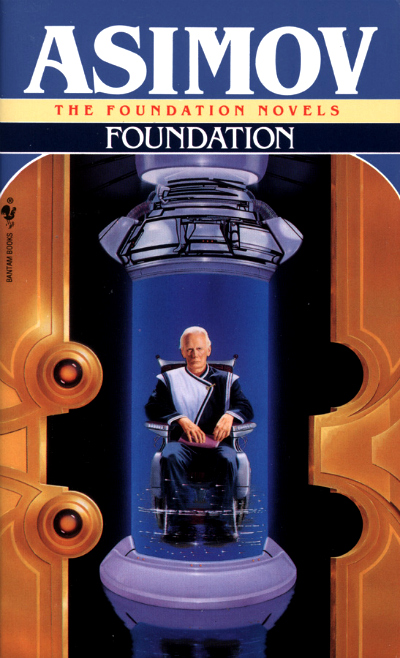
Welcome to the first of a two-part discussion of Isaac Asimov’s novel Foundation. Following are various questions meant to serve as a guide for discussion, followed by my answers to those questions. Group participants were emailed the questions earlier this week and links to their discussion posts will be included at the end. If you are not participating in this specific group read but have read Foundation, please feel free to dive right in to the conversation.
Before getting to the Q&A, allow me to make this public service announcement:
I will be hosting a two-week group read of the second book in the trilogy, Foundation and Empire, beginning January 21st, followed by Second Foundation beginning February 11th. More details will be forthcoming. I hope everyone will consider continuing on with the other two books.
And now, let’s talk about Foundation.
For the purpose of satisfying curiosity, is this your first time reading Foundation or have you read it before?
I read the original Foundation trilogy for the first time in January of 2008. After years of feeling intimidated by the thought of reading it, I finally decided to give it a shot. I found the story to be far more accessible than I believed it would be while at the same time being challenging enough to keep my mind actively engaged. At the end of Foundation I could not wait to get to the second and then third book. Oddly enough my first and only other reading of these was with a group of people, friends of mine who I hung out with at the local comic shop. What proceeded was several weeks of interesting conversation. I look forward to more of that with this much larger group of readers.
For those who have read it before, how has it held up to your memory/feelings about previous reads?
My memories of the experience of reading this book for the first time were not only strong but were wrapped up in the great feelings of it being a shared experience. That fact hindered me at the start of this read of Foundation, as my expectations were at fever pitch. Once I settled down and hit the trial of Hari Seldon I was back in the groove, enjoying the story. It hasn’t hit adrenaline-rush status yet, but I remember the stories getting better and better and I hope to experience that as I read through the novels on this occasion. Nothing is quite the same as that first time, but I am happy that any worries I had about this being a complete let down have been proven to be unfounded.
What are your thoughts about the structure of the novel thus far?
My affection for short stories predisposes me to like this kind of structure so long as the results pay off. They do with Foundation, in large part because Asimov is telling a much broader story than many science fiction novels or even series attempt to do. While individual characters may be in focus at any one time, their part in the drama unfolding is brief, though important. This is a story told on a grand scale about an unfathomably large galactic empire and the prediction of results that will span hundreds if not thousands of years. It works, or at least it works for me.
The added bonus of this kind of story structure is that there are natural reading breaks, something I appreciate more and more when I find myself having short windows of time in which to read. For the uninitiated, the sections of story get longer as the trilogy proceeds, so if shorter stories are not your thing I would encourage you to hang in there.
What are your initial thoughts on the field of psychohistory?
The concept of psychohistory is a creative one, allowing Asimov to have a device whereby Hari Seldon maintains a presence in the events unfolding long after his demise. It works as a fictional construct with which to view this vast galactic empire while watching it fall slowly into ruin. Reading classic science fiction is always interesting as it provides an interesting window into the thoughts and imaginations of both the author and by association those who lived in that time period. In a time when science fiction stories contained ideas like mental telepathy and psychology was not as widely acceptable as it is today, seeing it used as part of a philosophy of predicting the future is very interesting. I have no doubt that the theory of psychohistory is littered with holes and implausibilities, but the fact remains that I am fascinated by this device in Asimov’s story.
What, if anything, is holding your interest thus far, what are you enjoying about Foundation?
One of the things that is holding my attention this time around is waiting for each appearance of Hari Seldon. It has been long enough since the first time that I read this book that I cannot recall what happens each time he arrives, so that anticipation is there plus the thrill of being able to rediscover what are now forgotten mysteries. I like the clever maneuvering and the idea that there is this potential deus ex machina that, at this point in the story, Salvador Hardin is banking on in a big way.
It is hard for me to pin down much else in what is just the beginning of the story because I have a lot of anticipation for parts of the story that I do remember from the first time I read it and those things are getting jumbled up together. The characters in these stories are not Asimov’s strong suit in that the story is more about large scale events, but for what they are meant to represent I do find myself enjoying the individuals who populate Asimov’s world.
What, if anything, are you not enjoying about Foundation?
At this point there is nothing that I can think of that bothers me or lessens my enjoyment of this story. I am pleased at the way in which it is holding up on this second reading and can’t wait to get on to the second part of the book.
You may have covered this in answering the other questions, but if not, what are your thoughts/feelings about the Galactic Empire. Is it a practical thing to have a galaxy spanning government? Can you imagine such a thing and do you think it would work?
One of the things I find very plausible in Asimov’s story is the notion that a galactic empire would crumble. While it may work for a time, and a long time at that, it seems almost like common sense that the government would not be able to administrate a fair and consistent government for millions of planets across an entire galaxy. It would make sense that such a system would eventually become too big for itself and that fractions of the empire would split off to do their own thing, what suits their best interests rather than that of a far distant government.
My other thought is that of a sense of wonder when imagining that many inhabited planets in a galaxy, let alone the sheer volume of that which make up the Galactic Empire.
What are your thoughts on Hardin’s creation of a religious system in which to house scientific ideas and technology while keeping the users of that science and technology in the dark?
I found the idea of creating a religious mythology and wrapping it around science/technology as a way to protect that knowledge while at the same time pass the results of that knowledge on to be a fascinating idea. The “science as magic” idea has been seen in other stories post-Foundation and I often enjoy it. And although it isn’t examined with the fine degree that it would be in a story focused on a more finite period of time, it does invite interesting speculation into the discussion.
I have more to say, but I’ll save it for the discussion. Please post links to your discussions below. If you are answering these questions in the comments section of my post I’ll be sure to include a link below directly to your comment.
As usual Carl well done in selecting a great novel to discuss. Before you mentioned that you were hosting this group read I had never heard of the novel or the series. And I am enjoying it immensely. I’ll have to see if the local library has the other two books in the series since I’ve sworn off buying new books for the present. We’ll see how long that lasts.
I really like how each section is like a short story. And each part gives me a big clue as to what may happen and I’m loving the mystery. I’m also really loving how most of the concepts are still relevant today. Atomic power/threats are still huge. Empires still exist and many are faltering. Just look at the eurozone crisis and the whole revolt against Wall Street. And Hari intrigues me. I can’t wait to find out what he’s really up to!
Thanks TBM, although I can’t really take credit for this one. It was the January selection for the book club I belong to and so it only made sense to extend the read out to anyone else who wanted to join in.
I would hope your library has the others. I think you will feel compelled to read the other two once you finish this and I would love it if you could read along with us.
The mystery is a great part of the story, and although reading it this time I wasn’t thinking about how relevant some of the things might be, I have to agree with you that there are some interesting parallels to the time in which we now live.
I’m glad you extended the invitation to the rest of us. I have a feeling that if my library doesn’t have the books I’ll start keeping a lookout for them. I may not be able to do the group reads if my library doesn’t have them, but here’s to hoping that I won’t have to worry about that. Also I’m curious that the other books have female characters.
I’m loving the mystery. Especially when Hari appeared and told them that he lied.
For the purpose of satisfying curiosity, is this your first time reading Foundation or have you read it before?
It’s my first time actually ” reading ” it. I have listen to an unabridged audio copy of it before.
For those who have read it before, how has it held up to your memory/feelings about previous reads?
It’s held up will for all I remember of it. I’m terrible with remembering details of books. It feels the same to me the sceond time around.
What are your thoughts about the structure of the novel thus far? (I am referring to the brief glimpses of different parts of the history of the Foundation with big time gaps between events in the novel)
I like the jumping forward in time aspect of the novel. It gives it a more epic feel to me.
What are your initial thoughts on the field of psychohistory?
I doubt think of it as a field so much as a prediction by Seldon. I don’t think is a very big stretch for him to guess on the empire falling one day givien that all civilzation throughout time have fallen at some point after having risen. His idea on how to handle it’s rebirth is unique in that I never really understood how he figures out the math for hitting the right dates for his messages and the rebirth of civilization.
What, if anything, is holding your interest thus far, what are you enjoying about Foundation?
At this point I’m driven by the plot as Assimov doesn’t give us any actual character to latch on and root for. He’s trying to hook you with the idea and not the characters. I’m intrigued by the idea which compels me to keep reading.
What, if anything, are you not enjoying about Foundation?
I don’t enjoy having central characters that I care about and can root for through a book. I like character driven stories more so than plot driven stories as this one is.
You may have covered this in answering the other questions, but if not, what are your thoughts/feelings about the Galactic Empire. Is it a practical thing to have a galaxy spanning government? Can you imagine such a thing and do you think it would work?
I can see it working ala like the Federation in Star Trek.
What are your thoughts on Hardin’s creation of a religious system in which to house scientific ideas and technology while keeping the users of that science and technology in the dark?
I’m curious of Assimov’s own religious beliefs. Religion often seems to me to be portrayed is pushing ideas based on faith more so than science in my opinion. By keeping the users in the dark on the science and technology Hardin is able to push his agenda using faith over science which I find very ironic for the Foundation society considering there work on the Encyclopedia Galactica.
I will add one other question to yours. How do you feel about the lack of any female characters. I think it stinks. I for one miss the dynamics that arise from the mixing of the genders. I wonder how Assimov addressed the question of excluding the female gender from his Foundation novels over the years.
I meant just this first Foundation novel as far as excluding any female gender roles NOT the whole series.
That was just what I was about to mention. Having read all three and knowing (this is not a spoiler) that there are strong female roles in the next two books, I hadn’t ever thought much about this. Also it was pretty common with sf books in those days to exclude female characters, or to have them filling very traditional gender roles and/or male fantasy roles. Not making excuses for the writers of the time, just pointing out that this was common. That tendency makes it all the more amazing when an author does manage to not only include female characters but gives them an active role rather than a passive part of the cast.
I forgot that you listened to this the first time around and didn’t “read” it. Back in the days when you were driving so much for work.
I prefer character driven stories most of the time myself, but on rare occasions like this when an idea driven story is interesting I find it easy to get hooked and taken along for the ride.
I find the math part fascinating myself, especially given that I am no good at it. I’ve read interesting things in the past about the mathematical foundation (pardon the pun) of our universe and life’s mathematical base, and although it is far too hard for me to wrap my head around, the idea itself is intriguing and the way Asimov works that into his story is exciting. I can’t help but think it would be very interesting to have Asimov around today to interview about this creation of his.
I think the whole religious angle of the book could be looked at as simply a statement about religion being the “opiate of the masses” as it has been called, a way to show how “simple” people can be manipulated by belief. And it is effective in showing that, but I feel that Asimov goes beyond that in showing how clever Hardin was to use religion intertwined with science and technology to keep Terminus safe and protected until the next crisis hit.
Glad you decided to read this first book with us.
I’m curious that the other two books have strong females in them. Given the time period, I think that it is rare for a male writer to do. I really didn’t notice the lack of female characters in this one, but now that Jeff raised the point he’s right.
I remember being pleased at the way Asimov wrote them, again thinking of the context of the world Asimov wrote in. I’ll be interested if whether or not I feel the same way this time through.
And thanks to Jeff I see a line of questioning for the next book in the series.
The check is in the mail.
I’m curious to see how he writes female characters. I hope Jeff is well paid for his contribution!
The peanuts are quite fresh, I assure you.
Oddly enough, I don’t mind the lack of female characters, nor did I even notice it until you brought it up. Now I’m curious what he’ll do in the next books…
Well I’m glad you said that Grace because I hadn’t either but that makes me feel like a pig-headed male for not noticing. 🙂
pigheaded? ohhh do you also carry pin wheels and go “wheeeeeeeeee” all the way home?? (ducking)
Yep, I do indeed. Although I usually keep my clothes on.
Jeff, your answers made me wonder if there was anything I was rooting for since there is no character to root for, and I guess it would be that the galaxy will have the shorter time of decline. But I guess that’s not really anything to cheer about.
As far as female characters, I guess I’m bothered less by than absence of one than one who is just there to wear a miniskirt and serve coffee. Glad to hear from Carl, though, that we’ll see more in the next books in a good way.
Yes, much better not to have the miniskirt wearing coffee server…although those miniskirts in Star Trek are awful nice…. Ok, bad me.
Well, at least some of those miniskirt-wearing women in Star Trek have brains. Progress.
This is true!
Interesting Jeff about the lack of female characters. It did not even dawn on me, and now that it has come to my attention – I am not bothered. Although, if sans females remains throughout the series, then maybe it would start to bother me.
As Shelley points out though, sometimes there are worse things than having no female characters present. 🙂
Carl, I also loved the Hari Seldon moments. I want to see more of him, as he’s both fascinating and frustrating at the same time.
Good description of Hari. He is both!
I haven’t answered the questions yet, I have to take the cat to the vet soon, but I will before the day is out. What I did want to say is was I the only person that hated the guy that left out his ‘r’s’ when he talked. That chapter really bothered me, but maybe others enjoyed it? (I can’t remember his name and I don’t have the book handy.)
I actually found Lord Dorwin less annoying than the characters in Dune who also had a speech affectation. It was a bit annoying but I also found it humorous that it was obviously an act as he sometimes did pronounce his “r”‘s.
Look forward to your answers later tonight. Hope your cat is okay.
I thought of the character from Dune, but this one didn’t bother me as much either.
Oddly enough, I actually liked Lord Dorwin. I found him amusing, and I liked the way that he said absolutely nothing substantial the entire time he was there. Politics in a nutshell!
I certainly did not dislike him and his presence lent a bit of humor to the situation. I was not a fan of the characters in Dune and was pleased that their presence was brief. Or I should state that other than their vocal affectations they were very interesting characters, but the way in which Herbert chose to structure their speech was what I heartily disliked.
I just hate it when people don’t talk right. I am a terrible person I am sure because people don’t always speak correctly in the real world either, but it just hurts my head. And, well, I abandoned Dune so I don’t even really remember that guy, but if I did he would have probably bothered me.
Now, I did enjoy the humour of him and how he didn’t really say anything the entire time he was there, but the lack of the ‘r’s’ bugged me.
That is right, you did abandon Dune. I had forgotten about that. You probably would remember who we were talking about if you had read that far, believe me. 🙂
I should have wrote my post and THEN came on here. I’m going, I promise. 🙂
And yes, kitty is fine. For a more detailed answer see my reply to Shelley down a bit. Thanks for your concern, though!
Happy to hear that. Hopefully the vet bill didn’t set you back a month’s wages.
It’s ridiculous this cat ownership business. Going to cost 150 bucks to get her fixed!
That goes for just plain pet ownership. They are cute, but costly.
I just mentioned it in my answers. It bugged me too! Hope you’re cat’s okay.
Good, glad you caught up and have your answers up, I’ll be over to check them out. 🙂
She just had to have a needle. It’s just an event because I go to a vet that’s rather out of the way because they have different medical practices. It’s not so much for the vaccination, but for how they spay/neuter their cats, but I figure I might as well just use them all the time.
I did not dislike Lord Dorwin for his “r” impediment. Actually, I do not think I disliked him at all. His speech was only troubling in that it was hard to read, but once I got his rhythm and lack of r’s it was okay…I was able to read the word without the r. I will admit though, I am glad that his portion in the book, so far, has been fairly small.
Me too, Deanna. Me too.
Yes, well, maybe disliking him would be harsh. He just annoyed me…
I read THE FOUNDATION TRILOGY when I was a kid (early 1960s) and I reread these classic novels a few years ago. What struck me on rereading the FOUNDATION novels was the theme of civilization decline. These novels were written when nuclear war was a definite possibility and a major subject for science fiction writers of that time. Asimov just dealt with the topic in stealth mode.
It’s interesting that the theme remains relevant, even though now nukes are less of a threat than economic collapse.
I agree, George, and Asimov wasn’t the only one. Part of the enjoyment I get out of these classics, and even books like Fleming’s Bond series is that they were written in a Cold War era and dealt either directly or indirectly with Cold War issues. I grew up on the tail end of the CW and remember my own childhood fears of nuclear attack. It is interesting to take an almost observer role in reading these, imagining and somewhat identifying with the hopes and fears that were present when these books were written.
Do the users of the science and technology, not actually understand it? Is it only the people involved in the religion who actually understand it?
The people on the planet Terminus, at the edge of the galaxy, are the sole proprietors of nuclear technology and there are a handful of planets around them with war-like intentions. In order to keep them at bay and not have them band together to attack, they actually give them this technology but do so under the guise of religious ceremony and mythology so that it is seen as something magical rather than something that can be learned and controlled. It is a very interesting idea, though one fraught with potential dangers.
Oooo that is interesting! And thank you for your patients in answering my question Carl 😀
Oh no problem, it is a book I am enjoying talking about so it is my pleasure.
I definitely plan to read the entire trilogy, so I’m glad you’ll be hosting group reads for them. The whole concept of psychohistory is fascinating, and I want to hear more from Seldon. It makes me tired to think of how hard Hardin has to think through these things to get to what he thinks is the correct result. I like that he recognizes the weakness of figuring things out based on others’ research instead of going and finding out the evidence for yourself. That was just a small part but I’m wondering if that idea will be pursued further.
It only made sense once I started reading Foundation to host the whole trilogy seeing as how I think most people will finish this first book and will want to see where things go from there. Plus I’ve been wanting to reread these for a few years now and I’m happy to be doing so with a group of people.
I mentioned elsewhere something similar to what you say here, which is that if I think too much about the circular nature of psychohistory it makes my head hurt. I can only imagine Hardin having a splitting headache.
I first read these about the same time as George did, and reread them ditto. It’s still been many, many years, and frankly I don’t remember that much.
I consider it a bit of a blessing that it doesn’t take too long to forget many of the details of a story as it makes the rereading of it that much more pleasurable.
I love some of these comments! I never even considered the lack of female roles but I can genuinley say it doesnt bother me in the least. It will be interesting to see the characters in the next two novels.
And, concerning Lord Dorwin – I must admit I forgot all about him when I was thinking about any criticisms I might have! The character himself didn’t bother me too much, he was very affected but in spite of that astute – what got on my nerves a bit was the way his speech was written – I don’t know why, it just slowed me down reading it and like you observed he did say some of his ‘r’s. Just a little niggle I suppose.
Thanks
Lynn 😀
Lord Dorwin is pretty mild as far as potential annoyances go, and he does at least serve a purpose in propelling the story forward.
My copy of the book has a surprising number of spelling errors, and if Asimov hadn’t mentioned that Dorwin occasionally did pronounce his “r”s, I would have assumed they were spelling errors.
I’m always amazed that later editions have spelling errors. Can’t they catch it after a while? I’m assuming you aren’t reading a first edition, since that might be worth something and I would be afraid of ruining it.
It is weird. I mean my version is a 1989 reprint of a version that was packaged in 1983. Makes me wonder how the errors could be there edition after edition after edition.
The errors are there because the publisher only reprinted, didn’t re-edit.
Its too bad, especially because there are many errors in this first half of the book.
You started my year right when you announced the group reads for the rest of this trilogy. This is a great selection for a group read. I plan on commenting on the various postings tomorrow night.
On a side note, I never noticed the parallels to the Old Testament until I read Donald Hassler’s commentary in Starmont Reader’s Guide #40: Isaac Asimov. In retrospect, it was pretty obvious.
Have you read any other books that used this structure? One that I remember hearing about, but never read, was Mike Resnick’s Birthright: The Book of Man.
I’m glad to hear it Jim. Look forward to your comments both on your site and elsewhere.
That commentary sounds very interesting. I certainly wouldn’t mind checking out some “expert” opinion on the Foundation trilogy at some point, although I must admit that I am feeling much more enlightened just by the things people are sharing and how their comments spark my thought processes.
You believe that the stories become more an adernaline-rush…wow. I am finding Foundation to have a degree of a rush effect on me already.
As I discussed in my post, character connection is very important to me, and I am not gaining much of that with this book. Yet, that fact is not disturbing me.
After reading your thought that each character’s drama unfolds and is important set off a bell in my head…yes, I am in agreement – their brief appearances have importance, and that importance felt carries into the next phase. I think that fact contributes to my
liking of the story, and being okay with the lack of connection i am experiencing.
Your thoughts on psychohistory were interesting. I did not think of it from your point, but then again, I do not have the sci-fi experience you do so i have thought very little about stuff even remotely along this line.
I will admit, I had to look up deus ex machina but once I did and now know the meaning, I am there with you. Part of my intrigue and suspense is because I am wondering what Hardin has up his sleeve and will it work or not.
I, too, had a sense of wonder in that there were so many inhabited planets. I had a difficult time, for a bit, with wraping my head around the enormous vastness of the galaxy.
Well, that is my admittedly poor memory, Deanna. It is possible the adrenaline rush just came from my getting to them in the first place, but I do think the story picks up later on, and that is with me really liking the story right now.
I still have a difficult time wrapping my head around that many inhabited planets, that many people spread out all over many worlds.
I’m like you, character connection is very important and these short appearances from these characters hasn’t disturbed me either. And this was one of my concerns with Sci Fi reading.
The “science as magic” idea you mentioned makes sense even in our time. It is almost magical what scientists have done and will do.
I agree. It is sometimes unbelievable even when you watch things on shows like NOVA.
I first read Foundation back in the 1960s, and I was impressed with it then. I read all three books of the Foundation trilogy. Then a couple years ago I reread Foundation by listening to an audio book edition. I was really disappointed that it was just a collection of short stories and that it didn’t have a continuing character that I cared about. I liked Gaal, but he was gone all too soon.
I think what I remembered fondly from my teen years was reading about Trantor. I think Trantor was what really impressed me all those years ago. Reading the story for the third time I just couldn’t get into it and had to quit. The storytelling is just lame – and most of the plot is just to illustrate Asimov’s ideas. As an old bookworm I’ve got to have great characters for me to love a book – like those in Downton Abbey, or if we’re talking about SF, like those in Ready Player One.
Trantor impressive, especially if you take the time as I did this time to really try to imagine what a galaxy would be like with several inhabited planets, not to mention all of them being under one government housed on one single-city planet.
I disagree wholeheartedly that the storytelling is lame. I understand not connecting with it, but the fact that the books continue to be enjoyed today by fans old and new prove that it is far from that, that it is actually an engaging though not contemporary way to tell a story.
It would be interesting to see in the future if books like Ready Player One, which thus far is really good, or other future sf will have any shelf life once the time for their settings have passed. I suspect those which have good stories will hold up to nostalgia buffs like Foundation does to me, but who knows.
Pay attention to how Asimov presents story details in Foundation. Often it’s through dialog. He uses conversations to infodump. I consider that lame storytelling. Asimov does get better in time. The Foundation short stories are among Asimov’s earliest stories.
I certainly think many of the classics use the infodump technique, but I also consider the fact that this novel is made up of a series of short stories that were published in various stages and so there is bound to be some info dumping just to get audiences up to date. To Asimov’s credit these are much shorter than some contemporary novels that also have infodump issues. In a contemporary story I consider it poor form, but as a convention of the time I don’t.
Info dumping is always a problem with SF. But even for the 1940s, I think these early stories are not very well written. I think that’s why Heinlein got so much attention during the same years. He had a better knack for storytelling.
And if you went to writing classes today, new writers still try to do what Asimov was doing then. Asimov was a new writer when he wrote the Foundation stories. Over time writers learn more efficient and dramatic ways to tell their stories and feed out information. I’m assuming that Asimov gets better in Foundation and Empire and Second Foundation. I found this second story in Foundation particularly painful.
I don’t disagree that Asimov got better and learned better ways to tell stories. I’m not an infodump fan at all, but there is arguably something about these stories that sparks the imagination still today. This is my second time reading Foundation and after the first few pages I found myself right back into it enjoying what was coming next. There are far better told stories, to be sure and Foundation isn’t my favorite of Asimov’s work, but I still find it to be a compelling tale as a whole.
Now that’s a different issue. The Foundation stories resonate with people because they like the ideas and concepts. Like in the Classics group, some people still love E. E. Smith stories, even though they are terribly written. They have a charm that’s appealing to some. People can be madly in love with badly written stories because other elements overcome the writing.
But for me, I like to study the classics of science fiction, but for many of them, they aren’t enjoyable to read anymore. Dated and badly written stories just don’t work for me. But for you Carl, you’re able to maintain the magic and that’s great.
What I’ve always liked about science fiction is cutting edge ideas, but as I’ve gotten older, I’ve become more aware of great storytelling, and I’ve become addicted to that too. I want both.
I prefer both as well, but sometimes there are books that succeed despite flaws and I think the Foundation series is a good example of that. It might be easier for me to maintain the magic because I didn’t read these when I was younger, so much of my science fiction experience with the classics is happening now.
That said, even I couldn’t get past the first part of the E.E. Doc Smith book we were to read last month, so you are a much better man than me for doing so! 🙂
Even bad Asimov is way better writing than E. E. Doc Smith prose.
The other day I read the Nobel prize committee rejected Lord of the Rings for uninspiring writing when C. S. Lewis nominated it. What makes people love a book is often the story, which is different from the storytelling, and even the writing.
Carl, you love the stories in Foundation, and that’s cool. I’m not saying Asimov was a horrendous writer, but he’s pretty bad. But the ideas in Foundation have such a sense of wonder that they overcome Asimov’s poor narrative skills.
I was really sad about my experience with Smith. I was excited to think that here was going to a be a series of older SF to explore and I just couldn’t stomach it.
Of course it is an easier thing to get over knowing there is a TON of science fiction from the 20’s-60’s that I have yet to read.