Bram Stoker, Neil Gaiman, and Edgar Allan Poe…three authors whose works I can scarcely go through a few months without reading. In the case of Poe, this time of year always results in the digestion of several of his tales and poems in addition to my Poe shrine that goes up closer to Halloween.
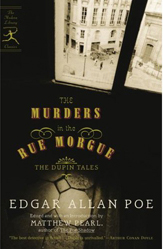
I saw this marvelous new Modern Library version of the book on Danielle’s site and knew that I had to pick it up and make it mine. Edgar Allan Poe is credited with creating the genre of detective fiction with these three stories entailing the deductive exploits of C. Auguste Dupin. Written in the years 1841-1844, a good 50 years prior to Sir Arthur Conan Doyle’s legendary detective came to life, the stories of C. Auguste Dupin, told in these three instances by his companion (the precursor to Holmes’ Dr. Watson), draw in the reader with the wonder of deductive reasoning. All three Dupin short stories are collected in this one volume: The Murders in the Rue Morgue, The Mystery of Marie Roget, and the Purloined Letter.
The Murders in the Rue Morgue feature a horrendous double murder enacted in a locked room, the arrest of a suspect, and the subsequent intervention of C. Auguste Dupin in order to exonerate the man he feels is wrongly arrested. The revelation of the murderer is unexpected and quite exciting.
The Mystery of Marie Roget is a fascinating story of the murder of a young perfume counter girl and the subsequent inability by the police to find a suspect. It is fascinating in that it is a story written to mirror a real tragedy of a similar nature that happened in New York City to cigar-girl, Mary Rogers. That murder remain unsolved and in The Mystery of Marie Roget Poe utilizes the deductive skills of Dupin to take all the information gathered through the study of the newspaper articles, in addition to a little inquiry by the narrator, to solve this case. It is interesting in that some people to this day believe that Dupin actually has the answers to the real life murder mystery.
The final tale, The Purloined Letter, finds the Prefect of the Paris police, a Monsieur G. (who is the equivalent of a fair and yet bumbling Scotland Yard in Doyle’s later Holmes tales) at the door of Dupin and friend seeking help solving the mystery of a stolen letter that could result in the downfall of an unnamed personage with a high station. This is the shortest of these three tales and it has a slightly humorous tone at times.
The only story of the three that I had read previously was The Murders in the Rue Morgue once before and even knowing the killer I was drawn into the story. Such is the nature of Edgar Allan Poe’s writing. I stand in awe when I read the words of Edgar Allan Poe. It is obvious that he had a creativity and an intellect eclipsed the average man. I marvel that these stories were written almost 170 years ago. For some reason I am always fascinated with scary, mysterious tales that were written so long ago. The fact that even then people enjoyed being thrilled and terrified with stories engenders a feeling of kinship with our ancestors. Beyond the content of the tales of people like Poe and Stoker I love the way that they wrote. Language was different then and people obviously spoke, and wrote, quite different from the way they do today. Though at times slightly more challenging than a modern novel I find myself drawn into the the tapestry of words of the classic novelists. The way that they write…the way that Poe writes…is so rich and full of depth and meaning.
I thoroughly enjoyed these three mysteries and highly recommend them as an example that Poe could do much more than write fantastic macabre tales.
What a great cover. I haven’t seen that one before. I do enjoy Poe a lot. Every Halloween I have to read The Raven 🙂 So fitting.
Yes, the cover is fantastic. And it matched so well color-wise with the look of The Illusionist which I saw later in the evening after I had started reading this.
The Raven is terrific. Every year I say I’m going to memorize it and haven’t. Maybe I need to do that this year! Give the ol’ brain a workout.
But… but… The detective novel was created with The Moonstone… Wasn’t it? I was lied to??
I think there are several people credited with ‘creating’ any number of things. In this book alone are 3 short passages from earlier writings featuring detectives. I don’t believe it is the detectives per se that Poe is credited with creating, I think it is the type of detective story. If you read these you see Sherlock Holmes all over them eventhough Holmes wasn’t created until years later. They aren’t like modern mysteries, they are stories that feature long passages of deductive reasoning and I believe that this is what Poe gets credited for.
Hmmm… you’re just saying that… 😉
Would I lie?????
I remember you telling me about these stories before and they sound great.
If a person hasn’t read Poe I would suggest his more famous gothic/horror stories first: The Black Cat, The Cask of Amontillado, The Fall of the House of Usher, The Pit and the Pendulum, The Raven (poem), etc. but for something a little more Holmes-esque and a little more intellectual I recommend these stories.
Well, okay, I’m not as enamored of Rue Morgue as you are, but I do find The Fall of Usher, Cask and Pit to be quite wonderful. (I used to perform The Tell-Tale Heart in grammar school for speech competitions!)
No way LK, that is too cool. In high school we had a performer come in a perform The Tell-Tale Heartin one of our assemblies and it was wonderful.
Okay Anne, I solved the Collins/Poe debate. It is all a matter of semantics. The back of Moonstone credits it as the first “English detective novel”….that may technically be true if you take “English” to mean ‘in or from England’ since the Dupin books are set in France. Also, EAP’s stories are not “novels”, they are “short stories”. So, it looks like both are technically true.
I am enjoying this book too. I had planned to read it over the long weekend, but things never turn out how you want them too sometimes! I am enjoying it, but the language is a bit different than I am used to . I am hoping to fit in some of his other short stories, too.
If you haven’t read any other Poe you really need to read some of his more well known scary stories. They are wonderful.
Only the Cask of Amontillado in school and it has always stayed with me!
That’s a good one!
Actually “The Masque of the Red Death” is the memorable Poe tale in my experience.
Also The Telltale Heart. When my son came home from high school one day, he shared
with me that one interpretation was that the narrator of the story was a woman!
Masque of the Red Death was my first ever Poe, read it in jr. high lit class, and I fell hard for Poe from that point on.