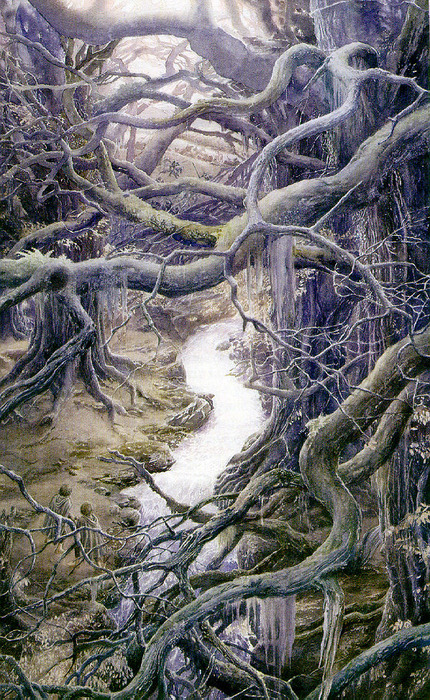
“The world is indeed full of peril, and in it there are many dark places; but still there is much that is fair, and though in all lands love is now mingled with grief, it grows perhaps the greater.”
It feels as if the journey has just begun and now here we are, at the breaking of the Fellowship. This final section of The Fellowship of the Ring begins in tragedy and continues with a growing air of melancholy and despair. It is as beautiful and as touched with sorrow as the last days of autumn before the coming of winter. By my reckoning it has been at least eight years since I last read The Fellowship of the Ring (for the first time) and if I recall correctly I skipped large sections of the beginning because I was not connecting with it. That was not the case on this occasion. I have cherished every word from Tolkien’s pen and have gotten so much out of the reading, in part because I have been reading it with an eye towards discussing it with you dear folk.
For those who are unfamiliar with the story, the following discussion is filled with spoilers. For anyone who has read the books and/or seen the films, intense gushing will soon ensue. I do hope you will join in the conversation.
Andrea came up with this week’s questions. In her email she stated:
“I’m not so good with coming up with specific questions, these are more along the lines of conversation starters. Don’t feel pressured to talk about all of them on Saturday, just pick a few that speak to you, and everyone’s posts will be a little different. And of course, if there are other talking points you’d like to bring up, go for it!”
Well, I think you’ll see that her “conversation starters” are actually very good and that I cannot follow directions, for I must address each one. My apologies.
Gandalf and the Balrog, just Wow. Just a short scene, but oh so intense! With their mentor gone, how will the group go on? Even when they do reach Lothlorien, no one seems to know how to get where they are going. They had been dependent on Gandalf making the decisions, and now he is gone.
Although I know that scene so very well from the movies, I still felt my heart begin to beat as the scene approached. It isn’t given a lot of page time, but it is definitely a “Wow!” scene. I must admit though that I see the film in my mind when I read it and I think of the way in which they injected the scene with such powerful emotion, particularly by the use of sound and music. It is heart-breaking when Gandalf falls. Even if you know the story past this time period it is heart-breaking. I cannot help but think of Frodo and Sam in particular, the two Hobbits who will soon lose all touch with their friends and won’t know how any of them fare until all is at an end.
I like that Aragorn quickly decides he will be the leader but readily admits that he only knows where Gandalf meant for them to go, up to a certain point. I also found it interesting the way the film is different from the book in regards to Aragorn’s thoughts about Minas Tirith. In the film he is very adamant about staying away from Minas Tirith for fear of what man might do with the One Ring. In the book you get the sense that he has those fears but they are not as explored and Tolkien portrays him as having strong desires to go to the home of his ancestors. His reluctance to embrace his destiny is not as strong, at least in this book, as it is in the film.
Galadriel and her Ring. She knows the Ring of power must be destroyed, but with it’s destruction comes the de-powering (is that a word?) of her Ring as well. The Elves must leave Middle Earth or forget who and what they are. For her, this is a no win situation. Frodo’s success effectively means the banishment of the Elves in Middle Earth. I wonder if that makes him more likely to do everything in his power to succeed, or less?
Well the elves are leaving Middle-earth regardless. Many have left before Frodo begins his journey. But the return of Sauron does spell out their final moments. I love how the elves are referred to as having been fighting “the long defeat”. There is a beautiful melancholy to the ending of the Elven age. The elves represent beauty and art and music, though theirs obviously isn’t the only culture to have these things. They seem to represent a high culture that is now passing from the world and with that comes the realization that in time the knowledge of the elves and their ways will diminish. Their buildings will eventually fall to ruin, the same as the work of the Numenoreans. And so you have sadness upon sadness.
One of the greatest things about Tolkien’s world-building is that he created such a believable layered history, one in which you see the ruins of a people long lost to history, whose only remnants besides the structures they created are the Dunedain race. By writing things the way he did you feel the same bittersweet feeling you do when you actually go visit (either in person or on video) one of the many ancient sites in our own world.
Boromir – I didn’t trust from way back at the Council at Rivendell. His conversation with Frodo at the end of Fellowship made him look like a know-it-all with a world view of colonialism and imperialism. Is this Tolkien taking a shot at the old fashioned British world view, or am I reading way, way too much into it?
I’ve read a few Tolkien biographies but it has been long enough ago that I do not recall what his feelings were about the British colonies. He was born and raised in one (Bloemfontein, South Africa). It is a really interesting idea though.
I have to admit that I like the way Boromir is made a more sympathetic though ultimately flawed character in the films. He is somewhat untrustworthy from the very beginning of both but the book doesn’t seem to allow him much in the way of range. Of course we still have a little more to see of Boromir in the story to come.
More than anything I think Boromir’s speech is a perfect contrast to that of Galadrial and Gandalf. Both of them had their own moments of temptation but were able to articulate with wisdom and foresight just what the result of them taking the One Ring would be, even though they took it out of a desire to do good. Boromir is much more blinded to the true destructive power of the Ring. He seems to truly believe, in his growing desperation, that he could simply “borrow” the Ring and vanquish the enemy with it.
I think Jackson caught the spirit of the Tolkien’s work well in the way they interpret his lines after Frodo puts on the Ring and disappears. That falling on his face and then the sad anguish over what he had done, over what he had been thinking and planning. I think the emotions are genuine. And of course it isn’t hard to empathize with Boromir when you think about the fact that his people are closest to the enemy’s gates and they have been fighting battles with Sauron’s forces, losing battles, for a long while now. He is intelligent enough to see that the men of Gondor cannot win and will ultimately come to an inglorious defeat without something miraculous turning the tide. It is no wonder he feels the need to turn the enemy’s weapon against him.
After spending some time in Lothlorien, Sam realizes the Elves aren’t quite as scary or as strange as he first thought. I wonder if when he gets back to the Shire if he’ll realize the Hobbits in the next town aren’t quite as strange as he once thought. I really don’t think this is an overt “message” story, but I do wonder if Tolkien didn’t mind throwing in a little message of “those folks in the next valley aren’t as different as you think”.
I personally feel the whole of The Lord of the Rings is ahead of its time in its demonstration of cultural diversity and the need for and benefit for cultures to come together to aid and support one another. I think he does this on a small scale, with relationships like that between Legolas and Gimli, and I think he does it on a larger scale (as we’ll see in other books). There are of course accusations of racism against Tolkien in that there is much emphasis on the “black” of the Black Riders early in the book and the men of Harad who are described as “dark”.
I don’t see this, or perhaps I just choose not too. There is, to my mind, too much of a movement to label people as racist or misogynistic or what have you.
I only stared reading fantasy a few years ago, and I keep running into this undercurrent of choice. Bilbo has to choose to give up the Ring. Frodo has to choose to take on the quest and be the Ring bearer. Even Boromir is choosing how he feels about the Ring and what it could bring him. In the end, this is all coming down to how we choose to live our lives from moment to moment.
I think Tolkien creates a nice balance between choice, as you say, and the reality that some things are beyond the control of anyone and must either be faced with boldness or run from in fear. The individual characters as well as the peoples themselves are given many choices in the events that take place. And at the same time none have the power to stand against the evil that is arising with any degree of lasting success. Without the destruction of the One Ring, all will be lost. It is that hope in the midst of despair that gives these works such feeling and emotion. It is the reality in Middle-earth that the times Frodo wished would not have come, have come regardless and that, as Gandalf says, “all you have to decide is what to do with the time that is given to you”.
And it really is “moment to moment” as you say. There is an emphasis on that and on the consequences of choices, from Isildur, who could have ended Sauron once and for all, down to Frodo who has no choice in the Ring coming to him, as it is a gift, but must choose what to do with it once he has it. I also like the idea of a greater power at work, albeit in limited ways. This is seen in the idea that Gandalf believed the Ring came to Bilbo and came to Frodo, with its own evil motives, but perhaps there were other motivating forces in place that caused the Ring to fall into the hands of the once race that might actually not have any desire to use it for evil and may actually set out to destroy it.
And the obligatory: what was your favorite part of this section?
This entire section is a favorite, which is of course a cop-out. I think my favorite section based almost solely on the films is the time in Moria. There is something that is awe-inspiring about the mines of Moria. The idea that whole cities could be carved into the earth is fascinating to me. I love the part of the story when Gandalf says, “Let me risk a little more light. Behold the great realm and dwarf city of Dwarrowdelf”, and the music swells and you see those majestic pillars, stretching out as far as the eye can see and stretching up into the darkness above. It is an amazing set and a moving part of the films. And when suddenly you hear that scraping, roaring sound and see the light of flames making their way down the columns, your blood just runs cold, for it is the mighty Balrog.
Another favorite section in the books was Lorien. I love Tolkien’s description of the realm. Those golden leaves bring such images to mind, especially as we are entering into autumn. The Fellowship’s time there is one of peace, though it belies the danger that still exists. I enjoy their respite in that place. I even enjoy the heavy feeling I got when they had to part and continue their journey. The giving of gifts by Galadriel was a great scene and I grew misty-eyed at the interaction between Gimli and the Lady Galadriel.
Other thoughts here at the end of Fellowship:
One thing I really appreciate about the films is that they helped me to think of the Hobbits not as funny little roly poly things but as real people with complex emotions. I liked having that image as I was reading The Fellowship of the Ring because despite their idiosyncrasies I think Tolkien meant for them to be taken seriously right from the start. They possess an unexpected boldness that I believe arises out of their great respect for the land, for their traditions, and for each other. Those things build such a strong foundation in Hobbits that it seems only natural that once they got started down the road on a journey, boldness and strength of character would arise within them.
I don’t remember every consciously getting that Arwen Undomiel is the granddaughter of the Lady Galadriel. I was so shocked by something Aragorn said to Galadriel that at first I thought he was saying Arwen was her daughter, which didn’t make sense to me.
Another favorite part of the book as a whole for me was the scene where Narsil was reforged and Aragorn renamed her Anduril, Flame of the West.
It has been the greatest pleasure reading this book with all of you fine folk who read along as well as those who have participated (and will continue to participate) in discussions because of your knowledge of the story. I could talk about The Lord of the Rings forever and a day and so I look forward to more lively discussion. Don’t forge to visit Andrea and Clint to find the links to the posts of the other participants. Thank you goes out to the both of them for hosting this reading event. And remember that we start in with The Two Towers at the beginning of October.
Additional Fellowship posts:
I am presently not rereading this but I wanted to comment on the painting which I really like.. it’s eyecatching to find an artist that gives a view of something that you’ve not seen before ..who would have thought to paint at that angle?…i really love creativity
Alan Lee is so incredible in his artistic vision and the realization of the things that spring into his imagination. I am so glad that he was one of the main artists on the LOTR films as his imagining of Tolkien’s world could not be more perfect. His use of light, almost faded, color gives the world that melancholy feel that pervades much of the story and yet he can also paint very beautiful, bright pictures as well. I have long been a BIG fan of his work.
I love your post. It’s so thoughtful and much better written than I could manage. I really loved the whole adventure in Moira, even starting from outside with Bill the Pony running away when the monster from the lake emerges. Strangely it feels a bit odd saying that your favourite part is one in which your favourite character is overcome (but I suppose that’s the beauty of this being a reread!) I know that the first time I read this I was quite literally sat with my mouth gaping open when Gandalf fell into the pit and I can remember almost not wanting to carry on reading! And, what that really makes me think about is the way that your view of a book differs so greatly when you read them for the second time. Obviously you lose the element of surprise and it’s difficult to sum up any sorrow for events that you know the true outcome of – but, like you mention the book still manages to inspire real spine tingling moments when your heart is beating fast and for a second it’s almost as though you’re sat on the edge of your seat reading. I suppose it shows how much you really love the story when it still manages to inspire edge of the seat moments when you’ve already read it and seen the film countless times!
Thanks
Lynn
Thanks Lynn, although I am sure you could and have written posts just as thoughtful. I happen to have exposed myself annually to thinks by or about Tolkien for the last decade so it is a subject that is much easier to write about.
I’m glad you brought up Bill the Pony. That character is a perfect example of how certain things cannot be done in a film and you only realize after you read the book how sad it is that it couldn’t have been conveyed more. I love the lines about how Bill seems to intuitively get that his life is immediately better when he leaves Fenrey’s place, even though he is suddenly having to work much harder. It is a really special and sweet idea to give Bill such personality, and looked at a little deeper it is a compelling look at a life of purpose vs. a life lived in idleness.
I saw the films before reading the books, but one thing I did not do was look at any spoilers AT ALL and I knew very little about the story, so when I saw Gandalf fall I honestly didn’t know if he would be back. I suspected so, but when Boromir also passes in the film I suddenly realized that anyone might be fair game. It made watching the films very exciting and I can only imagine how it felt reading the book for the first time.
I agree with you whole-heartedly, it is understandable how a tragic part of the book can still be a favorite part because that part of the story is so well done. And I also agree that it is a testament to the story when you know it well and it still inspires, still surprises you on some level. I love it when a story has such a hold on me that when I read it (or in the sake of films watch it) a second and subsequent times that I actually see knew things, get a deeper understanding, etc. That provides new inspiration.
This is a great article. I do only want to mention briefly (as I touched on it in my post as well), that I do hesitate over some of the later portrayals of the Haradrim. Do I think it’s Racism with a capital R “author was a bad person, shouldn’t read the book” Racism? No, of course not. But I do think it’s slightly problematic description to have the good guys (of all races) be so Northern European and the Men who ally with Sauron be so comparatively ‘exotic’; it dates the book a little.
This is not to mention the philosophical problem that these books bequeathed to the many works they inspired, that there are “evil” races of sentient beings (orcs, etc.) and “good” races.
I adore Lord of the Rings, and Tolkien is not anywhere near as painful in this manner as many (perhaps most) of his contemporaries, but I think it’s something modern readers should be gently aware of.
Thanks Lindsay.
I do agree, there are certainly elements in the story that are a product of their time. If you remember that Tolkien was trying to craft a mythology for England (as they didn’t really have their own) it would not be surprising that there were “darker” races of men that Tolkien would paint as bad because they allied themselves with Sauron. There is a long history of racial issues with Great Britain and its colonization of foreign lands, including many bloody wars, so it doesn’t surprise me that some of that seeps into Tolkien’s writing.
I don’t have a problem with the “evil races” issues because in Tolkien’s world many of the creatures that make up Sauron’s forces were created by Sauron, and by Morgoth before him. Some were created by twisting and perverting elves and men and others spawned out of those experiments, so their very natures would be evil. There would be a difference between them and they Haradrim because the Haradrim (I assume some, but not all) choose to ally themselves with the Dark Lord. That doesn’t necessarily make them evil, just makes them the enemies of the free peoples of Middle-earth.
I love the way that Tolkien writes his books. He gives you enough of a descriptions, but does not get into great detail. He allows the reader to imagine the characters or events how the reader want to imagine them.
I will say again you do a great job on every post on this site and keep up the great work.
Me too, G-Daddy! I know his writing style isn’t some peoples’ cup of tea, but I love it.
And thank you, it is not hard to be passionate (and verbose) about books that I love. 🙂