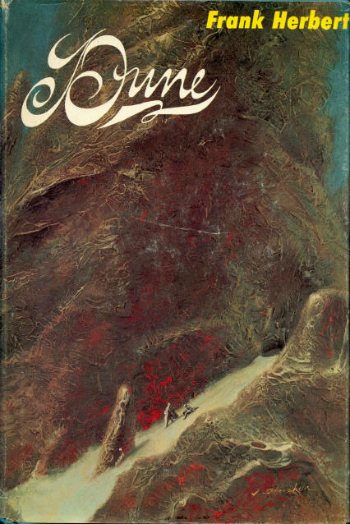
“Deep in the human unconscious is a pervasive need for a logical universe that makes sense. But the real universe is always one step beyond logic.”
~from “The Sayings of Muad’Dib” by the Princess Irulan
It seems impossible, this journey many years in the making, has come to an end. As I sit here in the early hours of Saturday morning I am stunned at the realization that I have completed this journey, that I have traveled with Paul Atreides to Arrakis and have watched him become Paul Muad’Dib.
This final week of the group read of Dune covered Book Three: The Prophet. Each section of this book has held surprises for me and it was rare that even the parts of the story that I knew weren’t filled with revelations that I had not expected.
I like this novel. I like it a great deal. I feel the deep satisfaction of a story well told and it was the intricacy and skill of Frank Herbert that made this tale come to life in ways that I had not foreseen. Grace was kind enough to step in to create the questions for this week’s discussion.
The standard warning still applies:
Here There Be Spoilers!
1. What is your reaction to finally learning the identity of Princess Irulan? Do you think that her convention added to the story?
My familiarity with the story through film precluded me from being surprised at the identity of Princess Irulan or her part to play in the story. However, that knowledge did nothing to diminish her role in my eyes. I imagine there is some literary term for this type of story structure, where a line or a paragraph hints at or reveals what the chapter ahead will hold. I don’t know what it is, but I have been fond of it for as long as I can remember.
And although we “see” Princess Irulan only briefly, the brilliance of Herbert’s writing is that we actually have a much deeper knowledge of and appreciation for her despite her lack of “screen time”. We easily gather through the information she shares with us that in some future she has written extensively about Paul Atriedes and his path to becoming the Kwisatz Haderach. I infer from that that she had some intimate relationship with Paul even if it was not one of physical intimacy like Chani enjoyed. Someone told her these stories. In fact I suspect multiple someones told her this story, OR she eventually drank from the Water of Life herself and was able to see the entire story unfold through the eyes of Jessica AND Paul, pulling from their memories. In fact this would explain just how she knew so much and again speaks of an intimate connection to the events of Paul and of Arrakis itself.
I really like her character and think she adds a great deal of weight to the story.
2. Were you satisfied with the ending? For those reading for the first time, was it what you expected?
I was very satisfied. I actually found the final lines of Book Three to be very powerful and emotionally satisfying. Each section of this book has proven to be much more than I expected and Book Three was no different in that respect. I knew much of the major plot points and yet was regularly surprised by the twists and turns, by the nuances in Herbert’s story. I was particularly fond of Alia and her role in the Emperor’s chamber. He bold assertions and confident faith in her brother set the blood stirring and I could practically feel the power in her voice when she said, “I told you, my brother comes.”
3. On both Arrakis and Salusa Secundus, ecology plays a major role in shaping both characters and the story itself. Was this convincing? Do you think that Paul would have gone through with his threat to destroy the spice, knowing what it would mean for Arrakis?
As my own personal read through of Dune progressed, I became more and more aware of the role that Arrakis played. We have talked before about how Arrakis is itself a character in this story and I hold to that belief even more firmly now that I am finished with the novel. The ecology of the planet and the interdependence between the Fremen and the Arrakis, coupled with the manner in which Arrakis reached out and touched the other planets, demonstrates just how pivotal a role Arrakis played in the unfolding of the events in Dune. Having the story written this way made me care much more deeply about the planet and consequently much more deeply about the story itself.
I believe Paul knew that they either would not call his bluff or that he would indeed be willing to at least destroy a part of it to prove to them just what he was capable of. Paul knew, just as the Emperor knew and the Guild knew and the Bene Gesserit knew that this situation would have to be resolved in the political arena which made the marriage between Paul and Princess Irulan so very critical to everyone’s future success.
4. Both Leto and Paul made their decisions on marriage for political reasons. Do you agree with their choices?
Setting aside my own personal convictions about marriage, the decisions Leto and Paul made to not formally marry the women they loved and Paul’s decision to offer himself to Princess Irulan in marriage for political reasons makes sense within the story and serves the story well. It gives the story an air of authenticity because this was certainly the main practice between nations and people groups for a long time and still happens in some countries on some level today. In order to secure peace and prosperity for their peoples, men and women of royalty were expected to make alliances and those alliances were not always accompanied by feelings of love.
In Dune the roles that all three women (Jessica, Chani and Irulan) play demonstrate just how powerful they are because all are willing to make hard and bittersweet sacrifices for the greater good. They are willing to make sacrifices which are arguably much greater than those made by their male counterparts. I respect them and their place in the story so much more so because of the fact that they become the heroes of this story, the ones who are truly laying their lives down for those they love.
5. What was your favorite part in this section of the book?
Its hard to choose favorites. I enjoyed the reunion between Gurney and Paul and found the part in which Gurney confronts Jessica to be very suspenseful. It kept me on the edge of my seat.
I found Alia to be more of a character than I expected her to be and I kind of like her precociousness.
Riding the worm was of course great.
Paul’s journey to manhood was a fascinating one to watch and I had already mentioned that I enjoyed the ending. That whole sequence played out in front of the Emperor was great.
6. One of the things I noticed in the discussions last week was Herbert’s use of the word “jihad.” What do you think of Herbert’s message about religion and politics?
Dune is a book that I suspect could be made to “say” many different and possibly conflicting things about religion and politics. Is it demonstrating that religion and politics don’t mix or is Muad’Dib evidence that there is a role for both to play in the administration of a government? Is Herbert suggesting through the role of the Bene Gesserit that religious ideas are merely a way to control the populace by planing all kinds of prophetic statements throughout history? If so, what does it say that despite all their scheming and at least some doubt and cynicism as show through Jessica’s character that they actually produced the Kwisatz Haderach?
I know one thing for sure I found both the political and the religious ideas in Dune to be endlessly intriguing and fascinating. Again I feel compelled to use that word “authenticity” and I think these elements give the story a degree of depth and reality. They not only seem reminiscent of the time period in which Herbert was writing (though not to the point of feeling dated) but they also seem very relevant today.
_________________________________
By way of a formal review, here are the other two spoiler-laden parts of this three-part discussion of Frank Herbert’s Dune:
I’m sad the readlong is finished and also because I will not have the time to put up a wrap-up. I have a four-day meeting next week, each day up to 12hrs of discussion of things far less gripping that part I pf Dune’s discussions. I’m saying this to let everybody know it isn’t because I’m not interested in the wrap-up posts but there is a bit of a time issue… I feel a bit like leaving the party before the end…
I also liked the riding of the sand worms! This is an incredible idea and I wonder how this is shown in the movie.
The Princess Irulan is a characater I like a lot but having her introduced this late, made me think the book was not really finished. One chapter is finished but not all, there are too many things open, too many ways the story of Dune could go from here.
The way religion and politics show me that the Western civilozations how we know them, did a good thing when they attempted to split this.
Alia is acharacter I liked a lot and would have liked to read more of. Imagine, being born with al the knowledge of someone before you? Would it be a gift or a curse.
Don’t feel bad, Caroline. Based on the responses to my email I don’t think many will be doing another post after this one, which is perfectly fine. I’m doing one more because I was too exhausted last night to write anymore on this post and I feel the desire to write a bit more about my experience with Dune.
The riding of the worms isn’t horrible in the film, but the film is pretty dated so it isn’t wonderful either. Now that I’ve read the book I would love to see a director adapt this in perhaps a two or three part film and really try to do it faithfully.
Dune is certainly very wide open, and yet it ends in such a way that if you want to believe that Paul then triumphs and the baddies get their comeuppance you can walk away and feel that has been accomplished.
I personally think it would be a curse to be born that way, but then I doubt she would feel that way about it, at least as she was presented the way Herbert wrote her. Then again who knows what effect adolescence might have on her outlook.
A four-day meeting. That does not sound fun!
I agree with you Caroline that introducing Princess Irulan so late in the game made me think that this work is not a standalone. So many things were left unfinished.
To clarify for myself, I don’t necessarily think that Herbert only intended to write one book. And I guess I could probably look it up and see. But I consider this a ‘stand-alone’ in that I don’t feel compelled to have to read another book and still feel like I got a complete three act story with a beginning, middle and an end. The end is left open for either more stories or for one’s imagination to fill in the blanks. Not all the loose ends are tied up and yet they are enough that I didn’t feel like Herbert wasted my time by including this or that and then never getting back to it.
I’ve had some of those multiple day meetings. I weep for you Caroline. 😉
I thought Alia was awesome (although my boyfriend found her creepy). I’d be interested to see what it’s like for her growing up. The way she was freaking out the Reverend Mother made me laugh, because I thought the Reverent Mother was a manipulative little twit.
I haven’t decided yet whether or not to do a wrap-up post.
Alia is a bit creepy, which is part of her appeal. 🙂
I would recommend reading “Dune Messiah”. It is the follow up to this one that I think was originally going to be the last section of “Dune”. “Dune” was an extremely long book when it first appeared. I know that I put off reading it because of the length. In that day a lot of novels were around 150 pages.
As much as I enjoyed re-reading “Dune”, I will probably revisit the rest of Herbert’s Dune books.
Jim: I know I don’t want to read all the Dune books (at least I am not leaning that way right now) but I would be interested in reading the next one. I really and truly enjoyed this. It was great fun and, as I suspected, I find myself wondering just why I waited so long to give it a try. I think it is great that you joined us by re-reading the book.
Hi Carl. Thanks again for hosting this event. You and I have the same favorite scene in the book. I couldn’t read the Gurney part fast enough! Was he going to succeed? Would he be killed? It was pretty exciting.
I have a question about your comment that maybe Herbert’s use of religion was an attempt to control people. Do you think Herbert was commenting on or expanding on Karl Marx’s statement that “religion is the opium of the people”.
I mentioned on Caroline’s site that I felt like Herbert was actually rolling in a wide spectrum of ideas about religion and politics and I was left with the pleasant feeling of not having been preached to or told “this is the right way to believe”.
I certainly think through Jessica he was indicating that the Bene Gesserit were manipulating events through religious doctrine and were doing so because they (at least as interpreted by Jessica’s words/thoughts) had that “opium” philosophy. And yet within that there was obviously some degree of true belief as they were continuing to practice the breeding programs to try to create this messianic character. And we also see that the Fremen at first looked like a people that were being manipulated and controlled by beliefs and in some ways were and yet their devotion was paid off by some of the prophecies coming true. I think it is a unique and brilliant weaving together of two very prevalent ideas, 1) that religion is just a crutch and is doctrine made up by man to control, enslave, make docile, etc. mankind and 2) that there is a real God and that there are spiritual forces at work in our lives. And I never felt like Herbert was taking one side or the other. It is one of many things that made this novel feel contemporary (not dated) to me and one of the things that really pulled me in.
When discussing religion and politics, I thought that Herbert did a good job of making you think without trying to ram ideas down your throat. I saw Paul’s visions of the jihad as a warning about the danger of mixing politics and religion, but at the same time, Paul took political power because it was necessary to prevent worse destruction.
Good way to put it Grace, I didn’t feel that he rammed it down the reader’s throat either. It was an interesting and well-rounded examination.
Was no one suprised about the truth about the Count Fenring? I bet you were all parying that he doesn’t start to mumble again. I have a feeling he could be very importnat in the next book?
Its funny that you bring him up because I was surprised, pleasantly so, that there was no more mumbling! I guess once his wife got pregnant she wasn’t needed “in scene” anymore and so we are spared the silly talk. I was surprised at my own forgetfulness. Princess Irulan writes much earlier in the story about the Count’s friendship with her father and how he once refuses to kill someone and that too shows his friendship. It didn’t dawn on me at all that this was a reference to what we see at the end of the story, even after I read it. It wasn’t until I was re-scanning her quotes for something to put at the start of my post that I re-read this and thought, “duh!”. LOL!
I do like what was hinted at about him and do think he could be a very formidable character as the story unfolds.
He could… if the mumbling is only between him and his wife, if not … In any case I found this to be one of the more surprising things.
One of my visions of hell would be having to read a Dune-length novel with Count Fenring and his wife repeatedly hmmming to each other.
I too will am sad to see this group read end. I think it was a great book for this type of project. The layers of depth that Herbert put in the story lent itself to many different discussions.
You did a good job of pointing out the use of religion in this novel. If Herbert had only presented one point of view it would not have been as strong a novel.
Jim, by not being narrow-minded about his viewpoints Herbert really did make a more complex novel, didn’t he?
It is a bittersweet ending, especially because of how fun this has been.
Carl, I was pleased to read your reviews and also to read your comment that you’d like to see someone do a film of the book that is faithful to it, which the earlier film is certainly not! I hope now you see why I tried to be so adamant that you forget the film when reading the book.
One thing I didn’t see that I’d really like to hear discussed is to what extent do you and the others think the book is a product of it’s time, remembering that it was written and serialized (in Astounding Science Fiction) in 1963-1964, then revised into the novel and published in 1965, winning the Hugo in 1966. Things were very different in the U.S and in science fiction then.
I’m glad you finally got around to reading Dune, and that you really liked it!
I’m glad you enjoyed them Richard, thanks for reading. There isn’t a book that I love that I wouldn’t like to see a faithful film adaptation to, but ones that are this long and complex really do need to be more than one film. I’m actually quite impressed with how much Lynch and co was able to put into their version of Dune.
We did talk some about how this novel feels timeless to us. There was also some talk about the way spice was presented as perhaps having some reference in the drug culture of the time period. But given the fact that I wasn’t even born until 1968 I certainly don’t feel too qualified to talk about it. It is easier to see 50’s SF as having a lot of communist paranoia to it but for me the stuff in the 60’s and 70’s isn’t always as easy to pin down. Would love to hear your thoughts on it and the time period it was written in.
It was a great book, I am glad I finally got around to it.
Once again, thoroughly enjoyed the Q&A. Thank’s so much to all involved, I’ts been delightful 😀
Thank you for reading and responding Kelly. It was great to have you do so even though you weren’t reading along with us. I very much appreciate it.
Thank you so much for putting this group read together! I’ve written my post and read through your post and the comments and my eyelids are starting to droop. I will hopefully have time tomorrow to comment on your answers and visit everyone else when I’m more alert :).
I look forward to getting over there and reading your thoughts, Shelley. It has been wonderful having you involved in the reading and discussion. Thank you so much for taking part. I mentioned to someone else that I did not expect it to be this involved and this much fun and was frankly blown away by the experience. I’ll certainly be hosting more.
I loved they way we learned bit by bit things about Princess Irulan through her writings, and then at the end, even though I think she only has one line (which says a lot on its own) we still have a pretty good idea of what she’s like. (Except that I pictured her looking completely different which isn’t that important after all.)
I felt a bit of dissatisfaction in the end, but not necessarily in a negative way. I just wanted more, and the end almost seemed like a beginning. I do plan to read Dune Messiah. I found Alia scarier than the worms, but I like her.
The women sacrificed much, but then so did Paul. I think you mentioned that you would not like to be in his place, and I agree. I’d rather be eaten by the worm.
I enjoyed many of the parts that you did (love Gurney!) and agree with you about the religious aspect of the book. It was more of an exploration than a statement of any kind. We end up with more questions than answers, though, don’t we?
Thanks again for hosting!
You are welcome, Shelley, thank you so much for joining in. I really liked the way Princess Irulan’s character was developed through her writing about Paul. It is, from my experience, a very unique way in which to present a character and it is a testament to Herbert’s writing that we all connect with her on some level.
The women did and do have to sacrifice a lot in Herbert’s universe and I found them all to be very strong, heroic characters because of it. Whether or not it is “fair” or “right”, it made sense in Herbert’s landscape and it made the story much more powerful than it would have been otherwise.
This has been great fun. Looking forward to discussing more books with you in the future.
This was Shaz. It exceeding any expectations I had and I’m anxious to host one again soon.
Be sure to let me know when you are!
I am so glad you enjoyed Dune. I liked the movie (saw it twice in the theatre), and really liked the two mini-series (even bought the Making of book), but they naturally fell short of my own imaginings.
Dune Messiah and Children of Dune and shorter and worth reading together.
I like the movie as well, and even though the book is a much more rich and rewarding experience I still like the film. I am certainly more interested now in reading some of the Dune sequels than I thought I would be prior to reading Dune.
I didn’t read all of this because I didn’t want to spoil it… I’m seriously considering listening to Dune as an upcoming audiobook. I read it years and years ago and loved it, although I found it confusing (I think I was 17 when I read it)… so I’m considering trying it again. Worth it? Big time commitment.
I definitely think it is worth it. I loved Dune, much more so than I anticipated doing.
Hi! Can you send me the third batch of questions? I have been very busy with work and had just started with the third part of the book. Sorry. Thanks in advance!
Will do Wilson!
Hi Carl, thanks! I have already answered the questions. 🙂