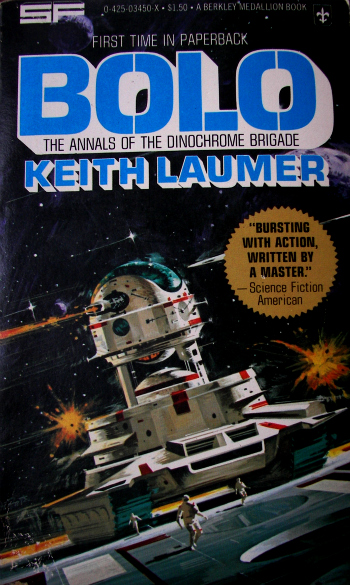
Bolo: The Annals of the Dinochrome Brigade ~Keith Laumer
–first paperback collected publication, 1976
–Berkley Publishing Corporation
–216 pages
–cover illustration by Vincent di Fate
–7/10 Good fun!
My quest to explore the history of science fiction took a sharp turn off its plotted course recently when a cover illustrated by Tom Kidd caught my eye. It was for a Baen book publication, Best of the Bolos, edited by Keith Laumer. With a little digging I discovered that Keith Laumer created a series of future history stories featuring the Bolos–large super-tanks that were initially manned craft but later became self-aware due to the addition of artificial intelligence. Over the course of many centuries the Bolos became more and more advanced and were lauded again and again as the saviors of mankind. On a recent visit to the newly-installed stacks of used books at my local comic shop I came across this collection, Bolo: The Annals of the Dinochrome Brigade. As my interest in these stories was already piqued, I decided to bring it home to begin at the beginning.
The 6 short stories contained within this collection call to mind the stories that fueled my excitement for science fiction several decades ago. I started it last night, reluctantly put it aside to go to bed, and began my day by finishing the last two stories. This was fun.
I love the back-cover descriptions of older science fiction novels, the melodramatic copy practically reaches off the page to give you a good working-over:
“In these scintillating tales of the ever-advancing Dinochrome Brigade, the most effective weapons ever devised tell their own story in action-packed chronicles of extra-terrestrial adventure. Bolo, fighting in proud combat as monster saviors of their human creators.”
I can practically hear the movie-trailer-guy’s voice shouting it out, pouring greater and greater emphasis into each word. Where the emphasis struck me was the idea of these machines “tell[ing] their own story.” It hasn’t been that many years since I fell hard for Asimov’s robot short stories and my hope was that something of a similar vein would appear in Laumer’s tales. While the Bolo stories cannot stand shoulder-to-shoulder with the work of the Master, they actually do a fair job of walking in his footsteps and made for an entertaining read.
The first two stories in this collection do not live up to the advertisement of machines telling their own tales, and yet they stand on their own as two fine male-centric adventure stories.
In “The Night of the Trolls”, Jackson awakens from a hibernation chamber believing that he has only been in stasis for a few short months. What he soon discovers is that decades have passed and the world he went to sleep in does not at all resemble the post-war disaster that he has awakened to. The Bolos in this story are early models with some automatic functions, yet are made to be piloted by human beings. The story is interesting in that it is a precursor to the kind of post-apocalyptic fiction that exists today without the heavy message or depressed mood. Jackson wears the role of everyman-hero like a glove. Nice emotional touch at the end.
Keith Laumer may be best known for his stories featuring the galactic diplomat, Retief. “Courier” finds Retief the reluctant recipient of a mission to Jorgensen’s Worlds, where an alien race known as the Soetti are rumored to be planning a hostile takeover. I could not help but like Retief. He is cut from the same cloth as my favorite literary anti-hero, “Slippery” Jim DiGriz, the Stainless Steel Rat. “Courier” wastes no time in establishing that Retief is a man not to be trifled with. The dialogue, setting and characters in “Courier” would feel very much at home in the prototypical “tough guy” crime fiction that was written about this same time. The bolo in this story was a set piece as opposed to the main event, but you won’t find me complaining. “Courier” was a rollicking good time.
The final four stories, “Field Test”, “The Last Command”, “A Relic of War” and “Combat Unit” delivered on the idea of sentient machines that play various roles in the protection of mankind. These stories range from tales of actual combat to moments in time long after battles have been won and lost in which bolo units re-awaken and have to process an unfamiliar world. They all, to varying degrees, address some similar ideas that Asimov explores so well in his robot stories: the price of true artificial intelligence, the risks of ever-increasing reliance on machines, the fundamental questions of what it means to be “alive”. In these stories the reader gets to experience stories from both the machine’s perspective and from man’s, making them intriguing and suspenseful at the same time.
Isaac Asimov created a set of laws governing artificial intelligence. Around these laws he crafted a series of short stories, many of which prove to be thought-provoking reading some 50+ years later. There is no doubt that Keith Laumer built upon this foundation in creating the Bolos and telling their stories. While the time periods are different (these stories were all written in the 1960’s), both sets of stories have a nostalgic aura that heightens my attraction. If you are looking to pick up a set of solid adventure stories with a science fictional bent that address timeless questions without forgetting the fun, I strongly recommend Bolo: The Annals of the Dinochrome Brigade.
All but one of these stories can be found free online. Click on the title to follow the link:
you wrote this review so well you make me want to read them
I have read most of the Retief books, but these had completely escaped my attention! Now I have to have them! Great review and just the ticket when I finish the Berserker story collection I’, working on now.
RkR: That surprises me, simply because I know you have more of a working knowledge/experience with older science fiction authors than I do. At least that is my impression. I hope you enjoy these.
Ciera: I would suggest giving one or two of the free ones linked above a try. Doesn’t cost you anything but time and you might enjoy them. 🙂 And thank you.
As you already know I love the Tom Kidd cover on this Bolo collection. Sounds like this book was a really fun read. Kind of like a summer blockbuster popcorn movie. I know I want to track down a copy of it for me now some day.
The one thing that bothers me a lot is so much of this material being online for anyone to read for free. I’m not a fan of free online fiction at all as it cuts out the author or their estate and/or the publisher from being properly compensated.
I like the idea of giving people access to samples of stories so people can get a feel of an author’s story or the work in a few pages or a chapter but I don’t like whole stories being completely posted online for anyone to read for free. I feel it devalues the work and the craft of writing. Most writers can’t make a living as it is from their craft. I think authors like most artists are too critical of their own work and often undervalue what they do already. The act of giving away material like this wether it’s from Baen doing legally or others illegally I believe continues to devalue author’s work and the craft of writing.
If people can just go read things online for free then publishers are in a bind. I think the will be much less likely to reprint this type of classic material if they don’t feel people will buy it because they can get it online for free.
I suppose this quite off topic for your review. Sorry buddy. I hope I don’t create any ugliness on your post.
Please don’t take this as an attack on you Carl, because you know it’s not, it’s just that the subject has been bothering me for awhile. When you noted that almost the entire book was online for free I guess it just bugged me enough to get up on a soapbox. I’ll step down now and return everyone to their normally programming. 🙂
Help, I’m being attacked!!! 🙂 And you know I don’t like off topic conversation, no sir! 😉
I certainly am not in favor of any work being made available online if it isn’t legal and above-board. We were just discussing that on the book club site recently too, in regards to finding stories for group reads.
I would tend to feel though that anything that is online which has the authors or publishers permission is fine, after all that is a choice they have made and I imagine they have their reasons, mostly likely the idea that the work will generate sales of future work by that same author.
I was surprised that so much of Jeff Vandermeer’s work that is included in The Third Bear was available free online. Then again he strikes me as the kind of contemporary author that is likely to be using this technology as a way to boost awareness of his work.
I am certainly big on supporting authors which is why I don’t have any qualms about buying more new books than used books throughout any given year. I want the writers I like to make a living. I think I probably agree with your thoughts more concerning whole novels than I do short story collections, although that is mostly based on the introduction to Charles Stross’ collection Wireless where he freely admits that there is very little money in short fiction but that it remains a very viable and important exercise for authors. He goes into greater detail about why he writes it. I’m wondering if short fiction is really and truly only a money maker the very first time it is published and then after that isn’t a big deal being free online because it doesn’t have a chance at generating much money after those initial sales? Far be it from me to know, I really know nothing about the industry when it comes right down to it.
I guess all that is to say that I don’t have a strong opinion on it either way. I wouldn’t agree that it devalues an authors work when it is published free online with consent. I would agree that anything illegally put online, be it a work of fiction, a film, music, etc. devalues the product and should not be used. That being said, it makes me think I should probably do a better job of checking out these free sources where I find these stories to make sure they are truly above board.
Speaking of the Baen book, I was going to pick it up the other day but saw that all of Laumer’s stories in it where ones in this collection. While I would be interested to read other writers’ take on the Bolos, there are several more Laumer stories out there that I would rather read first. I know there is a book out there with all the Laumer bolo stories in them (god awful cover) that I should probably track down.
Thanks for generating discussion, Jeff. No reason to apologize. I imagine anyone who wants to chime in can act adult about it regardless of their opinion. If not I can track them down and put bugs in their beds or something. 😉
I’ll have to read Charlie Stross’s article sometime on this subject. I didn’t know about it. Cool.
I don’t think giving the work away for free devalues the actual work itself. That’s not what I mean’t. I’m sorry I messed up conveying that.
What I failed to convey is that giving away the work devalues the craft of writing. I think of many other professions where people don’t give away what they produce. For some reason I feel that writer’s tend not to value what they produce as much as other artists and seem more willing to give away what they create for free. I think it’s a fine line of course between giving people samples of your work and a whole work when it comes to one promoting themselves. I realize it’s up to the artist to choose what they want to do with their own material it just sadens me that I see so many of them just give it away for nothing. What they do to create their work is worth more than nothing.
I’m concerned with the viability of many publishers and writers futures to survive in this economic climate and going forward when so much material is available to people for free online. I think we will continue to see publishers and book stores closing their doors as they can’t compete against the internet where people are just giving it away.
Now I for one don’t feel anyone needs to boycott going to those links above. I’m sure Baen has permission to post those stories. It just bugs ME which is my problem with the issue not anyone else’s which is why I won’t read it online for free.
Now if Baen and others online would compensate author’s for each time someone reads a story online of their website I would support that.
I for one do think short fiction tends to be even more devalued than long fiction which I also don’t think is right but I do believe that perception is reality. Some of my favorite stories are short fiction. That might be a good idea for a post Carl. One on short fiction not getting respect and why is it that way.
Ultimately I LOVE stories and want those to continue which I know they will. I just hate seeing the format war ( Actual books v. Virtual books ( internet/e-readers ) for how we consume those reduce author’s ability to make a living which has always been an uphill battle for those who create in that art form.
When I buy a book at a new book store, a used book store, or read it from the library I know that the publisher and/or author received compensation atleast once for that work. When I click on something and read it for free on line I have no idea if that publisher and/or author ever received any compensation for my enjoyment of their product. I figure atleast getting paid once is way better than not at all. 🙂
I agree with Jeff.
Allow me to preface all this that my complete lack of knowledge on this subject, and the fact that I’ve only really thought about it “seriously” since Jeff raised the subject, means that I could easily be swayed one way or the other depending on the information that comes to light. Anyway…
Again, I don’t necessarily disagree although I am not sure the issue is quite that black and white. First, I would venture to guess that the amount of fiction that is available free online is just the tiniest percentage vs. that which isn’t.
“When I buy a book at a new book store, a used book store, or read it from the library I know that the publisher and/or author received compensation at least once for that work.”
True, but most have been paid at least once for their work, unless the author specifically releases it for free before trying to sell it, or because he/she cannot sell it. The reason I make that assumption is that this work has been previously published, which means the author was paid something and the publisher made some money as well.
Lets look at this another way, and this is just a theory, but bear with me. Leaving aside authors who are no longer alive and thus are incapable of choosing what is to be done with their work, isn’t there still a strong possibility that publishers AND authors are doing this as a way to try to generate more income by getting the work out there, thus actually trying to add value rather than decrease value?
Here is an example: Apex Magazine publishes two new stories each month, pays the author for any stories they use, and charges a fee for each individual digital magazine or a smaller amount for a yearly subscription. Then when next month’s issue comes out, the previous month’s stories are available for free download on the website. The first thought might be, “well that is ridiculous, why spend the money at all and not just wait”. But look at it this way: the author and publisher made some money up front. They then make the material available for free. Websites small and large review the issues and author A’s story gets some positive buzz. The reward would be more people discovering your work with the hope that it generates income for future work you do.
Then lets say that awards season comes around and the story gets nominated for a Locus or Hugo or Nebula. Doesn’t that give it a greater chance of being picked up for republication in book form, thus creating more income for the author and publishers AND increasing the author’s exposure. Plus, magazines that publish award-winning material also start winning awards, get more awareness, and have a chance to make more money. I don’t say that any of this WILL happen, but it increases the chances that it DOES happen as opposed to the authors story ONLY being read by those who pay the subscription for the magazine and no one else. I think most science fiction fans agree that on some level the awards are a popularity contest. How else does popularity come but from exposure and over-exposure. However, I think authors and publishers should ONLY allow their fiction to be made free on the author or publisher website and not all over the place, that way any links to the story brings the reader right to the author/publisher’s front door.
Now this is just one theoretical scenario, but I don’t think it is wildly off base when I look at what I’ve seen happen over the years with small presses and digital publications.
I’m certainly not the person to actually know much about this though. It seems like authors like John Scalzi and others who have embraced the internet as a marketing tool by giving away fiction would have a better idea of the risk/reward factor. I think my bottom line in all this babble of mine is that I believe authors have to eat, want to be paid for their fiction, and want to have their work consumed and whether or not the gamble pays off it is a risk they are trying in order to see if they can survive in the new world.
I think that exposure can also be a boon for the estates of authors who are dead, if an estate still has the rights, and/or the publisher if work is in the public domain. If the technology isn’t embraced in some fashion, how will the industry make any money off of these older authors and how will they remain in the public eye?
In all this I’m not saying that putting stuff out there for free is a GOOD idea. It could back fire, as all marketing techniques have a potential of doing so. And the stuff that is out there for free reading that is pirated in some way is terrible and should be shut down. I’m just not sure that it cuts down an author’s ability to make money, or a publishers, if either or both are doing it of their own free will. We know if that is the case they are doing it to try to make a buck somehow. The industry is not that generous, and authors want to make a living off of their craft. Still, it is a gamble and it could be the wrong one to make in this day and age.
That leads me to some questions I don’t have answers for: how should authors or publishers be using this technology to survive? Is there a way for new authors to take advantage of this somehow and get more exposure than they would going the standard publishing route OR does this make it harder for new authors to compete? And also, who else has discussed this on the internet and have they done any market research to see if it is hurting or harming the industry or if there is any effect at all?
I think the internet has over run many many industries and only now are some finding a way to resurface and make it work for them. I wonder how the publishing industry feels they are doing in this respect?
Excellent food for thought. Let me chew out it this afternoon. I have to run out the door right now for a cub scout project this afternoon but I promise to repsond tonight. Take care buddy.
Why you are chewin’, allow me to play Smeagol/Gollum and argue with myself on my last comment:
I was thinking about this while I was out and about myself. I had mentioned Scalzi earlier and it brought to mind a discussion that was going on over several websites last year where various authors and fans were discussing selling stories to various online and print magazines, one in particular which wasn’t paying much at all per word for their stories. John Scalzi took up a position which I agreed with which was somewhat opposite of what I seemed to be saying in my comment above, which is that exposure isn’t everything. He was positing that it authors were indeed de-valuing themselves and their work if they were providing work for a less than equitable rate.
So that makes me wonder if the idea of free online fiction is only a good marketing technique for better known authors who have been first paid a reasonable price for their work vs. authors who are just trying to break into the business and may be indeed slitting their own financial throats by providing their work for no cost.
Not surprisingly, this (at least in my mind) is a complicated issue.
Let me also put this out there, and I can only do this with a good conscience because Jeff and I are friends and when it comes to wanting authors to be paid fairly for their work AND wanting publishers to be successful so that books keep getting on shelves, we see eye to eye–are we being hypocritical in our assertions that we feel that way when we, for example, go out and buy a used copy of a Robert A. Heinlein book because we like the old classic cover vs. say, supporting Baen books who are doing an admirable job in making sure Heinlein’s works, especially his juveniles, are staying in print and on store shelves?
At first I would argue that we are indeed buying work that at one time the author and publisher had been paid for, which is good. But, are we then not doing our part for the current publishing industry by not buying that same book new from Baen? And of course that is just one example. There are several publishers, Night Shade, Subterranean, Baen, Persephone Books and many more who are or have made sure that works that were or could be out of print remain out there for the public to enjoy.
And speaking of Baen and referring back to publishers trying all kinds of things from a marketing perspective, did you know that they have been including CD’s in some of their newer books that include the entirety of that book plus some of the authors other works and that they are actively encouraging you to share that book with others? There is a CD in my copy of Cryoburn, for example. Is this a good thing or something that will backfire?
Sorry to not wait for anyone else’s reply to the last comments, but these things were on my mind and I wanted to get them out there.
Kicking something else into this discussion, Small Beer Press is one of several publishers who in 2010 joined in an experiment in releasing some of their books for free download under the Creative Commons License. I just happened to come across this today when checking on the link for a book club short story, John Kessell’s “Pride and Prometheus.” The link to that site is here:
http://smallbeerpress.com/creative-commons/?category=5
and you can read more about the project there. I thought this statement, #4 in the FAQ’s, was interesting. Of course it ONLY represents this publisher’s opinion and I post it only for thought, not as my own commentary:
“Will giving this book away kill sales?
“We don’t think so.
60,000+ people have downloaded Kelly Link’s Stranger Things Happen since we made it available under Creative Commons. In the meantime the book has gone into its sixth printing, has been translated into more than half-a-dozen languages, is being taught in many schools, and is still being passed hand to hand to new readers.
Our books are available in hundreds of libraries, on books.google.com and Amazon.com’s Search Inside program, in a few used bookshops, on BookCrossing, Scribd, Teleread, and, again, in hundreds of libraries.
In other words: as with any book, if you want to read it for free, you can. We’ve just made it easier for this book to reach the 6 billion readers out there!”
basically, anything that promotes a person to purchase or borrow from the library a book printed in ink on paper, I’m for that, and things that influence people to avoid the printed book for an e-book, computer file, magazine excerpt, or just plain reading noting, I’m against that. No, it’s not a stance that’s thoughtful and cognizant of all the aspects of the author, publisher, reader, educational, literary viewpoints, yes it’s probably just thrusting my head into the sand and saying “you can’t drag me, kicking and screaming, into the electronic age of neo-books, but there it is. If I can’t smell the paper, it’s faux.
RkR: Now I’m with you in that sense, Richard. I’m pretty darn dyed in the wool when it comes to reading being all about “books”, meaning the actual physical object, held in hand. The exceptions I make, which worry me (next thing I know I’ll be buying an e-reader…no!!!!) are short stories, which I mostly only read online during the Sci Fi Experience and now will once a week for the book club, and with my digital subscription to Apex. In my own case a great deal of my online reading has resulted in actual book sales.
One example I was thinking of today was a couple of years ago when I read a couple of Philip K. Dick short stories online: “Minority Report” and “Father-thing”. I liked them both so much I decided to finally read Do Androids Dream of Electric Sheep, which I promptly went out and bought and read right after reading these stories. That is one of several examples of online experiences over the years that have lead to library checkouts, used book purchases, and new book purchases.
AMAZING. I remembered reading a short story (about 45 years ago) about a fighting machine being awakened accidentally after a long period of time. Googled the name I dimly recalled, and found this site. Still don’t quite recognize the story although “the Last Command” seems pretty close.
I’m glad you did Paul, hope you are able to figure out exactly which story it was. In the meantime, if you get a chance to read some of these stories they are well worth while.
Glad I found your post — I’ve read one Bolo story and loved it (also a huge fan of Asimov’s robot stories), but didn’t know where to find the others! Thanks for the links. 🙂
I am glad you did too! There is a novel Keith Laumer wrote with Bolo stories called Rogue Bolo, and he has edited volumes with other writers who created short stories in this universe he created.