“The books we pass to our children and friends are the books that will form the literature of the future.”
~Kristine Kathryn Rusch
Those familiar with my science fictional reading habits know that I alternate between reading works of contemporary and classic fiction, with a fair mix between volumes of short and long fiction. I have read some fantastic contemporary works over the last few years–The Martian, Wool, Love Minus Eighty, Ready Player One, several Liaden Universe novels (and so much more)–and engaging science fiction short story anthologies and collections, including many wonderful stories by the editor of this very collection, Kristine Kathryn Rusch.
As Rusch states in the quote that opened this review, the works of literature that have gone before (those that are actually read, that is) inform the stories that are later written by readers who become writers. Scratch the surface of the quote and you can accurately infer that the books we read as children inform the kind of readers we become as we grow older.
That was certainly the case with me. Much of the science fiction I read as a child may have barely been considered “contemporary” back then, but it was written by authors whose work stretched back well into the past. The result of falling in love with science fiction literature from that period is that classics have a special appeal.
Being a fan of Kristine Kathryn Rusch’s work, I had high expectations of this collection when it came out a few months ago. Those expectations were met and exceeded.
I will honestly admit that I don’t pick my fiction based on any agenda beyond wanting to be entertained, and wanting to read what I am in the mood to read. I don’t seek out stories written by women in an effort to promote equality or to become better informed, any more than I seek out stories written by men because a) they are written by men, or b) any other reason. Not that I find fault with those who choose to challenge themselves to read a diverse stable of fiction, I think that is great. I just wanted to establish that this is not a habit of mine. Fiction can inspire, and can be profound, and can say much about the world in which we live in a way that makes it palatable to hear. I’m thrilled that it has that power. But I read to be entertained.
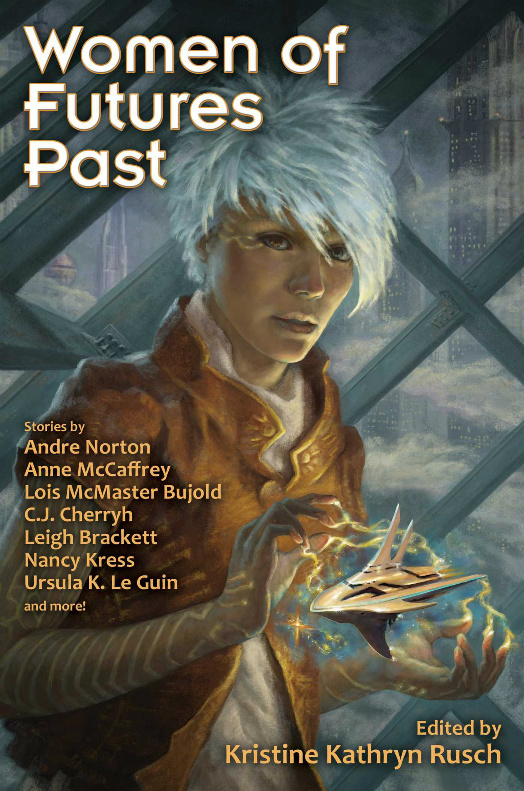
About Women of Futures Past, Rusch writes:
“As I put together this anthology, I slowly came to realize that I did not want to reprint the same old stories that everyone else has reprinted. I didn’t want a feminist anthology.
I wanted to show the young writers of the field that women write science fiction—of all kinds. Not just space opera, avant-garde, and galactic suburbia stories. Not just stories about women. But stories. Excellent stories, about anything the writer damn well pleased.
I wanted stories that entertained as much now as they had when they were published. Sometimes I did not choose good stories with language that would be offensive to a modern audience, although there is a little archaic language in some of the older stories. (Just deal with it.) I also wanted stories that had an impact on other writers in the field—not just female writers, but male writers as well.
Finally, I did not want the stories in this volume to have a particular political slant. This introduction and the introduction to the stories have a slant, because I’m trying to introduce the important women writers of science fiction to a generation who does not know they exist.
But that’s as far as the politics go here. The stories themselves are politically all over the map. They’re also all over the subgenre map. I’ve made sure that we have hearth-and-home stories, space opera, alien-among-us stories, hard science fiction, post-apocalyptic fiction, alternate history and time travel.”
It is a long quote, from a much longer and worthwhile introduction, but I felt that Rusch herself did the best job of laying out what kind of collection this is and what was her purpose for gathering it together. I am so glad that she did, it is a wonderful collection of stories that proves that, despite what some people unfortunately think, men past and present have not cornered the market on entertaining science fiction.
Here is the Table of Contents, and if you follow this link to the Baen website, you can read the Introduction and the stories by Zenna Henderson and Anne McCaffrey online.
The Indelible Kind by Zenna Henderson
The Smallest Dragonboy by Anne McCaffrey
Out of All Them Bright Stars by Nancy Kress
Angel by Pat Cadigan
Cassandra by C.J. Cherryh
Shambleau by C.L. Moore
The Last Days of Shandakor by Leigh Brackett
All Cats Are Gray by Andre Norton
Aftermaths by Lois McMaster Bujold
The Last Flight of Doctor Ain by James Tiptree, Jr.
Sur by Ursula K. Le Guin
Fire Watch by Connie Willis
Oddly enough, out of the twelve stories included in this collection, six were from authors I had not previously read. Out of the six authors I had previously experienced, Fire Watch was the only story I had already read, though it had been a long time, and it is an excellent story, so I read it once again.
As with any collection, some stories were more engaging than others, but there was not one story that I found myself wishing I had given a pass. My favorite experiences in Women of Futures Past were reading Zenna Henderson for the first time–I now want to read more of her ‘The People’ stories–and also my first Leigh Brackett short, The Last Days of Shandakor. Something about Brackett’s story echoed the experience I had when first reading Jack Vance’s Dying Earth stories.
Each story manages to satisfy on its own while motivating the reader to try more of the author’s work.
Kudos to Baen for commissioning such a collection and for their excellent choice in editors. Kristine Kathryn Rusch is a skilled author in her own right and that skill extends to her ability to define the boundaries for a short story collection and to find stories that fit well within those boundaries while being diverse enough to reward the reader with a variety of experiences.
This is a collection I will keep, as it includes stories I will want to revisit again. It is a collection that I highly recommend.
Good collection of short stories by the looks of it!
It is indeed!
I am a big fan of both Andre Norton and Anne McCaffrey, and have read several works from each of these authors. I haven’t heard of or read any of the other authors, but I am intrigued by your (and Kristine Kathryn Rusch’s) reviews.
This one goes on my Christmas list!
I hope you get it, it is such a nice introduction to these authors. I had read Norton and McCaffrey before, but was happy to see that both of these stories were entirely new to me.
I got the collection and really enjoyed it. Rusch’s introduction was really informative and also chilling. The only one I hadn’t read before was Zenna Henderson but I haven’t read short stories from several of the authors. The only story I’ve read before was Bujold’s Aftermaths.
Only NESFA seems to sell Henderson’s work anymore. They have a collection of People stories: http://www.nesfa.org/press/Books/Henderson.htm
Audible has some of Brackett’s longer stories.
I have a beautiful collection of Brackett’s stories that I need to get to.
Agree about the introduction.
I wish the NESFA collection of Henderson’s stories didn’t have such a (in my opinion) hideous cover.
I’m glad you enjoyed the book. I haven’t seen it popping up on too many SFF bloggers’ sites and I certainly want to get the word out for people to read it.
I was pleased by WOMEN OF FUTURES PAST. I’m hoping the success of this anthology will lead to more collections of this type.
I do as well, George, and I also hope the success leads to someone optioning a short story collection of Rusch’s work.