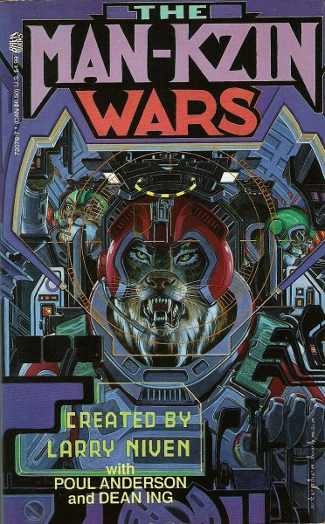
Everyone has their favorites, and author Larry Niven is one of mine. Although I have read comparatively few of his numerous short stories, novels and novel collaborations, I have a special connection to Larry Niven: he has the distinction of being the author of the first science fiction novel that I walked into a bookstore as a young man and purchased for myself. That novel, A World Out of Time, is one of my favorites, a book that I re-read every few years. I own a very special copy of the book and I go into more detail about its arrival at my doorstep in this 2007 post.
In Larry Niven’s Known Space universe, made most famous in his award-winning novel, Ringworld and its sequels and prequels, mankind’s history is marked by multiple wars with the bloodthirsty, carnivorous cat-like aliens, the Kzinti. I’ve often been curious about those wars, hinted at but not detailed in Niven’s work. Over the years I have seen the various Man-Kzin Wars volumes, currently numbering fourteen, but have not been compelled to pick one up.
That changed when a visit to Half-Price books last week, with the buzz of Alastair Reynolds’ Galactic North collection still stirring my imagination (a series inspired by Larry Niven’s Known Space stories), yielded the first copy I have ever seen of volume one in this series, beginning with the first story Larry Niven ever sold, and the first appearance of the Kzinti: “The Warriors”.
I came home, laid aside my current reads, and lost myself in Known Space.
In his introduction, Niven writes:
“I’ve never been in a war, nor any of the armed forces. Wars have happened and may happen again in most of my series universes, including known space, but you’ll never see them. I lack the experience. Here are a couple of centuries of known space that are dark to me.”
An automobile trip with Jim Baen to a Nebula Awards banquet resulted in a conversation that opened up the years of the Man-Kzin wars to other authors, this being the opening chapter.
Volume one of The Man-Kzin Wars kicks things off with Niven’s aforementioned short story, and two longer works of fiction by authors Poul Anderson and Dean Ing. Three solid tales written in the style of stories that made me fall in love with science fiction as a young teen kept me up late turning the pages to see how it would all play out.
My Rating: 8/10
In Larry Niven’s 1966 story, “The Warriors”, readers experience the first ever contact between mankind and the Kzinti. A Kzinti warship encounters what they see as a primitive spacecraft and determine to kill its inhabitants in order to scavenge material from the ship. The story alternates between activities and conversations taking place in the Kzinti vessel and those happening in the human ship. This, the shortest of the three stories in this volume, teaches a valuable lesson: don’t underestimate humanity’s capability for war.
In the far distant future of Known Space, mankind has matured beyond the need for war. When the presence of another warrior race becomes a reality, that race comes to understand that one of the reasons that mankind gave up on waging war is that we were so good at it.
Poul Anderson and Dean Ing’s stories, perhaps accurately described as novellas, share the page count that many science fiction novels had in the days where 200 pages was a long novel. Anderson’s 1987 story, “Iron”, takes place during a time when humans and Kzinti are in a period of peace after protracted wars. Robert Saxtorph and his wife Dorcas, along with a scientist and his protege and a couple of additional explorers, set out on a journey to investigate a distant red dwarf star and the possibility of planetary bodies in its orbit. Upon arriving they find fascinating scientific discoveries…and a Kzinti presence. In their desire to stay alive and perhaps outlast their enemy, the team splits up, learning more about the various planets orbiting the dying star while doing their best to survive.
In “Cathouse”, by Dean Ing, a civilian named Locklear becomes the sole survivor of a Kzinti attack on the military vessel he had hitched a ride on, supposedly to travel to a more safe and secure location. Using his wits, and his study of animal psychology, Locklear convinces the Kzin Commander to leave him on a planet strangely akin to the Kzinti homeworld, until it can be decided what to do with him. The planet turns out to be a zoo of sorts, with cordoned off sectors filled with a large variety of creatures held in stasis fields. Locklear knows that his only chance at staying alive is to gain an upper hand while the Kzinti warship continues its mission. When they return, he needs to be ready for them, and to be ready he must awaken a Kzinti female and convince her that his cause–survival–is one worthy of her assistance.
The current Kzinti race have modified females to be little more than breeding stock. Upon awakening the female Kzin in statis, whom he eventually dubs “Kit”, Locklear discovers that she was captured many, many ages ago when female Kzinti had a limited role in society, but were no less intelligent or ferocious than the males. “Cathouse” provides a great deal of background information about the Kzinti race and their history, all woven into the story in such a way that it keeps the reader engaged in the story unfolding. The story is told from Locklear’s point of view and largely features these two very different beings who must work together for a common goal. By the end I felt that Dean Ing did a great job of making me care about the characters and their fate, making “Cathouse” a nice closing chapter in the anthology.
The writers present in this volume are know to write “hard” sf, science fiction with a goodly amount of real/plausible science and scientific theory. While science is strongly present in each story, and admittedly I am not very scientifically minded, it did not bog down the story, nor did it take me out of the flow of the narrative. I have found that to be the case with every Larry Niven story I have read, and was pleased to find that happening with Anderson and Ing.
If you are already a fan of Niven’s Known Space stories, this is a worthy chapter to explore. If you have not tried Larry Niven (or Poul Anderson or Dean Ing, for that matter), these stories are a great introduction to their work and to the Known Space universe as a whole. While Larry Niven’s entry is noticeably short, the other two stories are of sufficient length to do some solid world building while fleshing out the featured characters enough for readers to be engaged in their fate.
Sounds like you really enjoyed it but man that’s another silly Baen cover…
Actually its not bad, that’s what the Kzinti look like.
Yes, this one was fun. Was interesting to talk to Jerry about it today, hadn’t realized that he has read a ton of these.
I’ve been a fan of The Man-Kzin Wars for years. Larry Niven is an underrated SF writer. I think he’s a better short story writer than a novelist.
I’ve only read two of his non-collaborative novels, A World Out of Time and Ringworld, but really like them both. I’ve read more of his short stories and I agree, they are good. I read a lot of criticisms about his characters, but I always seem to like them just fine. His novels are more about ideas, but I find his creations fascinating and like the characters well enough. I’ll certainly be reading more of these.
Larry Niven’s works passed under my radar. So far, since it sounds like I really should give them a try. Even more so when military science fiction does hold some appeal for me.
I have so many of these classic authors who have passed under my radar as well. It really is hard to get to them all, especially when you get hooked on one and they have a large volume of works to read. I certainly think Niven is worth taking the time to read, but I’ve been hooked since my teen years.
holy cow.. I haven’t heard the names Larry Niven or Poul Anderson in eons!
Yes, I’ve been kickin’ it old school! 😉
It may come as a surprise to you that I’ve read this, and all of the first ten of these collections. Great stuff, and more and more of the Kzin race is learned as you go along. I really like Niven’s Known Space books, particularly the short story collections. Great stuff!
Actually I’ve had a couple of friends now tell me they’ve read and liked these and it does surprise me. But it also makes me happy. I’ll be on the lookout for more of these volumes as I’m visiting used bookstores.
One of these days I’m going to need to re-read the Draco Tavern collection, I enjoyed it the first time I read it.
Oops, I meant to say “It may come as NO surprise to you…
I definitely had this (mistaken) idea that these were somehow “lesser” works, something just thrown together. I was glad to be proven wrong with this volume, and the reviews for the others are fairly consistently strong.
I have to admit – I kind of like the cover. It’s out there for sure but I keep going back to look at it again!
And, in other news – probably no surprise, but I haven’t read either of these authors but then I’m not very well read in sci fi as you know – something I’m working on though!
Lynn 😀
It is fun, I like it myself. I’m not a fan of all of the covers for this series, but this one works for me and I Stephen Hickman is a talented artist.
I have read a lot of science fiction and this was still a first for me with two of these authors…I guess I did read one Poul Anderson novella a while back, so Dean Ing was a first.