Don Harvey is a young man working on a ranch on Earth who is about to depart for the colony on Mars to join his scientist parents. On instructions, he first visits an old friend of his parents, Dr. Jefferson, who cryptically bestows upon him a cheap trinket ring wrapped in paper with a request that he deliver the package to his father. Soon after, Dr. Jefferson is taken into custody and dies under mysterious circumstances.
Rumblings are in the air regarding a possible war for Venusian independence, but despite being born in space to a Venusian mother and Earth father, Don Harvey has little interest. His focus is on rejoining his parents on Mars.
That focus changes when a group of Venusian soldiers take control of the space station orbiting Earth, lighting the spark that sets fire to the impending war.
Suddenly Don Harvey is not going to Mars as he supposed–no one is. He is being shipped off to Venus to become embroiled in a war that he wants no part in, perhaps never to see his parents again.
Between Planets is a Heinlein juvenile that was first serialized in magazine form in 1951 and was published in hardcover later that same year. Like all of his juveniles, Robert A. Heinlein infuses plausible scientific ideas in an educational manner into his fiction in a manner that is interesting and adds to the momentum of the story. While doing so he also weaves in threads of political thought, offers up solid characters with good moral fiber who find themselves in circumstances in which they must rise to the occasion, and he makes sure to include elements of the fantastic.
In this case, one of his science fictional story elements includes the race of “dragons” who are the true inhabitants of Venus. Over the years the men and women who have relocated to or been born on Venus have come to be accepted by the Venusian dragons as welcome inhabitants, and for their part humanity reveres and respects the beings who have allowed them to call Venus “home”. Don is well-versed in the original whistling language of the dragons, having been taught at a young age by his parents. This skill comes in handy more than once during his unplanned adventure.
It is an understandable mistake to see the word “juvenile” and make the assumption that these books lack the weight or sophistication of “adult” fiction. There are several aspects of these stories that made them (and I contend still make them) great introductory works of science fiction for young readers, but there should be no conclusion that these stories are written down to younger readers. Instead, Heinlein writes up to young people, expecting them to have the capacity to absorb difficult concepts and to be stirred to think about political and social situations by telling them a compelling story.
Between Planets is a fun adventure story. Friendship, companionship and even a little romance provide seasoning to the story. Readers may guess at how the story will end, but that does not lessen the tension as Don Harvey finds himself over and over leaping out of the proverbial frying pan into the fire. As the war for Venusian independence begins, it is easy to find oneself just wanting to read one more page, or perhaps two. I read the greater part of Between Planets in one sitting as I reached a point where I was not interested in being distracted by any other form of entertainment and instead wanted to discover what would be Don Harvey’s ultimate fate.
Heinlein’s “dragons” are a fun fictional race. As Travis S. Taylor reminds readers in the afterward to this Baen edition, though we had more knowledge about Mars in 1951 than we had when Edgar Rice Burroughs was penning the adventures of John Carter, it was not much more in comparison to what we know today. And we knew very little about our cloud-covered sister planet. 1951 remained a time of ignorant bliss for the average man in which we could imagine life on other planets. When I read books like Between Planets, my experience is enhanced as I feel a sense of sympathetic nostalgia in musing about what life was like then and the impact that works of science fiction that are now considered classics had on readers of the time. When you read Between Planets, and first meet Sir Isaac, and later other Venusians, you cannot help but wish that such an implausible race could actually exist.
I read Between Planets as part of the Definitive 1950s SF Reading Challenge and I am happy to have chosen it for my 1951 entry. Next up is a re-read of The Demolished Man by Alfred Bester.
My Rating: 8/10 An adventure worth taking

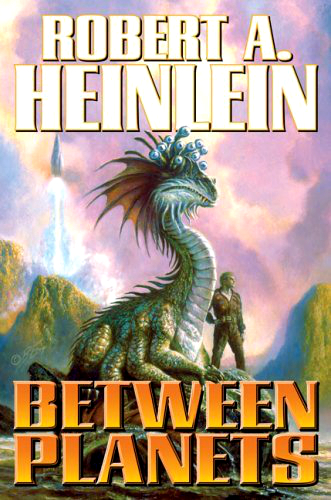
The cover for this Baen edition of Between Planets is the work of Hugo award winning artist Bob Eggleton. It is a fun cover, in large part because it so accurately represents Heinlein’s description of the Venusian dragons. I appreciate the way that Eggleton emphasizes the science fictional nature of the story by including a rocket blasting off in the distance. It could be easy to assume the book might be fantasy otherwise.
I have mentioned it before, but it bears repeating: kudos to Baen books for keeping classic works, like those of Robert A. Heinlein, in print. I appreciate the fact that I can walk into many brick and mortar stores and find works like those of Heinlein on the bookshelves.
Oh, Sir Isaac Newton! Husks of corn! [You have to know the book to get the reference]. One of my favorite Heinlein characters…who must have been one of the author’s as well, since he makes a brief, albeit off-stage, appearance in THE NUMBER OF THE BEAST. Love Heinlein’s juveniles and you’re so right: he never wrote down to young readers, only up.
Aww, shucks! 🙂 He is a great character. He and Lummox are two of my favorites.
I love that they called these books “juveniles” (that term would never fly in today’s market!) And I adore the Bob Eggleton cover. I haven’t read this but just reading your review makes me nostalgic for some Heinlein!
Yes, they use that term for his and for some of Andre Norton’s books, and I like it for the kind of fiction it represents but feel it is not the best term given the connotations it has today.
I read BETWEEN PLANETS and all of Heinlein’s “juveniles” back in the 1950s. My favorite was CITIZEN OF THE GALAXY, but I enjoyed them all.
Citizen of the Galaxy is one I have in my queue for this same challenge and I’ve had a few people mention it as a favorite, so I’m looking forward to reading it. I have several Heinlein novels I’ll be reading as part of this, actually.
Wonderful review of a wonderful book. It’s been a long time since I read it, and may be time to read it again. Now this is an author I do love, as you know. Good job, Carl.
Thanks Richard. It was so fun to hit that groove the other night where I was sucked in for the remainder and just had to keep reading. I’m excited to have firm plans to read more Heinlein as the year goes on, including your favorite.
by the way, I bought a new print, up as part of my current new arrivals post. I think you will like it, and it was also used as the cover on THE BEST OF TAD WILLIAMS.
I do like it!
Wonderful review, Carl! I like that the author writes up to young adults, and that the story is thought-provoking and compelling. (Carl, you and your readers might be interested in my current sci-fi review.)
Thanks Suko! I’ll check out your review.
Just FYI – “BETWEEN PLANETS” appeared as a 2 part serial
iin BLUEBOOK MAGAZINE SEPEMBER and OCTOBER 1951,
under the title “PLANETS IN COMBAT” with illustrations in two color.
BLUE BOOK was probably the top general fiction pulp.
Thanks! I hadn’t even heard of Bluebook Magazine until reading about this story. I know back in the heyday, there were a ton of fiction magazines. I know we are not anywhere near that time now, but I like to see so many new SFF magazines springing up online and in print.
I’ll have to check if I have this. I thought I did, maybe a different cover…
I’m going to keep a lookout for the one with the Darrel K. Sweet cover. Now that I’ve read the book it is fun to see his image and see how every part of it comes right out of the story.
If you’re interested, Lee Sandlin’s article on Heinlein is one of the best I’ve ever read. You can find it here: http://www.leesandlin.com/reviews/14_0628.htm
I will definitely check that out, George. Thank you!
Another great review. Of Heinlein’s alien characters, I was always partial to Willis, the Martian bouncer in Red Planet.
Carl, did you know that Gardner Dozois and George R. R. Martin have a new anthology coming out called Old Venus? Back when I was growing up, Venus was the jungle planet, and Mars the desert planet, equally favorite settings for science fiction.
I saw that it was coming out, and they had previously done Old Mars. Both are books I would like to pick up.
I was thinking of you over lunch today when I found two pristine older copies (with Darrell K. Sweet covers) of Citizen of the Galaxy and……Have Spacesuit Will Travel. I snagged them along with paperbacks of Between Planets (also with a fun Sweet cover) and Rocketship Galileo