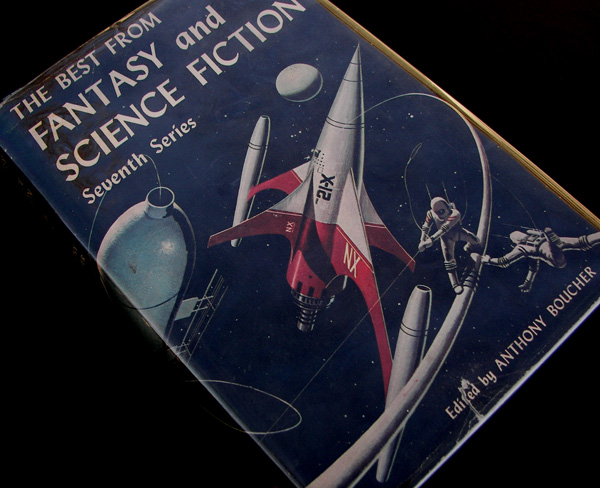
The Best from Fantasy and Science Fiction: Seventh Series ~Anthony Boucher, ed.
–published 1958 (Book Club Edition)
–Doubleday and Company
–264 pages
–4/5 stars
A book lover’s treasured possessions come in all shapes and sizes and their reasons for being cherished can be as enigmatic as the myriad of readers on the planet or as simple as a three word explanation. In the case of this recently purchased treasure it is the simple explanation: book cover art. I fell in love with this wonderful representation of 1950’s science fiction art the moment I pulled it off the top shelf of a small used bookstore in my home town on a shopping trip during Christmas vacation. I was bound to pick it up, it was only a couple of dollars, even before I opened to the table of contents to see a nearly balanced representation of authors that I have read, authors I have heard of but not read, and authors whose names were foreign to me. Imagine my great pleasure to find that this collection was every bit as fun to read as its cover art promised it to be.
I had determined to spend the last weekend of January reading short stories and though it was not my intention to read this book from start to finish, once I started I just could not put it down. Per usual I will attempt to give a very brief overview/rating of each story without spoiling the experience for you. After all, if I like a story then I want you to read it too!
Anthony Boucher, then editor of The Magazine of Fantasy and Science Fiction put together this collection of stories that all just happen to fall into the science fiction realm. Clarke, Brown, Asimov and Leiber were all authors I have previously read and enjoyed. Chandler, Davidson, Edmondson, Kornbluth and Anderson are all authors whose names were familiar but that, to the best of my knowledge, I have not read. The rest were all purely virginal experiences. For my own record keeping I will be placing an * next to each story written by an author that I had not previously read.
*The Wines of Earth ~Idris Seabright [Margaret St. Clair] (3.75/5 stars):
I suspect that my romantic attitudes about wine make this light, feel-good affair more pleasurable than it would be to those not fond of the nectar of the gods. Seabright proves that not all stories of human-alien contact have to end in hatred and bloodshed. The writing is solidly entertaining and I am already determined to read this aloud to my wife this spring over a bottle of Stagswood Red when we make our annual anniversary trip to Missouri’s wine country.
*Adjustment ~Ward Moore (3.5/5 stars):
A “well-adjusted” man is paired with one who is maladjusted in the hopes that he will have a stabilizing influence. What today would have been written as a more lurid, “bad company corrupts good morals”, tale turns out to be an innocent but fascinating wish-fulfillment story, done sci-fi style. I couldn’t help but imagine how great the environmental manipulation would look on the big, or small, screen given the technology used in post production today.
*The Cage ~Betram Chandler (4/5 stars):
A consistent thought while reading this collection was that many of these stories gave me a similar feeling to the one I get while watching episodes of The Twilight Zone (which is a good feeling, by the way). This is the first of the stories that brought this to mind. When the Lode Star goes off course and crash lands on an unknown planet, the ship’s passengers and crew find themselves in a veritable Garden of Eden sans snakes or any other creatures that might bring them harm. Just as they are beginning to plan for their survival, a party arrives that may not have their best interests in mind. Though they only share minor plot elements, I could not help but think of the 1965 pilot episode of Star Trek which bears the same name. The Cage was fun and suspenseful and ends with a bit of acerbic wit.
*Mr. Stillwell’s Stage ~Avram Davidson (3.75/5 stars):
I felt a sense of deja vu reading this, as if Neil Gaiman had channeled Mr. Davidson when writing one or two of the stories that are in his Smoke and Mirrors collection, for Mr. Stilwell’s Stage has some of the subtle menace and mystery that I have come to enjoy in Gaiman’s writing. As for Mr. Stilwell’s invention: I want one!!! Although I would find a very different use to put it to.
Venture to the Moon ~Arthur C. Clarke (4/5 stars)
In my recent review of The Green Hills of Earth, I make mention of that book’s description of Heinlein’s writing having a “homely realism”, especially in the way in which he makes his stories of life on the moon feel plausible and magical at the same time. In this story, comprised of six vignettes chronicling the first ever moon-flight–a joint mission of American, British, and Russian scientists–Clarke does something similarly engaging. Told from the point of view of the pilot of the British ship, the story takes us from pre-flight planning to the trip home. Venture to the Moon is equal parts humor and bravado told in the voice of an everyman. While I thrill at the unscientific novels featuring life on planets that we now know do not contain hordes of alien races, I am equally thrilled by stories that feel more realistic, like this one, that embody that same sense of wonder. Even though man has been to the moon since this was written and it did not exactly turn out this way, you cannot help but read this with a sense of hope and longing that someday it will be.
Expedition ~Fredric Brown (4.25/5 stars):
Brown is a master at telling entertaining stories while barely registering a number on the page-count scale. This two-page retelling of the “first major expedition to Mars” is funny in a sexually innocent, tongue-in-cheek, politically incorrect manner. As a male reader I couldn’t help but get a big smile while reading it, followed by a bit of sheepish guilt. I’ll be reading this one out loud to the missus.
*Rescue ~G.C. Edmondson (4.75/5 stars):
Jason, a miner in a failing operation on Mars, is in a tunnel when an explosion traps him underground. Presuming him dead, his fellow workers abandon him when they decide to pack up the entire operation and return to Earth. What follows is a Robinson Crusoe-like tale espousing, among other things, the virtues of solitude. I will certainly be seeking out more of G.C. Edmondson’s work, I really enjoyed this one. It actually makes an interesting contrast in emotions to Lester Del Rey’s story To Avenge Man which I recently reviewed.
*Between the Thunder and the Sun ~Chad Oliver (5/5 stars):
Whether you love it, hate it, or find yourself somewhere in the middle, one of the greatest things to come out of the controversy surrounding source material for the film Avatar is a growing list of sf/fantasy stories that one just might want to read. This story firmly belongs on that list. While in most ways dissimilar to James Cameron’s juggernaut, Between the Thunder and the Sun is a story told in that same general spirit, only much more effectively, in my opinion. If I were to do a word count, Oliver’s short story may well be classified as a novelette. It is by far the longest story in this collection and is also the very best. Had this been the only good story in the collection I would be glad to own this book. Anthropologist Evan Schaefer is given the chance of a life-time, to go to the rescue of an unknown race on a recently discovered planet. To do so he must break the so-called “Hands Off” law, a precursor of sorts to Star Trek‘s First Contact law. Success or failure, life or death, he may never speak to anyone of the 10+ year mission. Along with his wife Lee, ecologist Tino Sandoval, and a contingent of UN members plus captain and crew, Schaefer sets off on an adventure that will profoundly effect the rest of his life. Whether they are multi-dimensional or representatives of certain character types, Oliver writes people who are interesting to journey with. The main characters are well-realized and the story has a solid emotional impact that compels me to suggest that it is recommended reading.
A Loint of Paw ~Isaac Asimov (3.5/5 stars):
In the same vein as the Fredric Brown story in this collection, Asimov’s two-pager is entirely in the service of a good pun (an oxymoron?). This is the kind of clever throw-away story that an author of Asimov’s pedigree can get away with, and as part of a good anthology like this one, it works.
*The Wild Wood ~Mildred Clingerman (?/5 stars)
This is a Christmas story unlike any that I have ever read, and it also ranks as one of the more disturbing stories I have ever read as well. I hesitate to once again mention a contemporary author as comparison, but this story reminded me of a couple of Neil Gaiman’s stories that I read once and have no plans of reading again due to the manner in which they disquieted me. As with that handful of Gaiman stories that I do not generally re-read, Clingerman’s story is an example of very good writing. It is a page-turner of a story, but one whose dark sexual nature both surprised me (because of the time period in which it was written) and disturbed me.
*Dodger Fan ~Will Stanton (3.75/5 stars):
If you are a fan of sports at all, but particularly a fan of “America’s Pastime”, there is no doubt that you will find Jerome’s preoccupation with his hometown team, even while on a once-in-a-lifetime-trip to Mars, to be a real hoot.
*Goddess in Granite ~Robert F. Young (3.75/5 stars):
One of the great wonders in the universe is The Virgin, on planet Alpha Virginis. A creation of some unknown race, The Virgin is an enormous representation of a reclining goddess, created using the natural contours of the geological formations of the area. Marten has returned following the siren call of the goddess, whom he observed many years prior while studying to become a spaceman. As he climbs across her form with a definite destination in mind, he recounts the events of his life that have lead up to this reunion. One of the wonders of reading this story is that you cannot help but want to see this thing for yourself. If you have ever visited Mount Rushmore and/or thrilled at Weta Digital’s interpretation of The Argonath, it is easy to imagine just how incredible something like this would be. It is the massiveness of this creation, coupled with the description of Marten’s dangerous ascent, that makes this story compelling. Though Marten isn’t the most likable character, he is perhaps easy to identify with on some level. The dramatic reveal was interesting, but felt a bit rushed. Still, it was a pleasurable read.
*MS. Found in a Chinese Fortune Cookie ~C.M. Kornbluth (3.25/5 stars):
Kornbluth tells the story of science fiction author Cecil Corwin, who ostensibly sent Kornbluth this wild call for help on a series of cigarette wrappers hidden in Chinese fortune cookies. While not nearly as wacky as it sounds, the conspiratorial tale of what happens to Corwin when he discovers The Answer is a fun story right up until the end. The story turns out to be little more than a satire of the writing game, with an admittedly funny take on best seller fiction that is probably more entertaining today. That being said, I was really getting caught up in the more paranoid aspects of what happened and was slightly let down that it was all in the service of a punch line.
*Journey’s End ~Poul Anderson (4/5 stars):
Two stories sprang to mind as I was reading this, Alfred Bester’s The Demolished Man and the film What a Woman Wants, mostly because this story is like neither of them, despite being about a man who can read the minds of others. In a little over a dozen pages Anderson gives the reader a sense of just how horrible it might be to be subjected to the thoughts and memories of everyone you come in contact with. Despite this horror, and the confession of what it is doing to the protagonist, this is actually a very interesting and unique love story. I really enjoyed Anderson’s portrayal of Norman Kane and his insightful viewpoint on humanity. I am pleased to have finally read Poul Anderson and I look forward to more of his work in the future.
The Big Trek ~Fritz Leiber (3.75/5 stars):
If Dr. Seuss set out to write a science fiction short story, this is exactly the kind of story he might come up with. There is a real Seussian quality to various parts of this brief tale of a man who wakes up on a strange planet with no idea of how he got there. He soon becomes aware of a great procession of the oddest creatures imaginable, all seemingly bent on traveling to some predetermined destination. While mostly fun there is a slightly sinister element that plays out near the end of the story. While not the best Leiber story I have read, it was a fun end to this enjoyable anthology.
Anthony Boucher certainly put together a fantastic collection of stories. It makes me want to track down the other four books in this long running series that he edited. Boucher’s introduction is an optimistic view of science fiction’s past and future, one that should be shouted from the roof tops amidst the negativity that seems to be surrounding the genre today. Interestingly enough he also points out how these writers all have other jobs besides writing, something odd to think about given the status that some of these names have today.
There is no wasted space in this anthology, each story has a short introduction that mercifully does not reveal anything about the story you are going to read and in between almost every story, in the page space that would have been left open, there is some snippet of poetry or prose that I assume was included in issues of the magazine.
As I mentioned at the beginning, I treasured this book the moment I picked it up because of the wonderful, nostalgic art. I treasure it even more now that I know from experience that it contains the quality of tales that compel me to keep reading short stories from this era. I could only find one of these stories free online. If anyone knows where others are located, please feel free to leave a link in the comments and I will include it in the post.
_________________________________________________
This book is a selection for The Sci Fi Experience 2010
Mind Voyages (for the Neptune Voyage)
The 2010 42 Challenge
The 2010 Reading Challenge (for the Older Than You category)
The 2010 Short Story Challenge
and
When I was growing up I loved going to the library and getting these old annual anthologies put out by the monthly science fiction magazine. I don’t know why the top magazines don’t have these annual best of books now. Another nice cover.
Jim: I don’t understand it either, unless the thought is that there are other Best Of anthologies every year that theoretically cover some of the same material. I’m keeping an eye on some more of this series on Ebay.
Do you recall reading any of these stories?
LOVE the cover art !!!
I’ve ben readin science fiction for over 50 years and I love a lot of that cover art of the 1950’s.
In much more recent times I decided to give something back to the genre. Although I don’t have any cover art talent, I was very pleased with what was done for me:
http://www.StrategicBookPublishing.com/ScienceFictionandAlternateHistory.html
http://www.amazon.com/Essential-Reading-Science-Fiction-Scholes/dp/1449581889/ref=sr_1_1?ie=UTF8&s=books&qid=1261366245&sr=1-1
Cheers
Cool post, Carl. Not a bad find, and for $2. There used to be a really good, small used book store near here, with an upstrais roon crammed with boxes and shelves of goodies. I went there looking ofr specific things, never dreaming that one day it would just be…gone. Man, I miss that place.
I think (uninformed guess here) the best of anthologies aren’t around any more because 1) it hurts magazine sales, many customers decide to wait for the best and skip the magazine itself 2) the sales numbers aren’t there, and in publishers (and every other business large or small) our 21st Century bottom-line, bean counter mentality that’s the death knell. 3) the market for the magazines has shrunk so much that each (often bi-monthly or quarterly) magazine is in itself a kind of best of compilation.
Though I’ve not touched this anthology, I have read some of the stories: The Clarke, Asimov, Brown and Anderson, the latter just a couple of weeks ago in the fine NESFA collection of his short works. The Brown is in one of their collections as well. Once again, I can’t recommend NESFA highly enough!
The Anderson story delivers the message that ignorance trumps intelligence, an idea found throughout SF over the years. The Fredrick Brown story,is, as you say, delightful though thin, practically a toss-off, as is the Asimov. He loved to sell these little tidbits, they kept his name on the covers of the magazines and made a few bucks.
Avram Davidson is, for me, an enigma. A respected author of both science fiction and fantasy, to whom’s work I have never been able to warm. I’m sure it’s just me, and I haven’t read this particular story.
Overall, I think the anthology shows the range of F&SF content at the time. The term “fantasy” didn’t have the same meaning in 1958 that it attained a decade later. Often it was just SF that was a little less “hard”, so purists called it fantasy, or sci-fantasy or some other similar silly name. No elves, dwarves, magic, dragons, wizards, just fanciful stories without a basis in science. (example: Henry Kuttner’s Galloway Gallegher stories, currently collected by Planet Stories in ROBOTS HAVE NO TAILS)
A comment on Anthony Boucher (William Anthony White), the editor of F&SF at the time. Also a fine SF writer, and perhaps the finest mystery book reviewer the New York Times ever had. Boucher (pronounced bough-chur, by the way) was also a respected mystery writer. NESFA (again) has a nice collection of his SF.
Richard: You can push NESFA all you want, they have an enormous library of stuff that I want and will no doubt purchase someday. I have no doubt that Rediscovery of Man will be my first purchase from them. I do have one of their books already that I picked up years ago, Neil Gaiman’s Adventures in the Dream Trade.
I thought I saw Boucher’s name in a collection of stories that I was looking at online yesterday, thanks for confirming that he was an author as well. It will be interesting to read some of his work after seeing the kind of thing that he picked for an anthology.
Your description of the use of the word “fantasy” makes sense. I hadn’t ever thought about that. I am so used to what we consider fantasy today that I was surprised that every story in this collection was so obviously science fictional, at least in the way I view science fiction vs. fantasy today.
The only other Davidson I had read before was a nonfiction book of his and I just wasn’t getting into it. I suspect I enjoyed this story more because it reminded me of a Gaiman story. It too was in some ways a one-off story. Not one that you would want to read over and over again. It was good, but doesn’t make me want to rush out and find more of the author’s work like others in this collection do.
I wonder if authors like Asimov and Brown could get away with these short, clever one-note stories because they were so prolific elsewhere. It makes sense that they would do them to keep their names out there on the latest cover, and no doubt helped drive sales for the publisher. I find them quite fun, in part because I have had some experience with longer stories of theirs, particularly Asimov.
I think your explanation of the “Best Of’s” makes sense too. I did see that the Fantasy and Science Fiction magazine put out a 60th Anniversary collection. My library has it in their queue to purchase, so I put my name down for it.
You mention the bookstore that disappeared. Jeff and I were told about a place our friend Jerry discovered that had a really big sf/f section. We went there a few times and then they closed down. We did get fair warning and were able to go one last time, although I wish I had the knowledge then, a year or so ago, that I have now. There are many more classic authors that I would have snagged books from today if it was still around. I understand the marketplace doesn’t support businesses like this staying open AND I realize that much of this stuff can be had on the net, but there is nothing like that “aha!” moment of finding something on a shelf that you were hoping for, or weren’t expecting and were surprised by.
Hope this long comment of yours means your back is better!!!
David: I think they did a really nice job with the cover for your second book listed, the one on Amazon. Like the colors.
I loved these collections. I have one of the F@SF collections on my colossal TBR shelves. Along with it I have the Second IF Reader. Have you read Judy-Lynn Del Rey’s Stellar collections? I remember enjoying them in the 70s. Another one that I liked was the Continuum series. I liked the connected short story idea.
Jim: Here’s where my ignorance shines through (quiet the rest of you!!!), I haven’t heard of the Stellar collections or the Continuum series. Before the last 3 or 4 years I had only read a handful of short story collections/anthologies that I would consider sf. I’m learning though that I’ve missed a lot of great stuff over the years. Thankfully I have time to go back and discover that great stuff.
Stellar Science Fiction appeared in the 70s. Some of the authors in the series were James Tiptree Jr., Anne McCaffrey, Clifford Simak, Stephen Donaldson, Ben Bova, Robert Silverberg, Gordon Dickson. The most famous story that appeared in it was The Bicentennial Man by Asimov.
Continuum published connected short stories in each book. Edgar Pangborn did all of his stories in the world of his novel Davy. Poul Anderson’s stories all took place in the History of Rustum. Other authors were Chad Oliver, Anne McCaffrey, Gene Wolfe, Philip Jose Farmer, and others.
Both were favorites of mine.
Jim: Interesting that you mention Triptree, Jr. I was just thinking earlier tonight that I need to do two things this year: read some of her fiction and read her biography. I’ll be on the lookout for these others. All are authors I have read and want to read more or that I haven’t read but are on my list. After enjoying Chad Oliver’s story so much in this collection I really want to sample more of his stuff.