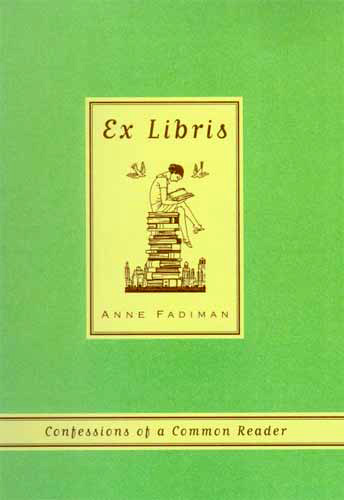
Ex Libris: Confessions of a Common Reader ~Anne Fadiman
–1998, Farrar, Straus and Giroux
–162 pages
–4.5/5 stars
“I have never been able to resist a book about books.”
~Anne Fadiman
Nor, of late, can I. It is unlikely, but not impossible, that this book would have ended up in my hands if it were not for the man dominating my reading of late, Nick Hornby. He mentions the book favorably in The Polysyllabic Spree. Like Hornby, Fadiman has an obvious love of the printed word which suffuses her essays with a warm glow. Reading Hornby and Fadiman back-to-back was an interesting experience. While the two have many similarities (in fact some of the subject matter in Housekeeping and Ex Libris actually mirrored each other), they also have some distinct differences. Nick Hornby is an obviously intelligent man who manages to write in an intelligent yet conversational style that embraces readers of all levels. Anne Fadiman is intelligent as well, but her writing seems to sit at a slightly different level. Not better, nor worse, just different. One is likely to find more words and references that need to be looked up in Ex Libris than in one of the three collections of Hornby essays. At first glance, Anne Fadiman’s essays seem to come off as more high-brow. But that image quickly fades as her essays ,manage to be every bit as accessible, because they cover a range of book related subjects echo the discussions had on book blogs the world over.
I had the pleasure of reading almost the whole of Ex Libris while sitting out on my deck this past Saturday afternoon, under partly sunny skies, while blossoms rained gently down from the trees in my yard. It was all quite picturesque and seemed tailor made for this kind bibliophilistic reverie. Like Housekeeping vs. The Dirt, this book had me from the Preface:
“I began to write Ex Libris when it occurred to me how curious it was that books are so often written about as if they were toasters. Is this brand of toaster better than that brand of toaster? At $24.95, is this toaster a best buy? There is nothing about how I may feel about my toaster ten years hence, and nothing about the tender feelings I may yet harbor for my old toaster. This model of readers as consumers–one I have abetted in many a book review myself–neatly omits what I consider the heart of reading: not whether we wish to purchase a new book but how we maintain our connections with our old books, the ones we have lived with for years, the ones whose textures and colors and smells have become as familiar to us as our children’s skins.”
Wonderful, no?
Ex Libris includes essays written over the period of four years, previously published in the magazine, Civilization. The majority of the essays are ones that I could find myself reading again, and even those that did not speak to me in that way contained moments of reading pleasure.
Ex Libris begins with Fadiman describing the process of ‘Marrying Libraries’, an event which is inevitable when two book lovers, and avid collectors, find themselves making a life commitment to one another. The essay was humorous, to be sure, but also made me glad that Mary and I possessed few books before we got married. The discussions about which copies of duplicate books to keep was enough to make me cringe in empathy. Considering the fact that they were well into their marriage before their libraries decided to follow suit is enough to give an indication of how difficult a process, and one potentially fraught with peril, this could be.
The essay describing the Odd Shelf was pure bliss. Anne Fadiman begins by postulating that everyone’s library contains an “odd shelf”. “On this shelf rests a small, mysterious corpus of volumes whose subject matter is completely unrelated to the rest of the library, yet which, upon closer inspection, reveals a good deal about its owner.” She goes on to give a few fascinating examples that you will just have to read for yourself. Fadiman’s ‘odd shelf’ contains a number of books about polar exploration. She goes on to admit that, “My interest is a lonely one. I cannot trot it out at cocktail parties. I feel sometimes as if I have spent a large part of my life learning a dead language that no one I know can speak”. On one hand you find yourself nodding in complete agreement with Anne, thinking about your own marginal interests or guilty pleasures that you can rarely discuss because of the feeling, true or not, that no one else will be interested. That said, I found it fascinating that Anne Fadiman spends most of the rest of this essay sharing stories and facts learned in her ‘odd shelf’ books that had me wanting to fill a shelf with similar volumes! It is an absolutely fascinating and gripping chapter that made me realize that if I were ever to meet Ms. Fadiman at a cocktail party, I would beg her to regale me with stories of the arctic explorers.
I mentioned in a read-a-thon update, having finished Ex Libris, that “we [Anne Fadiman and I] had a few minor disagreements, she unwittingly insulted me once, and the rest of the time she was a fascinating host”. One of our minor, fun disagreements is found in the chapter “Never Do That to a Book”, in which she proceeds to place book lovers in one of two camps: courtly love and carnal love.
Courtly love is described as “a book’s physical self was sacrosanct…its form inseparable from its content; [one’s] duty as lover was Platonic adoration, a noble but doomed attempt to conserve forever the state of perfect chastity in which it had left the bookseller”. She describes the Fadiman family as carnal lovers, “to us, a book’s words were holy, but the paper, cloth, cardboard, glue, thread, and ink that contained them were a mere vessel, and it was no sacrilege to treat them as wantonly as desire and pragmatism dictated. Hard use was a sign not of disrespect but of intimacy”. Our disagreement clearly lies in the fact that by and large I am a courtly lover while she is a carnal one. If you are a courtly lover, this essay is not for the faint of heart. Reading examples of carnal love by both famous and not-so-famous people was something akin to watching a splatter film!
I had to laugh out loud while reading this chapter when I came across this statement:
“I confess to marking my place promiscuously, sometimes splaying, sometimes committing the even more grievous sin of dog-earing the page. (Here I manage to be simultaneously abusive and compulsive: I turn down the upper corner for page-marking and the lower corner to identify passages I want to xerox for my commonplace book.”
What made me laugh was not the quote itself, but the fact that in this library copy, free of underlines and margin notes, in nearly new condition, the one and only page that had been dog-earred was this page. I detected the hand of a passive-aggressive courtly lover at work!
What made this essay so very interesting was the fact that I found myself thinking that I am a man of two minds about this. While I would never dream of in any way abusing a book that I purchased new or was given to me as a gift (for I truly am a courtly lover…even my well-read books have a nearly virginal appearance), I am also attracted to those books that occupy the other side of the tracks! I have a small but growing collection of classic hardback books and a larger collection of old paperback books illustrated by artists whose work I am a fan of. When it comes to these books I love the carnal love quality of them. Like Charles Lamb, who Fadiman quotes, I feel: “How beautiful to a genuine lover of reading are the sullied leaves, and worn-out appearance…of an old ‘Circulating Library’ Tom Jones, or Vicar of Wakefield! How they speak of the thousand thumbs that have turned over their pages with delight!…Who would have them a whit less soiled? What better condition could we desire to see them in?”. While I will never overthrow my courtly love habits, I find that I can never be quite faithful as I have no intention of subduing my attraction to those works who, through time, have been carnally loved.
There really are too many interesting essays to talk about without writing a book myself. One chapter expounds upon the often humorous phenomenon of inscriptions in books, in one Anne Fadiman learns that a book written about women in a time far different from our current age can still hold interesting lessons, in another Fadiman discusses the joy of You-Are-There Reading which describes the special joy of actually reading a book in the setting in which it is written. While I have had fewer opportunities to do this than Anne Fadiman has, I have on occasion read books either in the city in which the story is set or soon after having visited said city and it is always a great treat to do so.
Our only other disagreement that I can recall regards the essay on gender specific and gender neutral language. At the risk of making people mad, I am not a fan of the wholesale change of language in order to make all language gender neutral. I can only judge by Fadiman’s closing remarks in this essay that she is. She acknowledges that there is a heavy price to pay in sacrificing some of the beauty of language, but she feels this sacrifice is necessary and worth it. I do not. It wasn’t a major thing, and certainly is one of those discussions that I would not choose to get involved in, being a male, since I have had the benefit of centuries of language being slanted towards my gender. Suffice it to say that I believe there is more of a middle ground than Anne Fadiman does.
One essay that I especially liked was Anne Fadiman’s lovely tribute to her favorite pen. The romantic view of writing, as coming from one who is not a writer, is that to truly be a writer one would need to have a special desk, a journal in which to write, and a special pen! This kind of romance is certainly practiced by some, and yet the practical truth of any kind of work…and writing is work…is that the ease of technology is often too tempting to overcome just to honor silly romantic notions. I have always wanted a really good writing pen, and this chapter allowed me to live vicariously, however briefly, through someone that once had one.
Another essay that I really enjoyed was The Catalogical Imperative, in which Fadiman professes that she loves reading catalogs. I have to confess to the same thing, at least in regards to ones I consider particularly artistic and that ‘tell a story’. Hearing that someone of this caliber of reading and writing profess this guilty pleasure warmed my heart!
The essay entitled My Ancestral Castles contained the one line that I joked was an ‘unwitting’ insult to me. And even that was not meant, in my opinion, to be an insult. In describing her father’s library, Fadiman states, “The only junk, relatively speaking, was science fiction…”. I coudn’t not mention this. However, since her father, a learned man and writer himself, obviously considered science fiction worthy to stand alongside “English poetry and fiction of the eighteenth and nineteenth century”, I figured there was no real reason to take offense. 🙂
One of the essays close to the end discusses the act of reading aloud, something Anne Fadiman found herself doing more frequently after her father, and avid reader, lost his eyesight. It is a beautiful chapter of the book and in it she quotes Holbrook Jackson as saying:
“In reading aloud, you are greatly privileged, first to consort with all that is noble and beautiful in thought and imagination, and then to give it forth again. You adventure among masterpieces and spread the news of your discoveries. No news better worth the spreading; few things better worth sharing.”
As one who loves to read aloud, both to my wife and daughter, I couldn’t agree with this quote, or the sentiments in this essay, more.
Ex Libris: Confessions of a Common Reader was an uncommon delight. Anne Fadiman not only made me look at the varying degrees of book love from a slightly different angle than I had previously, she also made me think, taught me things I had no idea about, sparked interests in things I previously had no conscious interest in, and reaffirmed the fact that people from all walks of life (and Anne certainly travels in circles far different than the ones I travel in) have the opportunity to bond together over a shared love of one of the greatest things ever invented: the book.
I read this for the read-a-thon and I absolutely adored it. I agree with everything you said. The only thing that horrified me was the essay about different kinds of “book love.” I almost had a heart-attack reading about the part where her father tore whole chapters out of his book. 🙂
Glad you liked it!
J.S.: No doubt, I hadn’t realized at the time that I was going to be reading a horror story! Or a true crime! 😉
I am so glad you like Anne Fadiman. Now do the “gentlemanly” thing and give this book to your wife to read also. Then you can debate the matter of gender-specific/nonspecific language at the dinner table 😉 You have made me want to pull her off the ‘suitable for public consumption’ shelf and revel again, start to finish. Did you know there’s a sequel?
ds: My wife will have to take charge herself and get it back from the library! 😉 No, I didn’t know there was a sequel, but I will definitely be checking to see if the library has it. I really enjoyed her writing.
Yep, this one has been on my radar for far too long now…I really have to get to it!
Okay, so I added this book to the library holds list! I have been meaning to read it for a while, and since it is going to be a while since I can read the rest of Hornby’s books, this should be a nice detour! I think if I had like a week straight of read-a-thons I might be able to finally get the library pile down to a good level, but then I would just add more books to the hold list. It really is a losing battle!
this sounds really good.
i can relate to the marrying of libraries thing. charlotte and i frequently have discussions about this. its like a UN meeting of sorts, with both of us having an agenda of sorts.
she’d prefer a total book amalgamation and a getting rid of all but sentimental multiples, whereas i, gollum that i am, will not part with a single one of my books.
then there are other complications with where we put our books. she has sneakily taken up all the shelf space in the lounge and bedroom, leaving me with our dingy store room for my books. i want to bring them into the lounge but theres no more space… 🙁
its all quite funny.
how do you and mary manage your books together?
of sorts
why did i say that twice?
Speaking as a woman, I have no trouble with with the generic “he!” I hate the lengths some people go to in order to make language gender neutral. I might feel oppressed by corsets and not being able to own property… I don’t feel oppressed by lingual tradition.
Fate: I was certainly alright with some of the compromises and changes she mentioned in the essay, but her end statements that seemed to me to be advocating wholesale language changes regardless of the cost was going a bit too far, in my opinion.
JP: I don’t blame you. I’m pretty sentimental about all my books, so I cannot imagine giving any of them up. As for Mary and I, it works out pretty good because Mary is not a consumer. She would much rather check out a book from the library as opposed to buying it. Almost every book she has acquired over the last 19+ years of our marriage has been either a gift, or the result of using a gift card. She reads much more than I do, and listens to a ton of books on audio in her long commute to and from work, and possessing has never been an issue with her. For every one book she has I probably have 10 or more.
The other thing that works out for us is that she lets me do the decorating. I certainly ask her opinion on the big things, but by and large I do all the ‘this goes there’, choosing and hanging pics, putting out the knick-knacks, etc. So when it came to shelving books in our new bedroom shelf, I didn’t have as many books from her and I added some of hers to the mix.
Kailana: My library pile keeps growing and growing as well. I just added the sequel to this book to my library queue as well as a book she edited entitled Rereadings, where 17 authors talk about books and readers in regards to the act of reading a book again.
Chris: I have no doubt that you would enjoy this one.
You know I have always avoided Nick Hornby and I really don’t know why! Yet I keep reading about fabulous books he has recommended, so I will endeavour to change my avoidance techniques and pick one up. Thanks for stopping by my blog. I have to say I am really enjoying the Once Upon A Time challenge – it is fab.
I love books about books, and I’ve avoided this one for some reason! But your review made me really want to read it. I may have to skip the essay on marrying libraries – too terrifying to contemplate getting rid of any of my lovely books!
Jenny: If you love books about books this is certainly a must read. It is a lovely book. I just checked out the sequel…the second set of essays is a better description, I guess…from the library. Can’t wait to sit down and enjoy it. I think you’ll enjoy the marrying libraries one…just cringe along like I did. 🙂
Vivienne: I’m glad you are enjoying the challenge. The nice thing about Hornby’s essay collections is they are not a big commitment. All are very slight and take no time to read, so even if you end up not being as impressed as some of us were, you aren’t making some big commitment!
How strange! I picked this book up less than two weeks ago and loved it. I’m so glad you had a chance to read this book and enjoyed it as well.
I must admit to strong feelings about this book, because it was the first Christmas present my husband gave me, three months after we got together. I love it, and have read it so often I know bits of it by heart. The number of books I’ve read simply because they were mentioned in there…
It was only last month that I came across her second collection, “At Large and at Small”, and I thoroughly recommend that, too. The vexed question of gender-balanced language is not touched upon!